AI Dashboards in Marketing: From Data Overload to Data-Driven Decisions
In short
How AI Dashboards with NLQ, anomaly detection, and predictive analytics are revolutionizing marketing reporting – including tool comparison, KPI framework, and implementation plan.
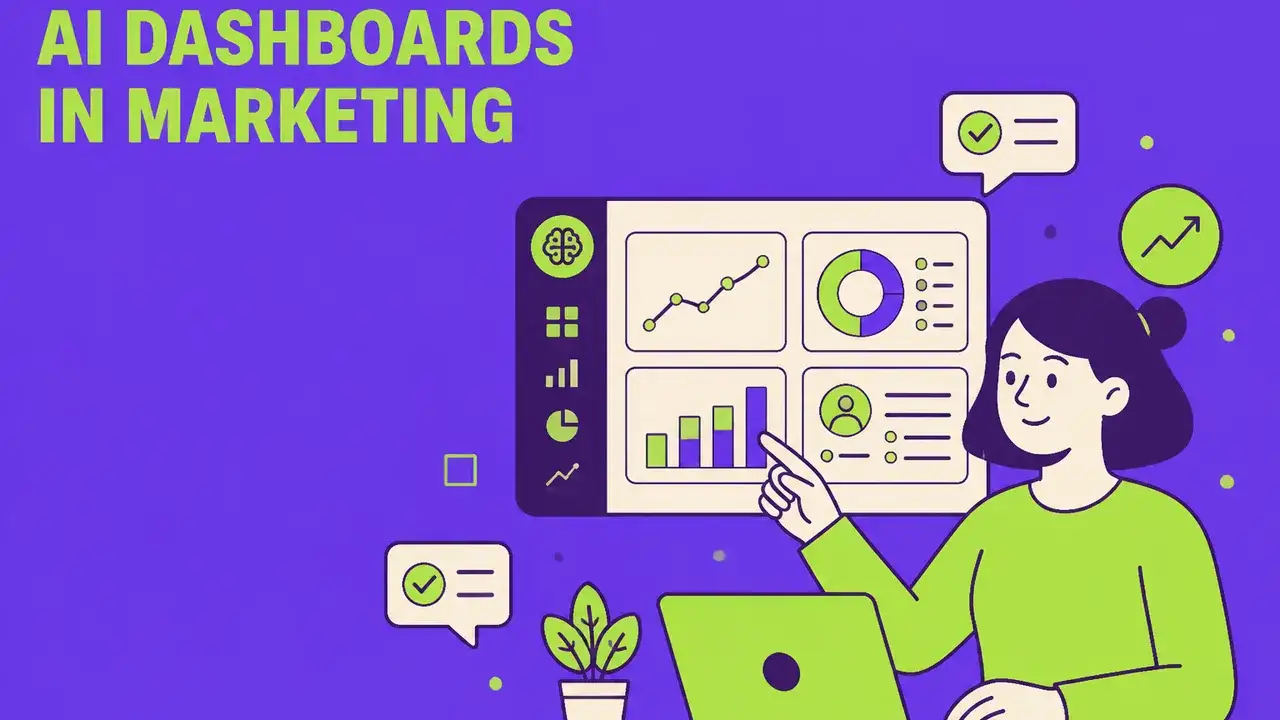
Table of Contents
Why Traditional Marketing Dashboards Fall Short in 2026
Marketing teams are drowning in data: Google Ads, Meta Business Suite, LinkedIn Campaign Manager, email automation, CRM, website analytics – each platform delivers its own reports. The result: marketing decision-makers spend up to 30% of their work time gathering, formatting, and interpreting data from various sources.
Traditional dashboards like Google Looker Studio or Tableau solve only part of the problem. They visualize data – but they don't understand it. AI Dashboards go one crucial step further: they recognize patterns, identify anomalies, and deliver proactive recommendations.
Three Generations of Marketing Dashboards
| Generation | Period | Core Function | Examples |
|---|---|---|---|
| 1. Static Reports | 2010–2018 | Manual Excel/PDF reports | Excel, Google Sheets |
| 2. Interactive Dashboards | 2018–2024 | Real-time visualization, filters | Looker Studio, Tableau, Power BI |
| 3. AI Dashboards | 2024–present | Autonomous analysis, predictions, NLQ | Davies Meyer AI Dashboards, Databox AI, Improvado AI |
What AI Dashboards Deliver for Marketing
1. Natural Language Queries (NLQ)
Instead of configuring complex filters, simply ask questions in natural language:
- "Which campaign had the best ROAS last quarter?"
- "Show me the top 5 landing pages by conversion rate for mobile traffic"
- "Compare Q4 2025 vs Q1 2026 performance by channel"
Modern AI models like GPT-5 and Gemini 3 translate these questions into precise database queries and deliver visually formatted answers in seconds.
2. Real-Time Anomaly Detection
AI Dashboards continuously monitor your KPIs and alert on unusual deviations:
- Sudden CPC increase of 40% in a Google Ads campaign → immediate notification with root cause analysis
- Conversion drop on a landing page → automatic correlation with technical changes or competitor actions
- Unusual traffic spikes → distinguishing between bot traffic and genuine interest
This perfectly complements our Performance Alerts for proactive campaign management.
3. Predictive Analytics
Instead of only analyzing past data, AI Dashboards forecast future developments:
- Budget forecasting: Projected costs and returns for the next 30/60/90 days
- Seasonal trends: Automatic detection of recurring patterns and peak times
- Churn prediction: Early warning system for churning customers based on engagement data
For deeper forecasting, we offer specialized Predictive Analytics solutions.
4. Cross-Channel Attribution
The biggest challenge in modern marketing: Which touchpoint actually contributed to the conversion? AI Dashboards use multi-touch attribution models powered by machine learning:
- Data-driven attribution: Algorithms weight each touchpoint based on actual influence
- Incrementality testing: A/B tests at channel level to measure true added value
- Customer journey mapping: Visualization of actual user paths across all channels
Ideally combined with our Media Mix Optimizer for data-driven budget allocation.
The 5 Most Important KPIs for AI Marketing Dashboards
1. AI-Enhanced ROAS (Return on Ad Spend)
Classic ROAS only considers direct conversions. AI-Enhanced ROAS also factors in view-through conversions, cross-device attribution, and offline impact.
How to measure it:
- Connect online and offline data in a Proprietary Data Lake
- Use probabilistic models for cross-device matching
- Dynamically weight touchpoints based on ML models
2. Customer Lifetime Value (CLV) Prediction
Instead of calculating CLV retrospectively, AI predicts expected customer value:
- Cohort analysis: Segmentation by acquisition channel and period
- Behavioral scoring: Engagement-based prediction of customer retention
- Revenue forecast: Expected revenue per customer segment
3. Content Performance Score
A composite score that weights multiple metrics:
- Engagement rate (likes, shares, comments)
- Conversion contribution (direct and assisted conversions)
- SEO impact (rankings, organic traffic)
- Brand sentiment (positive/negative mentions)
4. Campaign Health Index
A real-time indicator of active campaign health:
- Budget pace (spending too fast/too slow)
- Quality score trends
- Frequency cap monitoring
- Creative fatigue detection
5. Marketing Efficiency Ratio (MER)
The ratio of total marketing budget to total revenue – simpler and often more meaningful than channel-specific metrics:
- Benchmarking: Comparison with industry averages
- Trend analysis: Development across quarters
- What-if scenarios: Simulation of different budget distributions with our What-If Calculators
AI Dashboard Architecture: Building Your Marketing Stack
Layer 1: Data Sources
| Channel | Data Type | Integration |
|---|---|---|
| Google Ads | Campaigns, keywords, costs | API / Connector |
| Meta Ads | Ad sets, creatives, audiences | Marketing API |
| Sponsored content, lead gen | Campaign Manager API | |
| Opens, clicks, conversions | ESP API (Mailchimp, Braze) | |
| CRM | Leads, deals, revenue | HubSpot/Salesforce API |
| Website | Sessions, events, conversions | GA4 / Tracking pixel |
Layer 2: Data Processing
- ETL/ELT Pipeline: Automated data extraction and transformation
- Data Warehouse: Centralized data storage (BigQuery, Snowflake, or our Proprietary Data Lake)
- Data Quality: Automatic cleansing, deduplication, and validation
Layer 3: AI Analysis
- NLQ Engine: Natural language processing for conversational queries
- ML Models: Anomaly detection, forecasting, attribution
- Agentic AI: Autonomous agents that independently perform analyses and generate recommendations
Layer 4: Visualization & Action
- Interactive Dashboards: Dynamic charts, drill-downs, filters
- Automated Reports: Weekly/monthly executive summaries
- Action Triggers: Automatic campaign adjustments based on data thresholds
Tool Comparison: AI Dashboard Platforms 2026
| Criterion | Davies Meyer AI Dashboards | Databox AI | Improvado | Supermetrics + Looker | Domo |
|---|---|---|---|---|---|
| NLQ Support | ✅ GPT-5/Gemini 3 | ✅ Proprietary | ⚠️ Basic | ❌ Manual | ✅ Proprietary |
| Anomaly Detection | ✅ Real-time | ✅ Real-time | ✅ Real-time | ❌ No | ✅ Real-time |
| Predictive Analytics | ✅ Multi-model | ⚠️ Basic | ✅ Advanced | ❌ No | ✅ Advanced |
| Cross-Channel | ✅ 50+ sources | ✅ 70+ sources | ✅ 300+ sources | ✅ 100+ sources | ✅ 200+ sources |
| Customization | ✅ Fully custom | ⚠️ Template-based | ✅ Flexible | ✅ Flexible | ✅ Flexible |
| Agentic AI | ✅ Marketing Agents | ❌ No | ❌ No | ❌ No | ⚠️ Basic |
| Privacy (GDPR) | ✅ EU-hosted | ⚠️ US-hosted | ⚠️ US-hosted | ⚠️ US-hosted | ⚠️ US-hosted |
| Setup Time | 2–4 weeks | 1–2 days | 1–2 weeks | 1–3 days | 2–4 weeks |
Our Recommendation
For SMBs and quick prototypes: Databox AI or Supermetrics offer fast starts. For enterprise marketing teams with complex requirements, we recommend custom AI Dashboards with Tech Stack Embedding into your existing infrastructure.
Case Study: AI Dashboard for Performance Marketing
Starting Point
An e-commerce company with €50,000 monthly ad spend across 4 channels (Google, Meta, TikTok, Pinterest) and 3 markets (DACH, France, Benelux).
Challenge
- 12+ different data sources
- Monthly reporting took 3 days
- No cross-channel attribution
- Reactive instead of proactive optimization
Solution: AI Dashboard with 4 Modules
- Real-Time Performance Monitor: All channels at a glance with automatic alerts
- AI Attribution Engine: Data-driven attribution across all touchpoints
- Budget Optimizer: Daily budget recommendations based on ML forecasts
- Executive Report Generator: Automatic weekly and monthly reports
Results
- Reporting time: 3 days → 15 minutes (automated)
- ROAS improvement: +23% through optimized budget allocation
- Anomaly response time: 24 hours → 15 minutes
- Marketing team productivity: +35% more time for strategic tasks
Implementation: Getting Started with AI Dashboards
Phase 1: Data Audit (Weeks 1–2)
- Inventory of all marketing data sources
- Identification of data quality issues
- Definition of key KPIs and reporting requirements
- Assessment of current tool landscape
Phase 2: Architecture & Setup (Weeks 3–4)
- Selection of AI Dashboard platform
- Configuration of data pipelines
- Data warehouse structure setup
- Integration of data sources via APIs
Phase 3: AI Configuration (Weeks 5–6)
- Training the NLQ engine on marketing-specific questions
- Configuration of anomaly detection (thresholds, notifications)
- Setup of predictive analytics models
- Definition of automated reports
Phase 4: Rollout & Optimization (Weeks 7–8)
- Team training and onboarding
- Iterative model refinement based on feedback
- Setup of Workflow Automation for data-driven actions
- Documentation and playbook creation
Privacy and Compliance
GDPR-Compliant AI Dashboards
Processing marketing data with AI requires special considerations:
- Data minimization: Only capture data necessary for analysis
- Anonymization: Anonymize personal data before AI processing
- Consent management: Ensure tracking consent is in place
- Data processing agreements: Execute DPAs with all data processors
- EU hosting: Keep data in European data centers
For comprehensive compliance consulting, we recommend our AI Governance services, ensuring your AI infrastructure meets EU AI Act requirements.
Trends: The Future of AI Dashboards
1. Conversational Analytics
Dashboards are becoming conversation partners: Instead of reading data, marketing managers have dialogues with their dashboards – supported by multimodal AI models combining text, charts, and voice.
2. Autonomous Decision-Making
AI Dashboards are evolving from descriptive through predictive to prescriptive analytics: They not only recommend actions but execute them – after approval – independently. This is the core of the Agentic AI approach.
3. Embedded AI
Instead of separate dashboard applications, AI analytics are embedded directly into existing marketing tools – via MCP (Model Context Protocol) or native integrations.
4. Real-Time Creative Optimization
AI Dashboards analyze not just performance data but also creative elements: Which imagery, headlines, and CTAs perform best? Combined with our Automated A/B Tester, this creates self-optimizing campaigns.
Further Reading
- Agentic AI in Marketing: Autonomous Workflows 2026 – How autonomous AI systems are transforming marketing processes
- Marketing Agents 2026: Autonomous AI Agents – Specialized agents for automated marketing
- MCP (Model Context Protocol) – The open protocol connecting AI tools with data sources
- The CMO as Chief Agent Officer – Leadership in the age of AI agents
Want to build an AI Dashboard for your marketing team? Contact us for individual consulting – we'll help you find the right architecture and optimal AI stack for your requirements.
Frequently Asked Questions
What is "AI Dashboards in Marketing: From Data Overload to Data-Driven Decisions" about?
How AI Dashboards with NLQ, anomaly detection, and predictive analytics are revolutionizing marketing reporting – including tool comparison, KPI framework, and implementation plan.
Why Traditional Marketing Dashboards Fall Short in 2026: what matters?
Marketing teams are drowning in data: Google Ads, Meta Business Suite, LinkedIn Campaign Manager, email automation, CRM, website analytics – each platform delivers its own reports.
Natural Language Queries (NLQ): what matters?
Instead of configuring complex filters, simply ask questions in natural language: "Which campaign had the best ROAS last quarter?" "Show me the top 5 landing pages by conversion rate for mobile traffic" "Compare Q4 2025 vs Q1 2026 performance by channel" Modern AI models like GPT-5 and Gemini 3 translate these questions into precise database queries and deliver visually formatted answers in seconds.
Real-Time Anomaly Detection: what matters?
AI Dashboards continuously monitor your KPIs and alert on unusual deviations: Sudden CPC increase of 40% in a Google Ads campaign → immediate notification with root cause analysis Conversion drop on a landing page → automatic correlation with technical changes or competitor actions Unusual traffic spikes → distinguishing between bot traffic and genuine interest
Related Articles
You might also be interested in these posts
 Tools & Technology
AI Reporting: Marketing Dashboards That Explain Themselves
6 AI use cases for marketing reporting: From cross-channel reports to anomaly detection to predictive analytics. €44,500 net effect per year.
 Tools & Technology
Google Ads and Microsoft: Campaign Control with AI Max
AI Max changes search campaigns. Verified Google upgrades and how teams should check conversion data, budgets and available bid limits.
 Tools & Technology
Legacy Refactoring and Code Translation: What Agents Really Deliver
Python to Rust in days rather than months: how agentic porting works in practice, why factors of 10 to 40 are not transferable and which tests, benchmarks and ownership must be settled first.