AI Observability: Why Arize AI Is Revolutionizing AI Monitoring
In short
From 50M+ evaluations/month to a $70M Series C: How Arize AI, Fiddler, and Superwise are defining the AI observability market – and why every AI team needs to act now.
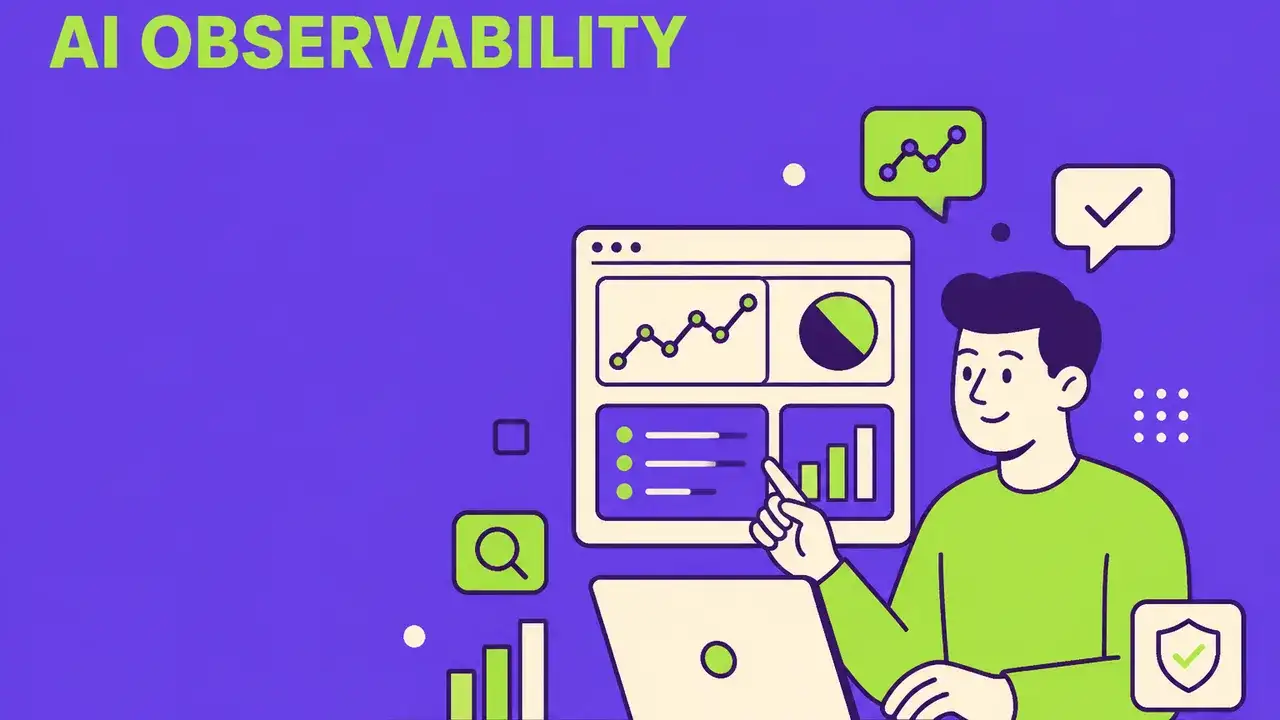
Table of Contents
AI Observability: Why Arize AI Is Defining the Industry
78% of companies worldwide are already using AI in some capacity. 90% are at least exploring its use. But here's the problem: Over half of all AI engineers, data scientists, and developers still cite data privacy and accuracy of responses as barriers to LLM deployment.
The solution? AI Observability – the ability to monitor, evaluate, and optimize AI models in real-time. And no company embodies this trend quite like Arize AI.
What Is AI Observability?
AI Observability goes far beyond classical ML monitoring:
| Aspect | ML Monitoring (Classic) | AI Observability (Modern) |
|---|---|---|
| Focus | Model metrics (Accuracy, F1) | End-to-end system behavior |
| Scope | Training & Inference | Prompts, Retrieval, Agents, Guardrails |
| Response Time | Minutes to hours | Real-time |
| Debugging | Manual log file searching | Automatic trace analysis |
| LLM Support | Minimal | Native integration |
The core question: Not "does my model work?" but "is my AI system behaving as intended – and if not, why?"
Arize AI: The Platform in Detail
Key Facts
- Founded: 2020
- Headquarters: San Francisco
- Funding: $70M Series C (February 2025) – the largest ever funding round for an AI observability platform
- Scale: 50M+ evaluations per month, serving over 1T inferences
- Open Source: Phoenix (2.5M+ downloads/month since 2023 launch)
What Arize Does
- LLM Tracing & Evaluation: Every prompt-response chain becomes traceable
- Real-time Drift Detection: Detects when models behave differently than expected
- RAG Evaluation: Tests retrieval quality and hallucination rates
- Agent Observability: Tracks multi-step agent workflows with full transparency
- Guardrail Monitoring: Ensures safety filters are working
Phoenix: The Open-Source Foundation
Phoenix is Arize's open-source platform for:
- Prompt Analysis: Which prompts perform well, which don't?
- Trace Visualization: Where do errors occur in complex LLM pipelines?
- Evaluation: Automatic assessment of LLM outputs for relevance, toxicity, faithfulness
- Integration: Works with LangChain, LlamaIndex, OpenAI, and dozens more frameworks
The AI Observability Ecosystem
Arize isn't alone. An entire ecosystem of platforms is emerging:
Fiddler AI
- Focus: Model Performance Management for Enterprise
- Funding: $30M Series C (January 2025), total funding ~$94M
- Strength: Helps companies launch and update models faster through automated issue detection and efficiency improvements
- Ideal for: Regulated industries (financial services, healthcare)
Superwise
- Focus: AI Observability and monitoring with 100+ metrics
- Strength: Real-time incident reports and comprehensive performance tracking dashboards
- Ideal for: Teams needing granular control over model performance
Other Players
| Platform | Focus Area |
|---|---|
| Weights & Biases | Experiment Tracking & MLOps |
| Langfuse | Open-Source LLM Observability |
| Datadog ML Monitoring | Infrastructure + ML in one platform |
| WhyLabs | Data-centric AI Monitoring |
Why AI Observability Is Exploding Now
1. LLMs Are Unpredictable
Classical ML models have predictable failure modes. LLMs hallucinate, drift, and respond completely differently to subtle prompt changes. Without observability, you're flying blind.
2. Regulation Demands Transparency
The EU AI Act (effective since August 2024) requires high-risk AI systems to have:
- Traceability of decisions
- Documentation of performance metrics
- Audit-ready logs
AI Observability delivers exactly this infrastructure.
3. AI Ethics Is No Longer Optional
Searches for "AI Ethics" have increased by 418% in the last 2 years. Companies need tools that detect bias, measure fairness, and create transparency – before reputational damage occurs.
4. Agentic AI Needs Guardrails
With the rise of AI Agents (autonomous multi-step workflows), observability becomes critical. When an agent makes 15 tool calls in sequence, each one must be traceable.
ROI Calculation: AI Observability in Marketing
Scenario: Marketing Team with 5 AI Applications
| Category | Without Observability | With Observability |
|---|---|---|
| Hallucination Rate (Content) | ~8% | ~1.5% |
| Faulty Personalizations | ~12% | ~2% |
| Mean Time to Resolution | 4 hours | 22 minutes |
| Compliance Violations/Quarter | 3–5 | 0–1 |
| Content Recalls/Month | 4 | 0.5 |
Cost Savings
- Reduced content recalls: €2,400/month (6 hours rework × €50/h × 8 incidents)
- Faster debugging: €1,800/month (3.5h time savings × 20 incidents × €50/h)
- Avoided compliance penalties: €5,000/quarter (conservative average)
- Higher personalization conversion: +2.1% CR = €4,200/month
Estimated annual savings: ~€120,000+
Implementation: How to Start with AI Observability
Phase 1: Audit (Week 1-2)
- Inventory all deployed AI models and applications
- Risk assessment: Which applications are business-critical?
- Define quality metrics per application
Phase 2: Instrumentation (Week 3-4)
- Integrate Phoenix (open source) or Arize Enterprise
- Activate tracing for all LLM calls
- Define evaluation metrics (relevance, faithfulness, toxicity)
Phase 3: Monitoring & Alerting (Week 5-6)
- Set up dashboards for real-time monitoring
- Define alert thresholds
- Establish incident response processes
Phase 4: Optimization (Ongoing)
- A/B test prompt variants based on observability data
- Continuously improve RAG pipelines
- Regular bias and fairness audits
Tool Stack Recommendation
| Need | Recommendation |
|---|---|
| Getting started (open source) | Phoenix by Arize |
| Enterprise-grade | Arize AI Platform |
| Regulated industry | Fiddler AI |
| Granular monitoring | Superwise |
| Already using Datadog | Datadog ML Monitoring |
| Budget-friendly | Langfuse (Open Source) |
Conclusion: Observability Is the Baseline, Not a Bonus
The era of "deploy a model and hope for the best" is over. With 78% of companies using AI and rising regulatory requirements, AI Observability isn't optional – it's the prerequisite for responsible AI deployment.
Arize AI has proven with its $70M Series C and 50M+ monthly evaluations that the market is ready. The question isn't whether, but how quickly your team implements observability.
Next step: Start with Phoenix (free, open source) and evaluate within 2 weeks how much transparency you gain over your AI systems.
Frequently Asked Questions
What is "AI Observability: Why Arize AI Is Revolutionizing AI Monitoring" about?
From 50M+ evaluations/month to a $70M Series C: How Arize AI, Fiddler, and Superwise are defining the AI observability market – and why every AI team needs to act now.
AI Observability: Why Arize AI Is Defining the Industry: what matters?
78% of companies worldwide are already using AI in some capacity. 90% are at least exploring its use. But here's the problem: Over half of all AI engineers, data scientists, and developers still cite data privacy and accuracy of responses as barriers to LLM deployment.
What Is AI Observability?
AI Observability goes far beyond classical ML monitoring: The core question: Not "does my model work?" but "is my AI system behaving as intended – and if not, why?
Key Facts: what matters?
Founded: 2020 Headquarters: San Francisco Funding: $70M Series C (February 2025) – the largest ever funding round for an AI observability platform Scale: 50M+ evaluations per month, serving over 1T inferences Open Source: Phoenix (2.
Related Articles
You might also be interested in these posts
 Trends & Insights
Meta's "Muse": What Autonomous Long-Horizon Agents Change for Companies
From prompt to delegated goal: long-term memory, confidential execution, sentinel agents and revenue share — assessed soberly, with a concrete path for marketing teams.
 Trends & Insights
Creator Commerce Goes Agentic: Product Feeds for the AI Discovery Layer
LTK, TikTok Shop and agentic campaign management: why attribute coverage now beats aesthetics — and how to make invisible losses visible.
 Trends & Insights
SynthID Text: How Invisible Watermarks in AI Text Work
Anthropic brings SynthID watermarking to Claude. What it means for content teams, detectors and compliance.