n8n vs. Claude Code vs. Zapier vs. Make: Workflow Automation for Marketing Teams 2026
In short
No-code, low-code, or AI-native? The ultimate comparison of leading automation platforms – with decision matrix, price comparison, and hybrid stack recommendation.
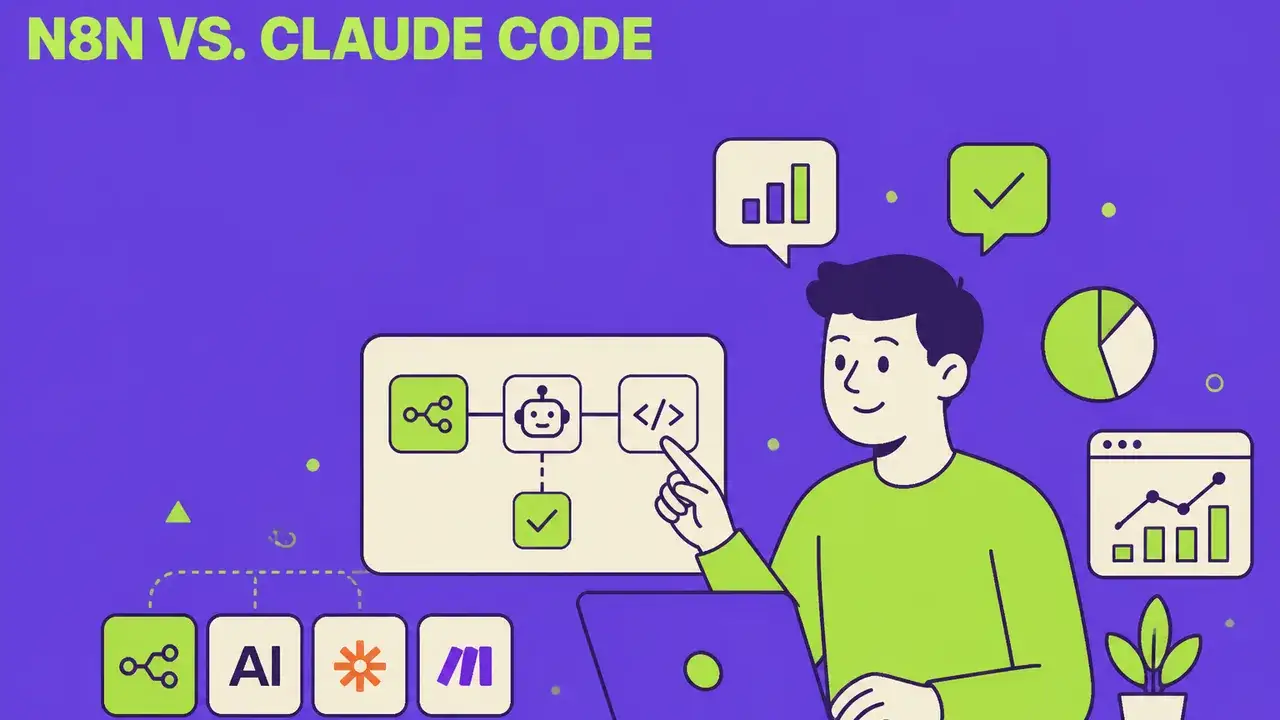
Table of Contents
The Automation Revolution in Marketing 2026
Marketing teams in 2026 face a fundamental decision: How do we automate our workflows? The landscape has changed dramatically – from classic no-code platforms to AI-native coding tools and hybrid solutions. This guide compares the most important platforms and helps you choose the right tech stack.
The 4 Paradigms of Marketing Automation
Before diving into the tool comparison, it's important to understand the fundamental approaches:
| Paradigm | Description | Examples |
|---|---|---|
| No-Code Visual | Drag-and-drop workflow builder | Zapier, Make |
| Low-Code Hybrid | Visual builder + code nodes | n8n, Retool |
| AI-Native Coding | AI writes and deploys code autonomously | Claude Code, Lovable |
| Agentic Automation | Autonomous AI agents orchestrate workflows | Marketing Agents, Custom Agents |
n8n: The Open-Source Champion
Strengths
n8n has established itself as the leading open-source automation platform. The combination of a visual workflow builder with the ability to embed custom code makes it the Swiss Army knife of automation.
Core advantages of n8n:
- Self-Hosting: Full data sovereignty – especially relevant after the EU AI Act
- 400+ Integrations: From CRM to email to AI APIs
- AI Nodes: Native connections to GPT-5, Claude 4.6, Gemini 3.1 Pro
- MCP Support: Model Context Protocol for seamless tool integration
- Community Workflows: Thousands of templates for marketing use cases
- Transparent Pricing: Cloud from $20/month, self-hosted free
Typical marketing workflows with n8n:
- Content Pipeline: RSS Feed → AI Summary → Social Media Posting → Analytics Tracking
- Lead Scoring: Form Submission → Enrichment → Scoring Logic → CRM Update → Slack Notification
- Campaign Reporting: Multi-channel data → Aggregation → AI Analysis → Dashboard Update → Stakeholder Email
Weaknesses
- Learning Curve: Complex workflows require JavaScript/Python knowledge
- UI Limitations: The visual builder struggles with 50+ nodes
- Debugging: Error handling in nested workflows is challenging
- No Frontend Creation: n8n automates backends but doesn't create UIs
Claude Code: AI-Native Automation
Strengths
Claude Code (powered by Claude 4.6 Sonnet) represents a radically different approach: Instead of visually clicking workflows together, you describe what you need in natural language – and the AI writes, tests, and deploys the code.
Core advantages of Claude Code:
- Natural Language: "Create a workflow that aggregates blog performance data daily"
- Code Quality: Generates production-ready TypeScript/Python code
- Context Understanding: Understands existing codebases and extends them consistently
- Agentic Mode: Can autonomously research, plan, and implement
- Terminal Integration: Direct execution of CLI commands
Typical marketing use cases:
- Custom Analytics: Tailored dashboards with specific business logic
- API Integrations: Connecting to proprietary marketing APIs
- Data Pipelines: Complex ETL processes for marketing dashboards
- Prototyping: Rapid MVP development for marketing tools
Weaknesses
- Technical Knowledge Required: You need to be able to review and understand code
- No Visual Builder: Non-technical team members can't participate
- No Hosting: You need your own infrastructure for deployments
- Costs: API-based billing can get expensive with intensive use
- No Monitoring: No built-in workflow monitoring or retry logic
Zapier: The Mainstream Champion
Strengths
Zapier remains the market leader for simple automations. With over 7,000 app integrations and an extremely simple interface, it's the first choice for quick, straightforward workflows.
Core advantages of Zapier:
- Simplicity: 5-minute setup for standard workflows
- 7,000+ Integrations: The largest app library on the market
- AI Actions: GPT-5-powered transformations directly in the workflow
- Tables: Native database for simple data storage
- Interfaces: Simple forms and dashboards
- Reliability: 99.9% uptime SLA
Typical marketing use cases:
- Lead Routing: Form → CRM → Email Sequence
- Social Listening: Mention → Slack → Response Template
- Content Distribution: Blog Post → Social Media → Newsletter
Weaknesses
- Price Explosion: Beyond 750 tasks/month, Zapier gets expensive quickly ($69.95/month+)
- Vendor Lock-in: No workflow export, no self-hosting
- Complexity Ceiling: Multi-step workflows with conditions become unwieldy
- No Code Nodes: Only limited JavaScript support
- Rate Limits: Polling-based, no real-time triggers for all apps
Make (formerly Integromat): The Visual Poweruser
Strengths
Make offers the most powerful visual workflow builder. The combination of flexibility and visual design makes it the preferred platform for more complex no-code automations.
Core advantages of Make:
- Visual Builder: The best drag-and-drop editor on the market
- Router & Filter: Complex branching logic visually representable
- Operations-based: Fair pricing based on actual usage
- Error Handling: Robust error management with retry logic
- Data Stores: Integrated data stores for workflows
- Webhooks: Real-time triggers for all integrations
Typical marketing use cases:
- Multi-Channel Campaigns: Orchestration across 10+ channels
- Content Localization: Automatic translation and adaptation
- Reporting Pipelines: Complex data aggregation with visual logic
Weaknesses
- Performance: Slower than n8n with large data volumes
- Self-Hosting: Not possible – cloud-only
- AI Integration: Fewer native AI nodes than n8n
- Learning Curve: Flexibility brings complexity
The Big Comparison: Decision Matrix
| Criterion | n8n | Claude Code | Zapier | Make |
|---|---|---|---|---|
| Entry Barrier | ⭐⭐⭐ | ⭐⭐ | ⭐⭐⭐⭐⭐ | ⭐⭐⭐⭐ |
| Flexibility | ⭐⭐⭐⭐⭐ | ⭐⭐⭐⭐⭐ | ⭐⭐⭐ | ⭐⭐⭐⭐ |
| AI Integration | ⭐⭐⭐⭐⭐ | ⭐⭐⭐⭐⭐ | ⭐⭐⭐ | ⭐⭐⭐ |
| Value for Money | ⭐⭐⭐⭐⭐ | ⭐⭐⭐ | ⭐⭐ | ⭐⭐⭐⭐ |
| Self-Hosting | ✅ | ❌ | ❌ | ❌ |
| MCP Support | ✅ | ✅ | ❌ | ❌ |
| Agentic Workflows | ✅ | ✅ | ❌ | ❌ |
| No-Code Possible | ✅ | ❌ | ✅ | ✅ |
| Enterprise-ready | ✅ | ⚠️ | ✅ | ✅ |
| Community | Open-Source | Anthropic Eco | Commercial | Commercial |
Price Comparison (as of February 2026)
| Plan | n8n Cloud | Claude Code | Zapier | Make |
|---|---|---|---|---|
| Starter | $20/month | Usage-based | $19.99/month | $10.59/month |
| Pro | $50/month | ~$100-500/month | $69.95/month | $18.82/month |
| Team | $100/month | Team Plan | $103.50/month | $34.12/month |
| Enterprise | Custom | Custom | Custom | Custom |
| Self-Hosted | Free | N/A | N/A | N/A |
Which Tool for Which Team?
Scenario 1: Small Marketing Team (2-5 people)
Recommendation: Zapier + AI Actions
For small teams without developers, Zapier is the most pragmatic choice. Built-in AI Actions enable smart transformations without writing code. Make is a more cost-effective alternative for budget-conscious teams.
Scenario 2: Mid-Size Marketing Team (5-20 people)
Recommendation: n8n Cloud + Claude Code for Custom Projects
The combination of n8n for recurring workflows and Claude Code for custom solutions offers the best value. n8n handles standard automations while Claude Code is used for complex agentic workflows.
Scenario 3: Enterprise Marketing Team (20+ people)
Recommendation: n8n Self-Hosted + Custom AI Agents
For enterprise teams, data sovereignty is key. n8n self-hosted combined with marketing agents and a context engineering framework provides maximum control and scalability.
The Hybrid Stack: Best of All Worlds
The best strategy for most marketing teams is a hybrid approach:
Layer 1: Quick Automations (Zapier/Make)
Simple trigger-action workflows set up in 5 minutes:
- New Leads → CRM
- Social Mentions → Slack
- Blog Post → Newsletter
Layer 2: Complex Workflows (n8n)
Multi-step processes with logic, AI integration, and data processing:
- Content pipelines with AI quality checks
- Multi-channel campaign orchestration
- Automated reporting with anomaly detection
Layer 3: Custom Solutions (Claude Code / Lovable)
Custom tools and dashboards that no workflow builder covers:
- Custom AI dashboards with proprietary business logic
- Industry-specific marketing tools
- Internal portals and self-service platforms
MCP: The Game-Changer for Tool Integration
The Model Context Protocol (MCP) is changing how tools communicate. Instead of manually connecting REST APIs, MCP enables a standardized interface through which AI agents directly access tool functions.
MCP-capable tools in our comparison:
- n8n: Full MCP server support since v1.70 – workflows are exposed as tools
- Claude Code: Native MCP client integration for tool access
- Zapier: No MCP support (proprietary ecosystem)
- Make: No MCP support (proprietary ecosystem)
n8n + MCP: The Killer Combination
The integration of n8n as an MCP server is particularly exciting for marketing teams:
- Workflows as Tools: Every n8n workflow can be exposed as an MCP tool
- AI Agent Access: Marketing agents can autonomously trigger n8n workflows
- Bidirectional Communication: Agents read results and dynamically adjust workflows
- Scaling: New capabilities are added through new workflows – without code changes
Future Outlook: Where Are Things Heading?
Trend 1: Agentic-First Automation
The future belongs to autonomous AI agents that don't just execute workflows but autonomously create and optimize them. n8n and Claude Code are best positioned for this trend.
Trend 2: Conversational Workflow Building
Instead of drag-and-drop, workflows are increasingly created via natural language. n8n has already integrated an AI assistant that generates workflows from descriptions.
Trend 3: Consolidation
The market is consolidating. Simple Zapier automations are increasingly covered natively by CRM and marketing platforms. The future belongs to complex, AI-powered workflows – the terrain of n8n and Claude Code.
Conclusion: Making the Right Choice
There is no "best" tool – only the right one for your context:
- Zapier if you want to start quickly and simply
- Make if you need visual control over complex workflows
- n8n if you need data sovereignty, AI integration, and MCP
- Claude Code if you want to build custom solutions with code
For most marketing teams, we recommend the hybrid stack: n8n as the central workflow engine, supplemented by Claude Code for custom projects and Zapier/Make for quick ad-hoc automations.
Want to strategically set up your marketing automation? Our Workflow Automation service helps you build the optimal tech stack. Or test your AI readiness with our AI Readiness Quiz.
Frequently Asked Questions
What is "n8n vs. Claude Code vs. Zapier vs. Make: Workflow Automation for Marketing Teams 2026" about?
No-code, low-code, or AI-native? The ultimate comparison of leading automation platforms – with decision matrix, price comparison, and hybrid stack recommendation.
The Automation Revolution in Marketing 2026: what matters?
Marketing teams in 2026 face a fundamental decision: How do we automate our workflows? The landscape has changed dramatically – from classic no-code platforms to AI-native coding tools and hybrid solutions.
The 4 Paradigms of Marketing Automation: what matters?
Before diving into the tool comparison, it's important to understand the fundamental approaches:
Strengths: what matters?
n8n has established itself as the leading open-source automation platform. The combination of a visual workflow builder with the ability to embed custom code makes it the Swiss Army knife of automation.
Related Articles
You might also be interested in these posts
 Tools & Technology
Claude Code in Marketing: CLI vs. MCP — and Why the Answer Is "Both"
Claude Code as CLI or via Model Context Protocol? When each tool wins, how marketing teams combine both — with decision matrix, 10 use cases, and realistic cost analysis.
 Tools & Technology
Figma × Claude Code: The New Design-to-Code Roundtrip for Marketing Teams
Figma has introduced "Claude Code to Figma", an integration that transforms code prototypes into editable designs—and back via MCP Server. We show the workflow, benefits, and best practices for marketing teams.
 Tools & Technology
MCP (Model Context Protocol): The USB-C for AI Agents
The Model Context Protocol standardizes how AI agents communicate with tools. Learn why MCP is the most important infrastructure standard of the agent era.