Retail Media Goes Agentic: MCP-Native Ad Serving for Shopping Agents
In short
When agents shop, ads need structured data instead of creatives. What Mirakl and Moloco are demonstrating.

Retail Media Goes Agentic: MCP-Native Ad Serving for Shopping Agents
The retail media landscape is undergoing a profound transformation, driven not merely by incremental technological advancements, but by a foundational shift in how consumers interact with products and services online. For years, retail media has focused on optimizing visibility and conversion within established e-commerce platforms, primarily through visual creatives and keyword-driven campaigns targeting human browsing behavior. This paradigm is now being fundamentally challenged by the emergence of sophisticated AI shopping agents. These agents, whether embedded in large language models like GPT-5.6 Sol or operating as specialized personal shopping companions, do not "browse" in the human sense. They analyze, compare, and recommend based on structured data, presenting a critical juncture for retail advertisers: adapt or become invisible.
This article delves into the implications of this agentic shift, focusing on the pioneering work by Mirakl Ads and Moloco in establishing MCP-native (Machine Comprehensible Protocol) ad serving. We will explore how advertisements are evolving from visually compelling creatives into structured, machine-readable offers, and the new metrics gaining prominence, such as A2G (Ads-to-GMV). For CMOs and marketing leads, understanding this evolution is not merely an exercise in future-proofing; it is about seizing a nascent opportunity to redefine product discoverability and drive revenue in an increasingly autonomous purchasing environment.
The Rise of the Autonomous Shopping Agent and the Data Paradigm Shift
The year 2026 marks a pivotal point in the consumer journey, characterized by the increasing adoption of AI shopping agents. These sophisticated entities, often powered by advanced large language models such as GPT-5.6 Terra, Claude Opus 5, or Gemini 3.6 Flash, are designed to execute complex shopping tasks on behalf of human users. Their capabilities extend far beyond simple product searches; they can understand nuanced preferences, compare hundreds of options across multiple retailers, negotiate prices (where applicable), and even manage fulfillment logistics.
Crucially, these agents do not process information in the same way a human shopper does. A traditional display ad, rich in imagery, persuasive copy, and branding elements, holds little intrinsic value for an AI agent. Instead, agents thrive on structured, semantic data. They require precise information regarding product attributes, real-time pricing, stock availability, estimated delivery times, and specific return or warranty policies. This fundamental difference necessitates a complete re-evaluation of how advertisements are constructed and delivered. The focus shifts from "persuading the eye" to "informing the algorithm." For a deeper dive into how AI is reshaping brand visibility, consider exploring our insights on AI Brand Visibility in 2026: The Age of Algorithmic Experience Optimization.
MCP-Native Ad Serving: The New Standard for Agent-Facing Campaigns
In response to this paradigm shift, Mirakl Ads and Moloco have spearheaded the introduction of MCP-native Ad Serving in 2026. This groundbreaking approach fundamentally alters the nature of an advertisement. Instead of traditional ad units, MCP-native ads are delivered as highly structured, machine-readable data packets directly to AI shopping agents.
An MCP-native ad is not a banner image or a video clip. It is a meticulously formatted data object comprising key transactional and product attributes. Think of it as a programmatic API call rather than a visual display. This method ensures that an AI agent can instantly parse and integrate the advertisement's core proposition into its decision-making process. The distinction is vital: while ACP/AP2/x402 protocols govern payment and authorization flows – ensuring that an agent can securely complete a purchase – MCP-native Ad Serving is exclusively concerned with discoverability and ranking. It dictates whether an agent finds and considers a product offer in the first place.
The structured data elements typically included in an MCP-native ad are:
| Data Field | Description | Example Value |
|---|---|---|
productId | Unique identifier for the product. | SKU123456789 |
productName | Machine-readable name of the product. | "Smartphone X Pro 256GB - Midnight Black" |
brand | Brand name of the product. | "TechCo" |
price | Current price, including currency. | {"amount": 999.99, "currency": "EUR"} |
availabilityStatus | Real-time stock status. | "IN_STOCK" / "OUT_OF_STOCK" / "PREORDER" |
deliveryTimeEstimate | Estimated delivery window. | {"minDays": 2, "maxDays": 4} |
shippingCost | Cost of shipping. | {"amount": 0.00, "currency": "EUR", "type": "FREE"} |
returnPolicy | Link or summary of return conditions. | "30-day free returns" |
sellerRating | Aggregate rating of the seller (if applicable). | 4.7 |
promotion | Any active promotions (e.g., discount, bundle). | {"type": "PERCENT_OFF", "value": 0.10, "label": "10% off"} |
productCategory | Hierarchical category of the product. | "Electronics > Mobile Phones > Smartphones" |
productUrl | Direct URL to the product detail page for human verification (if agent passes on). | https://shop.example.com/product/sku123 |
lastUpdated | Timestamp of the last data update. | "2026-08-15T14:30:00Z" |
This granular, real-time data flow allows agents to perform highly optimized comparisons, identify best matches based on complex criteria (e.g., "best smartphone under €800 with at least 128GB storage, delivered within 3 days, and a 4-star minimum seller rating"), and present those options to the user. Advertisers who fail to provide their product offers in this structured, MCP-native format risk being completely overlooked by the growing segment of agent-driven commerce.
The A2G Metric: A New KPI for Agentic Retail Media
In this new ecosystem, traditional advertising KPIs like impression share, click-through rates (CTR), or even conversion rates for human visitors, become less relevant for evaluating the performance of agent-facing campaigns. Instead, a new metric, A2G (Ads-to-GMV), is gaining significant traction and becoming a cornerstone for measuring the effectiveness of MCP-native ad serving.
A2G represents the percentage of Gross Merchandise Volume (GMV) directly attributable to agent-driven transactions initiated or significantly influenced by paid MCP-native advertisements. It quantifies the direct revenue impact of advertisements served to AI shopping agents. Typical values observed in 2026 for advanced retail media networks utilizing MCP-native ad serving range from 2% to 6%. This percentage indicates that for every €100 of GMV generated, €2 to €6 were directly facilitated by an MCP-native ad serving the agent.
Why A2G is critical:
- Direct Revenue Attribution: It provides a clear, quantitative link between ad spend and direct revenue generated through agent-led purchases.
- Agent-Centric Performance: It measures performance from the perspective of the agent's action (comparison, selection, recommendation) rather than human interaction metrics.
- Optimized Resource Allocation: CMOs can use A2G to strategically allocate budgets towards agent-facing campaigns, understanding their precise financial contribution.
- Competitive Advantage: Outperforming competitors on A2G signifies superior data structuring, real-time availability, and strategic bidding within the MCP-native ad ecosystem.
Optimizing A2G requires continuous monitoring and refinement of the structured data provided, the competitiveness of the offer (price, delivery), and the intelligent bidding strategies employed within the MCP-native platforms.
Strategic Implications for CMOs and Marketing Leads
The shift to MCP-native Ad Serving for shopping agents is not merely a technical update; it demands a strategic reorientation for marketing leadership. Ignoring this trend is akin to ignoring search engine optimization in the early 2000s.
Here are key strategic implications and actionable steps:
-
Prioritize Data Infrastructure:
- Challenge: Traditional product data feeds are often optimized for human readability, not machine parsing. Data can be outdated or incomplete.
- Action: Invest in robust Product Information Management (PIM) and Digital Asset Management (DAM) systems that can maintain real-time, granular, and highly structured data for every SKU. Ensure data is compliant with semantic web standards where possible.
- Recommendation: Conduct a comprehensive audit of current product data accuracy, completeness, and update frequency.
-
Redefine the "Creative" Department:
- Challenge: The concept of an "ad creative" is evolving from visual design to data architecture.
- Action: Reallocate resources from purely visual creative development to data scientists, semantic engineers, and product data specialists. Their "creativity" will lie in crafting the most compelling and accurate data representation of a product.
- Example: A "designer" might now be responsible for optimizing metadata tags for a product's sustainability attributes rather than a banner image.
-
Embrace Real-Time Optimization:
- Challenge: Agent decisions are instantaneous and based on the most current data. Latency is detrimental.
- Action: Implement systems for real-time price adjustments, stock level updates, and delivery promise changes. Integrate these systems directly with MCP-native ad platforms.
- Tooling: Leverage AI-powered dynamic pricing tools and inventory management systems that can feed directly into your MCP-native ad offerings.
-
Develop Agent-Specific Bidding Strategies:
- Challenge: Bidding on keywords for human search is different from bidding for agent visibility and selection.
- Action: Work with platforms like Mirakl Ads and Moloco to understand their agent-specific bidding algorithms. Strategies might involve bidding on specific product attributes (e.g., "fastest delivery," "eco-friendly," "best warranty") rather than generic keywords.
- KPI Focus: Shift bidding optimization targets towards A2G rather than traditional ROI metrics for human-facing ads.
-
Focus on Policy Clarity:
- Challenge: Agents need clear, unambiguous policies to make recommendations. Ambiguity leads to exclusion.
- Action: Standardize and clearly articulate return policies, warranty details, and customer service terms in a machine-readable format.
- Benefit: Transparent policies can become a competitive advantage when agents are comparing offers.
Implementing MCP-Native Ad Serving: A Step-by-Step Guide
For organizations looking to integrate MCP-native Ad Serving effectively, a structured approach is crucial. This process requires cross-functional collaboration between marketing, IT, product, and operations teams.
-
Phase 1: Internal Data Audit and Standardization (Weeks 1-4)
- Step 1.1: Identify all critical product data points required for MCP-native ads (price, availability, delivery, policies, etc.).
- Step 1.2: Audit existing data sources for accuracy, completeness, and freshness. Catalog discrepancies and missing information.
- Step 1.3: Define standardized data schema and nomenclature across all product lines. Ensure consistency (e.g., "in stock" vs. "available").
- Step 1.4: Establish a dedicated internal data team or assign responsibility to existing PIM/DAM owners.
-
Phase 2: Technical Integration and Data Pipeline Development (Weeks 5-12)
- Step 2.1: Evaluate and select MCP-native ad platforms (e.g., Mirakl Ads, Moloco) and their API documentation.
- Step 2.2: Develop or adapt data connectors/APIs to feed standardized product data from internal systems (PIM, ERP, Inventory Management) to the chosen MCP platform(s).
- Step 2.3: Implement real-time or near-real-time data synchronization mechanisms for critical fields like price and availability.
- Step 2.4: Set up monitoring and alerting for data feed integrity and latency.
-
Phase 3: Strategy, Bidding, and Policy Definition (Weeks 6-16)
- Step 3.1: Define clear business objectives for agent-driven commerce (e.g., target A2G, market share in specific categories).
- Step 3.2: Develop agent-specific bidding strategies. Identify key attributes or user intents to target (e.g., "fastest shipping," "most sustainable option").
- Step 3.3: Craft concise, machine-readable descriptions for all relevant policies (returns, warranties, customer support).
- Step 3.4: Create testing frameworks for different offer variations (price points, delivery promises) to gauge agent response.
-
Phase 4: Launch, Monitoring, and Iteration (Ongoing)
- Step 4.1: Soft launch MCP-native campaigns with a subset of products or categories.
- Step 4.2: Closely monitor A2G and other agent-centric KPIs. Analyze agent choice patterns and recommendation outcomes.
- Step 4.3: Continuously optimize data feeds, bidding strategies, and product offerings based on performance analytics.
- Step 4.4: Stay informed on updates to AI agent capabilities (e.g., GPT-5.6 Luna's enhanced reasoning) and MCP platform features. For practical insights into compliance, refer to our article on the EU AI Act in Praxis for Marketing 2026.
Measuring Success Beyond A2G: Holistic Performance Indicators
While A2G is the primary metric for direct revenue attribution in agent-driven commerce, a holistic understanding of success requires evaluating several complementary indicators. CMOs should consider a dashboard that integrates these metrics to paint a complete picture of agentic retail media performance.
| KPI Category | Specific KPI | Description | Measurement Focus |
|---|---|---|---|
| Direct Revenue Impact | A2G (Ads-to-GMV) | Percentage of Gross Merchandise Volume directly attributable to agent-driven ad interactions. | Primary revenue generation from agent ads. |
| Agent Conversion Rate (ACR) | Percentage of agent interactions (leading to recommendation/selection) that result in a purchase. | Efficiency of agent ad offers. | |
| Reach & Visibility | Agent Offer Share | Proportion of times an agent considered our offer out of all relevant queries. | Brand presence within agent search results. |
| Agent Recommendation Rate (ARR) | Frequency with which an agent recommends our product to a user based on an MCP-native ad. | Influence on agent's final decision. | |
| Data Quality & Health | Data Feed Accuracy Score | Percentage of product data fields that are accurate, up-to-date, and compliant with schema. | Foundation for agent ad effectiveness. |
| Data Latency Score | Average time delay between an internal data update and its reflection in the MCP-native ad platform. | Real-time responsiveness to market changes. | |
| Cost Efficiency | Cost Per Agent-Influenced GMV (€/GMV) | Total ad spend divided by the GMV influenced by agent-driven ads. | Cost-effectiveness of agent marketing efforts. |
| Return on Agent Ad Spend (ROAAS) | (GMV attributed to agent ads - Ad Spend) / Ad Spend. | Profitability of agent-facing advertising. |
These KPIs provide a multifaceted view, allowing marketing leaders to optimize not just the immediate transaction, but also the underlying data infrastructure, the competitive positioning of their offers, and the overall efficiency of their agent-driven marketing investments.
Fazit
The advent of AI shopping agents and MCP-native Ad Serving represents a fundamental shift in retail media, demanding a strategic pivot from traditional human-centric advertising to machine-comprehensible offer delivery. Brands that fail to adapt their infrastructure, data strategy, and team composition risk becoming invisible in an increasingly automated commerce landscape. Mirakl Ads and Moloco's pioneering efforts highlight the imperative for highly structured, real-time data as the new "creative" currency, with A2G emerging as the definitive metric for success.
For CMOs and marketing leads, the path forward involves a proactive investment in data governance, the re-skilling of marketing teams towards data and semantic engineering, and the integration of advanced real-time systems. Embracing MCP-native Ad Serving is not merely about staying competitive; it is about establishing a foundational presence in the future of retail, where the algorithm acts as the primary gatekeeper to consumer choice.
Frequently Asked Questions
What does MCP-native ad serving mean?
Ads are delivered as structured data offers over an agent protocol (Model Context Protocol) rather than as creatives: product, price, availability, delivery time, terms, and a sponsored label. The shopping agent decides on data, not on visual design.
What is the A2G metric?
A2G (agent-to-goal) measures how often an agent presented with an offer actually reaches the user's goal — from instruction to completed purchase or booking. Impressions and clicks lose meaning because agents neither scroll nor click out of curiosity.
How do you prepare product data for shopping agents?
Complete, current feeds with unique identifiers, real-time price and stock, clear shipping and returns terms, machine-readable attributes instead of marketing prose, and schema.org Product/Offer on landing pages. Mismatches between feed and site are the most common reason for exclusion.
Does this replace classic retail media advertising?
No, it adds a second layer. Human shoppers still see creatives while agentic purchases run in parallel through data channels. Use one shared budget and measurement model covering both paths instead of separate reports.
Related Articles
You might also be interested in these posts
 Trends & Insights
A2A eCommerce: When AI Agents Take Over Commerce
Agent-to-Agent Commerce is no longer a future vision: Autonomous AI agents negotiate, order, and optimize supply chains in real-time. What this means for B2B, DTC, and marketing teams.
 Trends & Insights
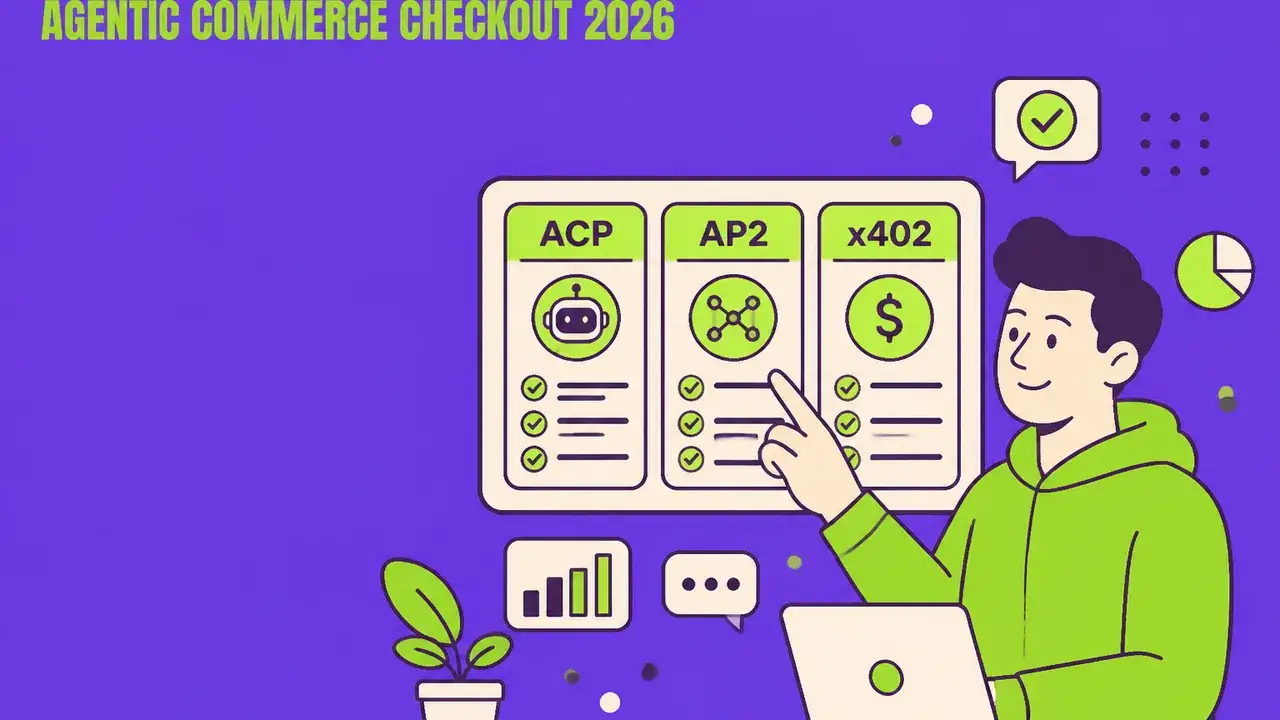
Agentic Commerce Checkout 2026: ACP vs. AP2 vs. x402 Compared
ACP, AP2, and x402 compared: how agents pay, who is liable, which mandates and spend limits are required, and what merchants and brands need to prepare technically now.
 Trends & Insights
Agent Skill Marketplaces: The New MCP Economy and How Brands Monetize It
Skills, MCP servers, and agent cards are becoming a new distribution channel. How discovery and ranking work inside agents, which monetization models hold up, and what brands need as skill providers.