Agentic Commerce Checkout 2026: ACP vs. AP2 vs. x402 Compared
In short
ACP, AP2, and x402 compared: how agents pay, who is liable, which mandates and spend limits are required, and what merchants and brands need to prepare technically now.
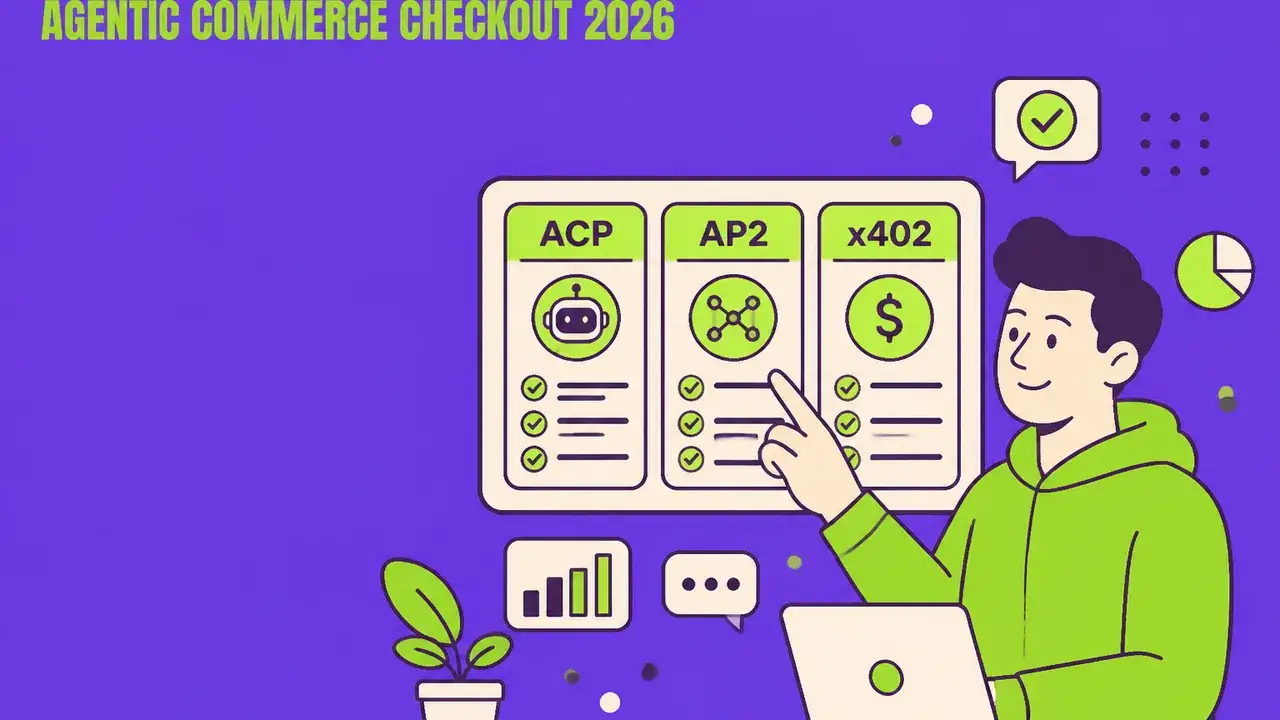
Table of Contents
Agentic Commerce Checkout 2026: ACP vs. AP2 vs. x402 Compared
As we navigate mid-2026, the promise of true agentic commerce is no longer a distant vision but an evolving reality. The underlying infrastructure enabling autonomous AI agents to discover, negotiate, and transact on behalf of users is rapidly maturing. While much attention has been paid to agent discovery mechanisms like Agent-to-Agent Commerce (A2A Commerce) and the intricacies of the Model Context Protocol (MCP), the critical, often overlooked, layer is the checkout process itself. This article delves into the leading payment protocols designed for AI agents: Agentic Commerce Protocol (ACP), Agent Payments Protocol (AP2), and x402. We will analyze their distinguishing features, implications for merchants, and necessary technical preparations.
The transition from human-driven e-commerce to agentic commerce presents both immense opportunities and significant technical challenges. For CMOs and marketing leadership, understanding these protocols is paramount to ensuring their brands are not just visible but transactable in this new paradigm. The ability of AI agents to autonomously manage purchases, subscriptions, and micro-transactions introduces complexities around authorization, fraud prevention, and liability that traditional payment gateways were not designed to handle.
The Evolution of Agentic Payments: Discovery vs. Checkout
Before diving into the protocols, it's crucial to differentiate between agent discovery and the actual checkout process. Agent discovery, facilitated by A2A and MCP, focuses on how AI agents find relevant products, services, and other agents. This includes semantic search, capability matching, and initial negotiation. Once discovery leads to a decision point – for example, an agent determines the best flight, hotel, or software subscription – the transaction must be executed. This is where the agentic payment protocols come into play, handling the authentication, authorization, and settlement without direct human intervention at every step.
Traditional e-commerce checkouts are designed for human interaction, often involving multi-step forms, CAPTCHAs, and explicit consent for each transaction. Agentic checkouts, conversely, must be programmatic, secured by granular mandates, and capable of handling vast volumes of micro-transactions efficiently.
Core Payment Protocols for AI Agents
Three primary protocols are emerging as standards for agentic payments:
Agentic Commerce Protocol (ACP)
Developed jointly by OpenAI and Stripe, ACP is designed for seamless integration with large language models (LLMs) and their derived agents. Its strength lies in its tight coupling with the agent's identity and OpenAI's ecosystem.
-
Key Features:
- Mandate-driven Authorizations: Users grant agents specific, revocable mandates detailing spending limits (per transaction, daily, monthly), acceptable merchant categories, and product types. These mandates are cryptographically signed.
- Verifiable Credentials (VCs): ACP leverages decentralized identifiers (DIDs) and VCs for agent and user identity verification, adding a layer of trust and privacy.
- Stripe Integration: Transactions are processed through Stripe's established infrastructure, benefiting from its fraud detection and global payment network.
- Pre-authorization and Auto-settlement: Agents can obtain pre-authorizations for potential purchases, which are then automatically settled upon condition fulfillment.
- Refund & Chargeback Mechanisms: ACP includes structured protocols for agent-initiated refunds and dispute resolution, albeit within the confines of established payment rails.
-
Implications for Merchants: Merchants expecting transactions via ACP need to ensure their product catalogs are highly structured and semantically rich (e.g., using Schema.org markups), allowing agents to accurately parse product details, pricing, and terms. API endpoints for real-time inventory and pricing are crucial.
Agent Payments Protocol (AP2)
Google's response to agentic payments, AP2 is closely integrated with the Gemini agent ecosystem and Google Wallet. It emphasizes user control through a central "Agent Payment Hub" and leverages Google's extensive cloud infrastructure.
-
Key Features:
- Centralized Mandate Management: Users define and manage agent mandates within their Google account, providing a unified interface for oversight.
- Contextual Authorization: AP2 attempts to infer authorization based on the user's past behavior and expressed preferences, reducing the need for constant explicit mandates for routine tasks.
- Tokenization: Extensive use of payment tokenization to secure card details and protect user privacy during transactions.
- Multi-modal Payment Options: Supports various payment methods linked to the Google Wallet, including traditional cards, bank transfers, and potentially cryptocurrencies in the future.
- AI-powered Fraud Detection: Leverages Google's formidable AI capabilities for real-time fraud detection and anomaly scoring.
-
Implications for Merchants: Google Merchant Center feeds and structured product data remain central. Merchants should prepare for API-driven payment requests that may bypass traditional cart flows, requiring robust backend integration to handle order creation and status updates initiated by agents.
x402 (HTTP-402-based Micropayments)
Unlike ACP and AP2, x402 is a more open and decentralized approach, leveraging the HTTP 402 "Payment Required" status code. It’s particularly suited for micro-transactions, API calls, and content access where small, granular payments are standard.
-
Key Features:
- HTTP-Standard Based: Directly integrates with web standards, making it easily adoptable by any web service.
- Invoice-on-Demand: When a resource requires payment, the server returns a 402 status code along with an invoice (e.g., a Lightning Network invoice, a URI to a payment request, or even a token-based request). The agent then pays, and retries the request.
- Protocol Agnostic: x402 itself doesn't define the payment method; it merely signals the requirement for payment. This allows for flexibility in using various payment rails (e.g., Bitcoin Lightning, Ethereum Layer 2, proprietary token systems).
- Low Latency, High Volume: Ideal for scenarios where millions of micro-transactions might occur daily, such as API access, data streaming, or AI model inferences.
- Stateless Operations: Each transaction can be atomic, simplifying implementation for developers.
-
Implications for Merchants: Implementing x402 requires a different mindset. It's less about a traditional "checkout" and more about monetizing access to digital assets or services directly. API monetization, premium content access, and usage-based billing are prime candidates. This demands robust analytics and billing systems capable of tracking granular consumption and issuing varied payment requests.
Comparison of Agentic Payment Protocols
| Feature | Agentic Commerce Protocol (ACP) | Agent Payments Protocol (AP2) | x402 (HTTP-402) |
|---|---|---|---|
| Originators | OpenAI, Stripe | Open standard, community-driven (e.g., Lightning Network) | |
| Primary Use Case | E-commerce, subscriptions, complex agent-driven purchases | E-commerce, routine purchases, service booking, digital content | Micropayments, API monetization, content access, data streams |
| Authorization Model | Cryptographically signed user mandates, VCs | Centralized mandate management in Google Account, contextual auth | Implicit via payment request; explicit per micro-transaction |
| Integration | Deeply integrated with OpenAI agent ecosystem, Stripe payments | Google Gemini agents, Google Wallet, Google Cloud | HTTP/Web services, relies on specific payment rails |
| Transaction Size Focus | Medium to Large (e.g., products, services) | Small to Large (e.g., digital goods, some physical products) | Very Small (e.g., API calls, few cents content access) |
| Fraud Prevention | Stripe Radar, proprietary agent safeguards | Google's AI-driven fraud detection, Google Wallet security | Dependent on underlying payment rail (e.g., Lightning Network security) |
| Liability Model | Defined by Stripe's terms, agent mandate scope | Defined by Google's terms, user-set spending limits | Dependent on underlying payment rail and service provider |
| Merchant Preparation | Structured product data, rich APIs for inventory/pricing, webhooks | Merchant Center integration, robust APIs, structured data | API endpoints returning 402, invoicing/payment request generation |
| Current Adoption (Est.) | Moderate (Early Adopter Programs) | Moderate (Growing with Gemini) | Low (Niche adoption, high potential for specialized use cases) |
Mandates and Verifiable Credentials
A cornerstone of agentic commerce across ACP and AP2 is the concept of "mandates." These are explicit permissions granted by a human user to an AI agent, outlining:
- Spending Limits: Maximum amount per transaction, daily, weekly, or monthly spend.
- Merchant Categories: Whitelisting or blacklisting specific types of merchants (e.g., "allow food delivery," "disallow gambling").
- Product Classes: Permitting transactions for specific product types (e.g., "allow booking flights," "disallow purchasing luxury goods").
- Timeframes: Mandates can have expiration dates or be time-limited.
- Geo-Restrictions: Limiting transactions to certain geographic regions.
For ACP, these mandates are often encoded as Verifiable Credentials (VCs), allowing for decentralized verification of an agent's authority without relying on a single central authority. This enhances privacy and security. AP2, while using a centralized Google account for mandate management, still relies on the same core principles of granular user control.
Authorization and Spend Limits
In agentic commerce, authorization is a multi-layered process:
- User-Agent Mandate: The human user authorizes their agent with broad or specific permissions.
- Agent-Merchant Authorization: The agent, acting on its mandate, initiates a transaction with a merchant, signaling its authority and requested spending.
- Payment Processor Authorization: The chosen payment protocol (ACP, AP2, x402) then handles the actual financial authorization with the card networks or other payment rails.
Intelligent spend limits are crucial. Agents are designed to optimize, and without strict limits, they could inadvertently overspend or make unauthorized purchases. These limits must be dynamic and easily adjustable by the user, providing both flexibility and control.
Chargebacks and Liability
The shift to agentic commerce significantly impacts chargeback mechanisms and liability. Who is responsible if an agent makes an unauthorized purchase due to a bug or misinterpretation of a mandate?
- Agent Provider Liability: OpenAI (for ACP) or Google (for AP2) takes on a degree of liability, especially if the agent acts outside its established parameters due to a platform error. Their insurance and fraud detection systems are critical here.
- User Liability: Users are generally liable for transactions within the scope of the mandates they explicitly granted. The clarity and granularity of mandates reduce ambiguity.
- Merchant Liability: Merchants still bear responsibilities related to product delivery, quality, and service as in traditional e-commerce. However, they are less likely to be liable for "unauthorized" payments if the payment protocol verified the agent's mandate correctly.
New dispute resolution mechanisms are being developed to cater to agentic transactions, likely involving automated agent audit trails and clearer definitions of mandate breaches.
Fraud Risks in Agentic Commerce
While agentic payments offer new ways to detect fraud through behavioral analysis of agents, they also introduce novel attack vectors:
- Mandate Tampering: Malicious actors attempting to alter an agent's spending mandates. VCs and secure digital signatures mitigate this.
- Agent Impersonation: Fraudsters creating fake agents or compromising legitimate ones to initiate unauthorized transactions. Strong authentication of agents (e.g., DIDs) is essential.
- Protocol Exploits: Vulnerabilities in ACP, AP2, or x402 implementations that could allow for unauthorized payments. Continuous auditing and secure coding practices are paramount.
- Collusion between Agents: A more futuristic threat where multiple compromised agents collude to defraud users or merchants.
Merchants must trust that the payment protocols provide robust security, but also implement their own monitoring for unusual transaction patterns originating from agents.
Technical Preparation for Merchants and Brands
To thrive in the agentic commerce era, merchants and brands must undertake several technical preparations:
-
Structured Product Feeds:
- Semantic Richness: Beyond basic product data (SKU, price, description), include highly granular attributes, material compositions, ethical sourcing data, and detailed specifications. Use Schema.org markups extensively.
- Real-time Updates: Ensure product feeds (e.g., Google Merchant Center, custom JSON feeds) are updated in real-time for inventory, pricing, and promotions. Agents need accurate, current data.
-
Advanced API Development:
- Transactional APIs: Develop robust, authenticated APIs for agents to check inventory, place orders, modify existing orders, track shipments, and initiate returns/refunds. These APIs must be highly resilient and scalable.
- Payment Gateway APIs: Integrate directly with ACP and AP2 endpoints, or be prepared to generate x402-compliant invoices/payment requests. This requires handling new authentication and authorization headers.
- Contextual Information APIs: Provide APIs for agents to query detailed product information, availability, lead times, and terms and conditions programmatically.
-
Verifiable Credentials and DIDs Integration (ACP-specific):
-
Webhooks and Notification Systems:
- Agents operate asynchronously. Merchants need robust webhook systems to notify agents of order status changes, payment confirmations, shipping updates, and potential issues.
- These webhooks should support standardized payloads for easy agent ingestion.
-
Pricing and Promotion Rules for Agents:
- Consider establishing specific pricing rules or promotional offers that are only accessible by agents, or which require agent-specific negotiation parameters.
- Ensure all terms are machine-readable and easily interpretable by AI.
-
Security Audit and Logging:
- Conduct regular security audits of all agent-facing APIs and payment integrations.
- Implement comprehensive logging of all agent interactions and transactions to aid in dispute resolution and fraud analysis.
Decision Matrix and Roadmap
For CMOs and marketing leadership, deciding which protocols to prioritize depends on their target markets, product types, and existing technological stack.
- If your primary focus is consumer e-commerce for physical/digital goods, integrated with major AI platforms: Prioritize AP2 (for Google/Gemini users) and ACP (for OpenAI/Stripe users). A dual strategy is often advisable to cover a broad spectrum of agent users.
- If you offer APIs, digital services, premium content, or require granular monetization of data/compute: Investigate x402. Its flexibility for micropayments and integration with decentralized payment rails makes it a strong contender for specific use cases.
- For high-value, complex transactions requiring detailed negotiation (e.g., B2B procurement): ACP's mandate-driven VC architecture offers robust security and auditability.
Roadmap for Implementation (Example):
- Q3 2026:
- Assessment: Evaluate current product data structure, API readiness, and existing payment gateway capabilities.
- Education: Train internal teams (product, marketing, engineering) on agentic commerce principles and protocols.
- Pilot Program Definition: Identify a specific product line or service for an initial agentic commerce pilot.
- Q4 2026 - Q1 2027:
- Data Standardization: Implement comprehensive Schema.org markups and standardize product feeds for AI consumption.
- API Refinement: Develop or enhance APIs for real-time inventory, pricing, and order placement.
- ACP/AP2 Integration Prep: Begin initial integration with one chosen protocol (e.g., ACP if heavily invested in OpenAI agent dev or AP2 for Google Merchant Center users).
- Q2 2027 - Q3 2027:
- Payment Protocol Integration: Deploy and test initial ACP/AP2 integration for the pilot product/service.
- Mandate Handling: Develop internal systems to process agent mandates and monitor spend limits.
- Fraud Monitoring: Enhance fraud detection systems to identify agent-specific attack patterns.
- Consider x402: If applicable, begin exploring x402 for specific micro-transaction use cases.
- Beyond: Iterate, expand coverage, refine agent interaction flows, and continuously monitor performance and security.
Conclusion
The agentic commerce checkout landscape in 2026 is defined by crucial developments in ACP, AP2, and x402. Each protocol offers distinct advantages tailored to different use cases and technological ecosystems. For CMOs and marketing leaders, neglecting these developments is to risk becoming untransactable in an increasingly automated economy. Proactive technical preparation, focused on structured data, robust APIs, and an understanding of agent mandates, is no longer optional but a fundamental requirement for future market relevance.
Davies Meyer helps companies navigate the complexities of AI-driven marketing and agentic commerce, developing strategies and technical roadmaps to ensure brands are future-ready.
Frequently Asked Questions
What is "Agentic Commerce Checkout 2026: ACP vs. AP2 vs. x402 Compared" about?
ACP, AP2, and x402 compared: how agents pay, who is liable, which mandates and spend limits are required, and what merchants and brands need to prepare technically now.
Agentic Commerce Checkout 2026: ACP vs. AP2 vs. x402 Compared: what matters?
As we navigate mid-2026, the promise of true agentic commerce is no longer a distant vision but an evolving reality. The underlying infrastructure enabling autonomous AI agents to discover, negotiate, and transact on behalf of users is rapidly maturing.
The Evolution of Agentic Payments: Discovery vs. Checkout: what matters?
Before diving into the protocols, it's crucial to differentiate between agent discovery and the actual checkout process. Agent discovery, facilitated by A2A and MCP, focuses on how AI agents find relevant products, services, and other agents.
Agentic Commerce Protocol (ACP): what matters?
Developed jointly by OpenAI and Stripe, ACP is designed for seamless integration with large language models (LLMs) and their derived agents. Its strength lies in its tight coupling with the agent's identity and OpenAI's ecosystem.
Related Articles
You might also be interested in these posts
 Trends & Insights
A2A eCommerce: When AI Agents Take Over Commerce
Agent-to-Agent Commerce is no longer a future vision: Autonomous AI agents negotiate, order, and optimize supply chains in real-time. What this means for B2B, DTC, and marketing teams.
 Trends & Insights
Retail Media Goes Agentic: MCP-Native Ad Serving for Shopping Agents
When agents shop, ads need structured data instead of creatives. What Mirakl and Moloco are demonstrating.
 Trends & Insights
Agent Skill Marketplaces: The New MCP Economy and How Brands Monetize It
Skills, MCP servers, and agent cards are becoming a new distribution channel. How discovery and ranking work inside agents, which monetization models hold up, and what brands need as skill providers.