GraphRAG for B2B Product Catalogues: When Vector Search Hits Its Limits With Variants, BOMs and Accessories
In short
Product advisor chatbots often fail on compatibility and variants. When a knowledge graph helps, what it doesn't do, and why stock must come live from the ERP.
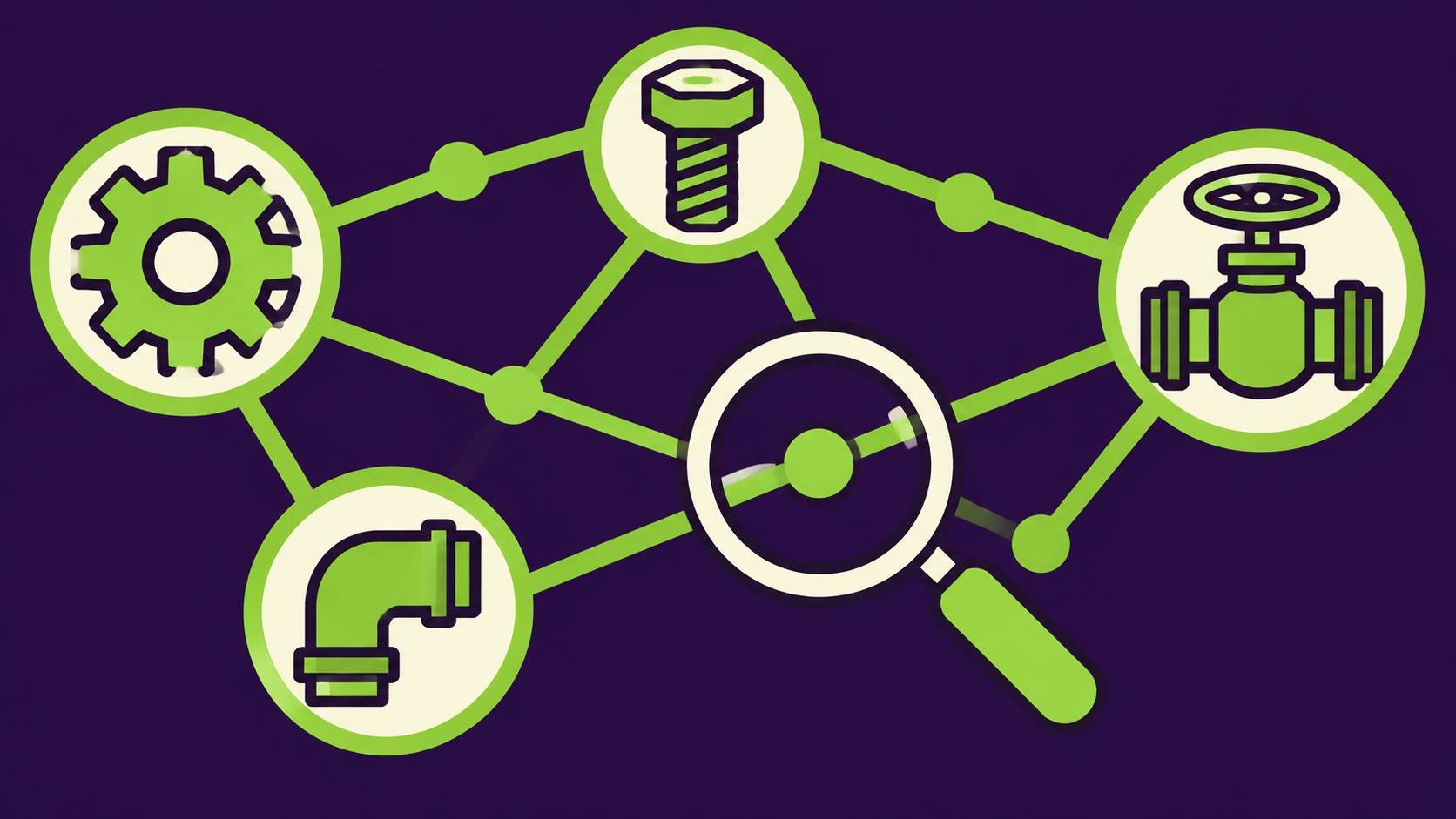
Table of Contents
"Does seal X fit valve Y in the food-grade version?" A standard chatbot finds data sheets that mention both and still answers wrongly. In technical catalogues the answer rarely sits in a single passage; it lies in the relationship between parts.
Why vector search struggles here
Vector search finds passages that are linguistically similar to a question. In B2B product data, though, hard relationships often decide: a variant belongs to a series, a spare part replaces a predecessor, an accessory only fits certain connection sizes, a standard applies only to one version. Two data sheets can read almost identically and differ in a single dimension. That is where wrong but convincing answers come from.
What GraphRAG adds
GraphRAG combines text retrieval with a knowledge graph of entities and relationships. Microsoft Research describes the method in From Local to Global; local search answers questions about specific entities and their neighbours. For product data this means the assistant can follow an edge such as "compatible with" or "replaces" instead of guessing it from text similarity. Questions spanning several steps, such as part → series → approved accessory, are what we call multi-hop retrieval.
Important: in product catalogues the graph is usually not a by-product of automatic text analysis. Bills of materials, variant logic and compatibilities already exist in structured form in the PIM or ERP. A good graph takes over that data instead of re-guessing it from PDFs.
What the graph should not do
- Stock and prices: these change constantly and should be queried live from the ERP, not stored in a precomputed graph.
- Approvals: whether a combination is permitted is decided by product management. The assistant shows the source instead of inventing approvals.
- Filling gaps: if an edge is missing, the system should say "unknown" and hand over to sales.
A four-step blueprint
- Collect questions: 30 real requests from sales and service, sorted by question type.
- Model relationships: which edges are really needed: compatible, replaces, belongs to, meets standard?
- Connect live data: stock, price and lead time via an interface, with a timestamp in the answer.
- Acceptance test: every answer with a source; compare error rates against basic RAG, see acceptance tests for marketing agents.
The basic choice between classic RAG, GraphRAG and agentic RAG is covered in Agentic RAG: When Company Knowledge Needs More Than Vector Search. For interactive product finders, also see A2UI.
Next step
Take your sales team's ten most common compatibility questions and check whether today's answer sits in a document or in a relationship between records. To test with your data, describe the project in the agent pilot.
Sources: Edge et al., Microsoft Research: From Local to Global: A GraphRAG Approach to Query-Focused Summarization; GraphRAG documentation: Local Search.
Frequently Asked Questions
What is "GraphRAG for B2B Product Catalogues: When Vector Search Hits Its Limits With Variants, BOMs and Accessories" about?
Product advisor chatbots often fail on compatibility and variants. When a knowledge graph helps, what it doesn't do, and why stock must come live from the ERP.
Why vector search struggles here: what matters?
Vector search finds passages that are linguistically similar to a question. In B2B product data, though, hard relationships often decide: a variant belongs to a series, a spare part replaces a predecessor, an accessory only fits certain connection sizes, a standard applies only to one version.
What GraphRAG adds: what matters?
GraphRAG combines text retrieval with a knowledge graph of entities and relationships. Microsoft Research describes the method in From Local to Global; local search answers questions about specific entities and their neighbours.
What the graph should not do: what matters?
Stock and prices: these change constantly and should be queried live from the ERP, not stored in a precomputed graph. Approvals: whether a combination is permitted is decided by product management.
Related Articles
You might also be interested in these posts
 Tools & Technology
Agentic RAG: When Company Knowledge Needs More Than Vector Search
Classic RAG, GraphRAG or agentic RAG? A decision grid for brand and product knowledge, with checks for contradictions and sources.
 Tools & Technology
Computer-Use Agents vs. RPA: How Mid-Sized Companies Safely Automate Legacy Software Without an API
Agents that operate screens look like the answer to the old ERP without an API. A three-tier rule shows when they fit and how to secure them.
 Tools & Technology
Stateless MCP (2026-07-28 Specification): What Dropping Sessions Means for IT Architects
The 2026-07-28 MCP specification removes sessions and the handshake. What changes for load balancers, gateways and tool design, with a migration checklist.