Agentic RAG: When Company Knowledge Needs More Than Vector Search
In short
Classic RAG, GraphRAG or agentic RAG? A decision grid for brand and product knowledge, with checks for contradictions and sources.
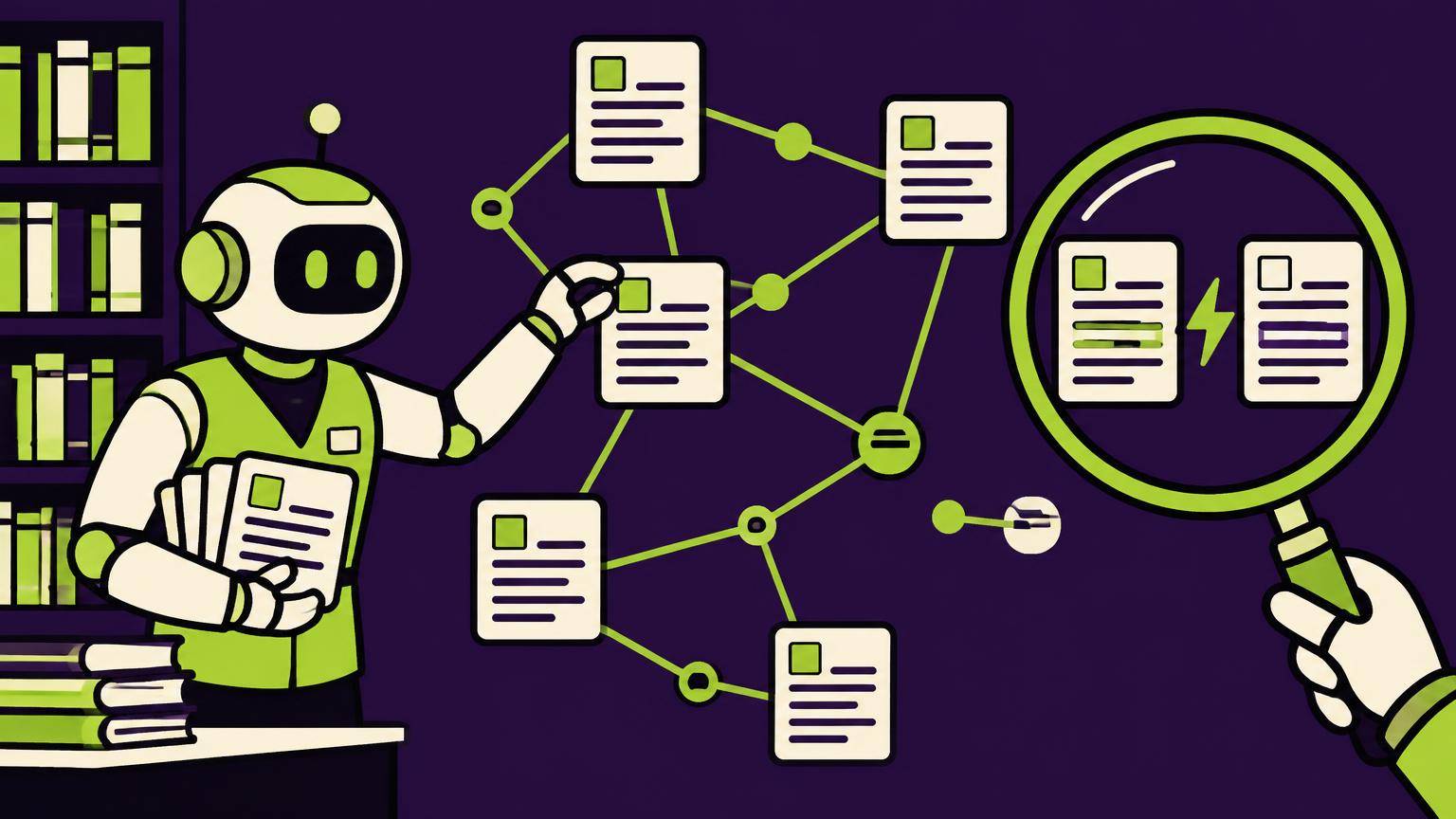
Table of Contents
An assistant finds the brand guideline but misses the newer retail exception. It answers fluently, and wrongly. The problem is rarely the language model; it is how knowledge is retrieved and assembled. Before investing in a complex architecture, a team should clarify which questions the system actually has to answer.
Three designs, three kinds of question
Classic RAG (retrieval-augmented generation) retrieves matching passages, usually through vector or keyword search, and passes them to the model as context. It suits targeted questions: "What is the minimum logo size?"
GraphRAG builds a knowledge graph of entities, relationships and summarised topic groups from the documents in advance. In "From Local to Global", Microsoft Research describes how baseline RAG fails on questions about the whole collection, such as "What are the main themes in our customer feedback?", because that is a summarisation task rather than a lookup. The GraphRAG documentation accordingly separates local search for questions about specific entities from global search over pre-summarised groups.
Agentic RAG lets an agent plan the retrieval itself: break the question down, query several sources, check results, search again. That helps with multi-step questions ("Which campaign visuals are approved for Austria, and with which claim?") but costs more time, more compute and more testing.
Decision grid
| Question type | Sensible starting point | Check |
|---|---|---|
| Single rule or fact | Classic RAG over maintained sources | Is the current version found? |
| Overview across many documents | GraphRAG or pre-built summaries | Are summaries traceably sourced? |
| Several steps, several systems | Agentic RAG with limited tools | Does the agent stop or ask when sources conflict? |
Contradictions are the real test
In marketing the riskiest case is not missing knowledge but conflicting knowledge: old and new guidelines, a country exception, an agency draft next to the approved version. Good systems show sources with date and status and name the conflict instead of smoothing it over. That has to be tested, not assumed.
Practical checks:
- Does every document carry a status (draft, approved, superseded) and a validity date?
- Does the answer show its sources so a person can open them?
- What happens when two approved sources contradict each other?
- Who maintains the collection when a guideline changes?
Our Creative Engineering view
Architecture follows editorial discipline, not the other way round. Teams that version brand knowledge cleanly and assign ownership often get far with classic RAG. Graph and agent approaches pay off where questions genuinely span many documents or systems, and only once an acceptance test shows the simpler method falls short. Related: acceptance tests for marketing agents and the Marketing Context Layer.
Next step
Collect 20 real questions from your team and sales, map them to the three question types and test the simplest suitable approach first. If you want a scoped trial, describe your project in the agent pilot.
Sources: Edge et al., Microsoft Research: From Local to Global: A GraphRAG Approach to Query-Focused Summarization; GraphRAG documentation: Global Search and Local Search.
Frequently Asked Questions
What is "Agentic RAG: When Company Knowledge Needs More Than Vector Search" about?
Classic RAG, GraphRAG or agentic RAG? A decision grid for brand and product knowledge, with checks for contradictions and sources.
Three designs, three kinds of question: what matters?
Classic RAG (retrieval-augmented generation) retrieves matching passages, usually through vector or keyword search, and passes them to the model as context. It suits targeted questions: "What is the minimum logo size?
Contradictions are the real test: what matters?
In marketing the riskiest case is not missing knowledge but conflicting knowledge: old and new guidelines, a country exception, an agency draft next to the approved version.
Our Creative Engineering view: what matters?
Architecture follows editorial discipline, not the other way round. Teams that version brand knowledge cleanly and assign ownership often get far with classic RAG.
Related Articles
You might also be interested in these posts
 Tools & Technology
Testing AI Agents: Marketing Workflow Acceptance
A practical acceptance matrix for marketing agents: sources, tool actions, failure cases, approvals and retesting after changes.
 Tools & Technology
MCP in Production: Connecting Agents With Least Privilege
What the MCP specification covers for authorisation, what it leaves open, and a permissions matrix for agents in CMS, CRM and ad accounts.
 Tools & Technology
AI Agent Frameworks for Marketing 2026: CrewAI, LangGraph & Claude Tasks Compared
The ultimate framework comparison for marketing teams: CrewAI, LangGraph, Claude Tasks and AutoGen in practice – strengths, weaknesses and use cases.
AI solutions by Davies Meyer
From an application to the right delivery
Good AI applications need brand knowledge, a clear idea and the right execution. Davies Meyer brings strategy, creativity, content production and technology together. Creative Engineering is our method for making that collaboration repeatable.
We take responsibility for the concept and quality.