Diffusion LLMs vs. Autoregressive: The Paradigm Is Tipping
In short
Mercury, parallel generation, new cost curves – why diffusion LLMs get serious in 2026.
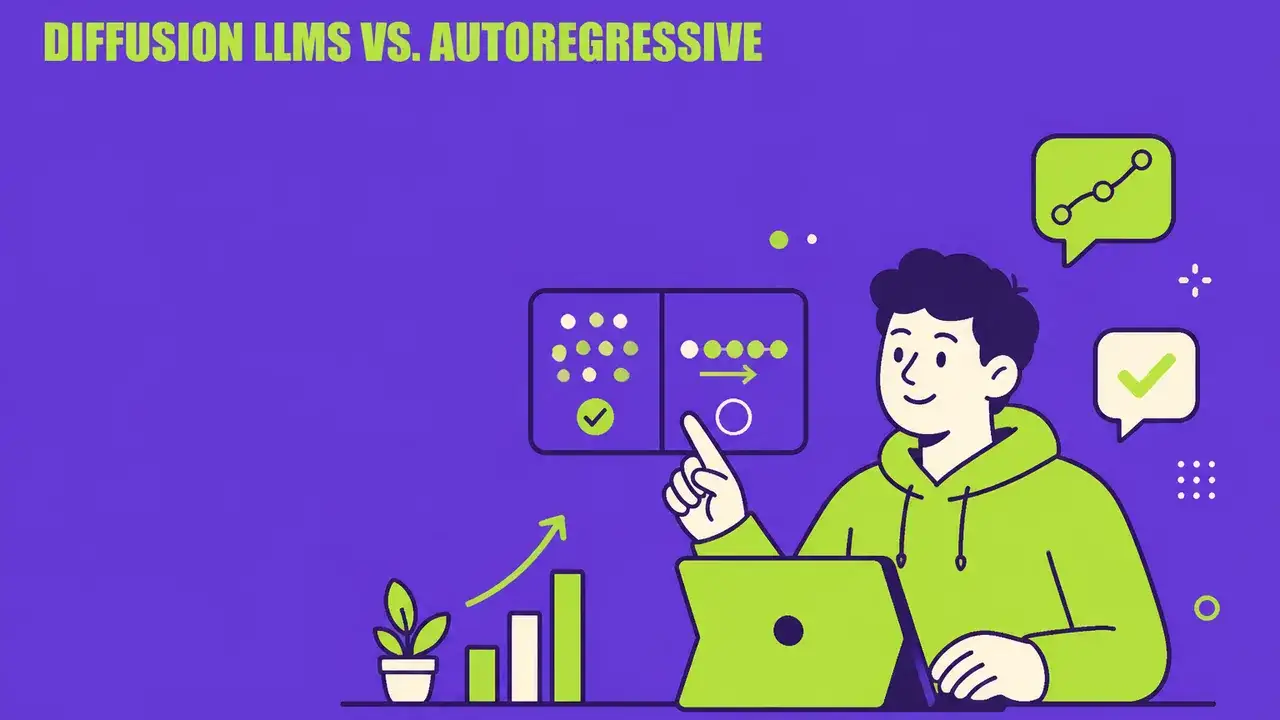
Table of Contents
Diffusion LLMs: when language emerges in parallel, not sequentially
Since GPT-2 we know: language models generate text token by token, autoregressively – each word depends on all previous ones. In 2026 that assumption tips. Diffusion LLMs (dLLMs) like Inception Labs Mercury show that language can be generated like images: from noise, a complete output emerges in several denoising steps – all tokens in parallel.
The result: 5-10× faster inference at comparable quality for many standard tasks.
Why this is more than a technical detail
Three implications for marketing stacks:
1. Latency becomes a design decision, not a constraint. If a 500-token answer takes 0.5 seconds instead of 4, it changes when and where you can embed LLM calls: real-time checkout personalization, dynamic headlines while scrolling, voice interfaces without audible pause.
2. Cost scales differently. Autoregressive models charge per output token; diffusion models per denoising step. For short, parallel outputs, diffusion is significantly cheaper. For long, sequentially logical reasoning chains, autoregressive still dominates.
3. Use case selection matters more. There is no "one model for everything" answer anymore.
Where diffusion LLMs are productive in 2026
| Use case | Diffusion advantage | Example tool |
|---|---|---|
| Code completion | Parallel generation of large context blocks | Inception Mercury Coder |
| High-throughput classification | 5-10× speedup on structured outputs | Custom Mercury fine-tunes |
| Headline / variation generation for ads | Dozens of variants in one pass | First Mercury-based tools |
| Real-time personalization | Sub-second answers possible | Own edge deployments |
| Long reasoning chains | Disadvantage – AR models better | – |
| Multi-step agent workflows | Disadvantage – AR models better | – |
Comparison: where diffusion pays off
Example calculation headline test, 50,000 variants/day (5-15 tokens each):
| Stack | Latency per answer | Monthly cost |
|---|---|---|
| GPT-5.6 Sol Nano (AR) | ~400 ms | ~12,000 USD |
| Claude 4.6 Haiku (AR) | ~350 ms | ~10,500 USD |
| Mercury-class diffusion LLM | ~70 ms | ~3,200 USD |
For long, multi-step reports the math flips the other way.
What's still in flux in 2026
- Reasoning quality: On mathematical proofs, code architecture and multi-hop research, autoregressive models stay ahead.
- Ecosystem: OpenAI, Anthropic and Google have diffusion research internally – productive APIs are still limited.
- Fine-tuning tooling: LoRA, DPO and RLHF pipelines are less mature for diffusion LLMs than for AR models.
Recommendation for marketing CTOs
Build a diffusion-LLM pilot setup by Q3 2026:
- Select a use case with high volume, short outputs, parallelizable (headline test, tag classification, variation generation).
- Benchmark Mercury or comparable dLLM next to your current AR model (GPT-5.6 Sol Nano, Claude 4.6 Haiku): latency, cost/1k calls, quality on your use case.
- Implement hybrid routing: light task → dLLM, reasoning task → AR model. A simple router function in front of your LLM layer.
Whoever ignores this funds the same tasks at 4-8× the price in 2027.
Bottom line
Diffusion LLMs are not a replacement for autoregressive models – they are a second gear available to marketing stacks in 2026. Whoever routes both wisely halves their LLM bill without quality loss. Whoever thinks "always GPT-5.6 Sol" pays premium for standard tasks.
Further reading: Diffusion LLM Glossary · Speculative Decoding · LLM Token Efficiency
Frequently Asked Questions
What is "Diffusion LLMs vs. Autoregressive: The Paradigm Is Tipping" about?
Mercury, parallel generation, new cost curves – why diffusion LLMs get serious in 2026.
Diffusion LLMs: when language emerges in parallel, not sequentially: what matters?
Since GPT-2 we know: language models generate text token by token, autoregressively – each word depends on all previous ones. In 2026 that assumption tips. Diffusion LLMs (dLLMs) like Inception Labs Mercury show that language can be generated like images: from noise, a complete output emerges in several denoising steps – all tokens in parallel.
Why this is more than a technical detail: what matters?
Three implications for marketing stacks: 1. Latency becomes a design decision, not a constraint. If a 500-token answer takes 0.
Comparison: where diffusion pays off: what matters?
Example calculation headline test, 50,000 variants/day (5-15 tokens each): For long, multi-step reports the math flips the other way.
Related Articles
You might also be interested in these posts
 Trends & Insights
Google Targets AI Mass Content and Fake Authors
Google warns against fake authors and content without value. A checklist for accountability, evidence and original contributions in AI-assisted production.
 Trends & Insights
Meta Ads MCP: What the Connection Means for Ad Teams
Meta ads MCP server in Databricks Marketplace: verified availability, possible uses and approval rules for agentic advertising tasks.
 Trends & Insights
Why Websites Block AI Agents — and What Brands Should Do
Agents do not see ads. Why blocking is mainly a revenue question, how pay per crawl works and which content brands should keep open.