Agentic Marketing Blueprint: The Four Layers of Working Agent Teams
In short
Knowledge, tools, agents, control: the reference architecture marketing organisations converge on in 2026 — including sequence, roles and metrics.
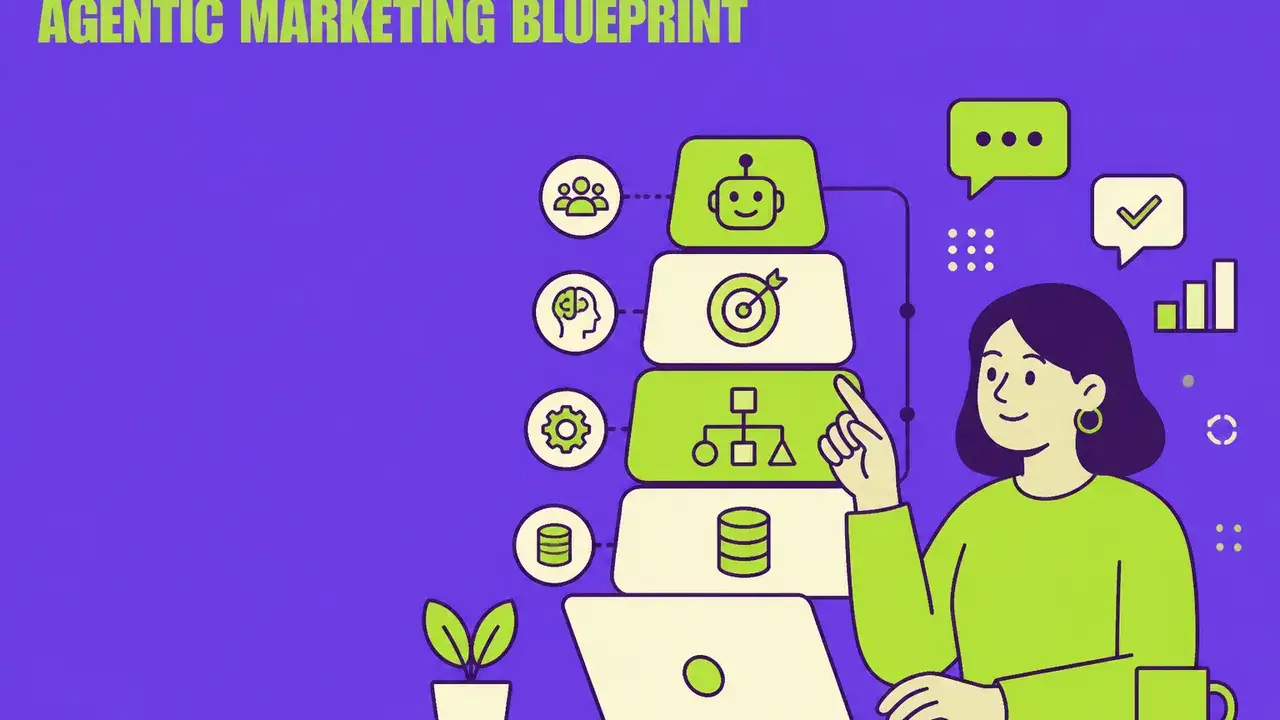
Table of Contents
The short answer
Marketing organisations running agents productively in 2026 converge on the same architecture regardless of industry or tool stack. It has four layers: knowledge, tools, agents, control. Skip a layer and you get impressive demos and no dependable results. Gartner expects roughly 40 percent of enterprise marketing workflows to run through autonomous agents by 2027; the bottleneck is not model quality, it is organisation.
Layer 1: Operational knowledge
An agent can only decide as well as the company has made its rules explicit. Whatever lives in people's heads and Slack threads does not exist for an agent.
The minimum: brand guidelines in checkable form, audience and offer definitions, approval paths, prohibited claims, legal frames (EU AI Act, advertising law, data protection) and the metric definitions you optimise against. This collection is not a by-product, it is the actual investment.
Layer 2: Tools and data access
Agents act through tool calls: CMS, CRM, ad accounts, analytics, asset database. Three rules hold up:
- Read first, write later. An agent's first production use case should change nothing.
- One right per purpose. No shared super-accounts; each agent gets exactly the rights its task requires.
- Idempotency and rollback. Every write action must be repeatable and reversible.
Layer 3: Agents with a narrow mandate
Instead of one universal agent, productive setups use a few tightly scoped roles:
| Agent role | Mandate | Typical boundary |
|---|---|---|
| Research | Watch market, competitors, citations | Read-only |
| Content | Draft against brand rules | No publishing without approval |
| Campaign | Detect anomalies, shift budget in a corridor | Hard daily cap |
| QA | Check compliance, disclosure, facts | Veto right instead of execution |
A QA agent with veto rights is often worth more than three additional producing agents.
Layer 4: Control and accountability
The hardest layer. It answers four questions:
- Who is accountable? A named person per agent, not a team.
- Where does autonomy end? Amount limits, reach limits, topic exclusions.
- How is it checked? Sampling at a fixed rate, not only when something looks odd.
- How is it measured? Throughput against risk: units shipped, error rate, rework rate, incrementality.
The role shift inside the team
Work moves from execution to supervision. That sounds like relief but creates its own load: reviewing agent output all day produces measurable fatigue and missed errors — documented as human-in-the-loop fatigue. Remedies are sampling instead of full review, rotating ownership and automated pre-screening by the QA agent.
The sequence that actually works
- Document the knowledge base (four to six weeks, unglamorous, decisive).
- Put a read-only research agent into production.
- Add a content agent with mandatory approval and measure the rework rate.
- Only then allow write actions on campaigns, with a corridor and an audit log.
- Run a quarterly incrementality check to rule out false wins.
Starting at step 4 produces exactly the projects that get quietly shut down after six months.
Next steps
Begin with an inventory: which marketing rules are written down, checkable and current today? That gap sets your pace. How we build agent architectures is on our AI automation page; go deeper in the glossary under agent sprawl and agentic AI.
Frequently Asked Questions
What belongs in the knowledge layer of an agentic marketing organisation?
Brand guidelines in checkable form, audience and offer definitions, approval paths, prohibited claims, legal frames such as the EU AI Act and data protection, plus unambiguous metric definitions. Anything living only in people's heads or chat history effectively does not exist for an agent.
How many agents does a marketing team need at the start?
One. Productive setups begin with a read-only research agent, then add a content agent with mandatory approval, and only finally permit write actions on campaigns inside narrow corridors with an audit log.
Which metrics show whether an agent architecture works?
Throughput against risk: units shipped per week, error rate in sampled reviews, rework rate and the incremental effect on revenue or pipeline. Raw output volume without error and rework rates routinely overstates the benefit.
What is human-in-the-loop fatigue and how do you counter it?
The measurable drop in diligence among reviewers who approve agent output continuously. Counter it with sampling instead of full review, rotating ownership, a QA agent with veto rights as a pre-filter and clear escalation thresholds rather than permanent supervision.
Related Articles
You might also be interested in these posts
 Strategy
The AI Confidence-Readiness Gap: Trust Without Maturity
Marketing teams trust AI more than their data, processes and skills justify. A maturity roadmap.
 Strategy
Prompt Injection & Tool Poisoning: The Security Gap in Marketing Agents
Indirect prompt injection, poisoned MCP tools, and data exfiltration via links: the realistic attack paths against marketing agents – plus a workable defense model and checklist.
 Strategy
Search Console Generative AI Reports: How to Read AI Impressions Correctly
Rolled out worldwide since August 2026: what Google Search Console's new AI reports show, what they hide, and how to measure GEO properly anyway.