Full Autonomy Instead of Autocomplete: The Shift to Agentic Engineering
In short
From code suggestions to parallel sub-agents: what changed technically, why "more agents" solves nothing and how teams rebuild workflows for delegation — including permissions, acceptance and cost caps.
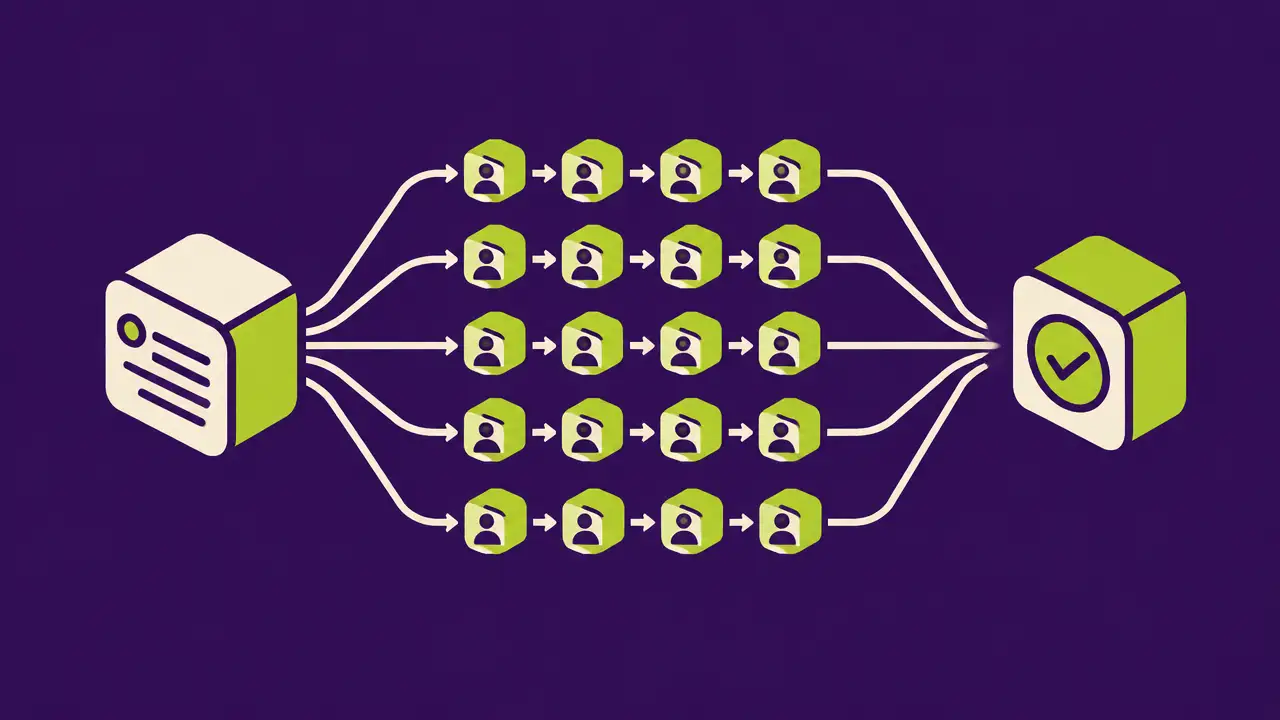
Table of Contents
The first wave of AI in daily development work was autocomplete: one suggestion per line, a chat window beside it, the human at the centre of every keystroke. The second wave looks different. A mandate goes in, several agents work in parallel, one result comes back for review. Assistance becomes execution.
This jump is not a change of tooling but a change in the division of labour. Treat it as faster typing and you gain little. Reshape your workflows around it and turnaround times change noticeably — while the point at which accountability arises moves.
1) What Actually Changed Technically
Three capabilities separate suggestion from execution:
- Tool access: agents read files, run tests, start builds and read their output. That lets them iterate instead of guessing once.
- Decomposition: a lead agent slices a task into subtasks and hands them to specialised sub-agents — each with its own small context.
- Parallelism: independent subtasks run concurrently. Waiting time drops not because the model thinks faster but because several strands run side by side.
The term for this is the agent harness: the orchestration layer that decomposes, launches, monitors, bounds and merges. More in the glossary: Sub-Agents & Agent Harnesses.
2) Why "More Agents" Alone Solves Nothing
The most common disappointment comes from throwing a harness at a process never built for delegation. Typical blockers:
- Unclear task boundaries. Where subtasks overlap, two agents write the same file — and one result silently overwrites the other.
- Missing acceptance criteria. Without tests or measurable goals nobody can say whether a partial result is done. The human becomes a permanent reviewer.
- Permissions by habit. Agents inherit access designed for humans. Every misstep then becomes a potential data incident.
- Cost without a cap. Twenty parallel sub-agents quickly cost more than one carefully guided single agent when nobody sets a budget per subtask.
3) Rebuilding Workflows for Delegation: Four Building Blocks
A) Cut Tasks into Verifiable Units
A delegable subtask has three properties: clear input, clear result, its own check. In practice that means one module, one file, one market, one format — not "the feature".
B) Define Acceptance Before Execution
Before starting, answer "how will we know it is right?". Tests, benchmarks, schema checks, wording rules. Without those criteria, review effort eats every speed gain.
C) Least-Privilege Permissions
Broad read access, narrow write access. Proposals instead of direct changes to production systems. Time-limited credentials, separated per task. Retrofitting this means adding control to a running automation — considerably more expensive.
D) Logging at Subtask Level
Mandate, inputs, tool calls, result, cost — per sub-agent. Without that trail you cannot determine after a failure which strand caused it. With it, automation becomes an evidenced process.
4) What This Means for Marketing and Product Teams
The effect does not stay in engineering. Exactly the tasks that decompose cleanly are everyday work in marketing organisations:
- Localisation across several markets, one strand per market
- Format adaptation across channels and aspect ratios
- Brand compliance checks across large asset volumes
- Research clusters with one source group per agent
The bottleneck therefore moves both upstream and downstream: upstream to clear briefings, downstream to fast, justified selection among many variants — the skill described in the glossary as Differential Evaluation.
5) Where Full Autonomy Is Inappropriate
Autonomy is a setting, not a stance. It is sensibly bounded wherever errors are irreversible:
- binding statements to customers (prices, commitments, deadlines)
- changes to production systems and payment paths
- processing of personal data without filtering
- legally sensitive claims and regulated statements
In these cases the human stays in the approval path — not as a brake but as the party that is liable.
6) A Realistic Four-Week Start
- Week 1: pick a recurring, measurable process. Establish a baseline: turnaround time, error rate, cost.
- Week 2: decompose into three to five verifiable subtasks. Write down acceptance criteria and permissions.
- Week 3: set up the harness, run in parallel, enable logging and cost caps.
- Week 4: compare against the baseline. Decide: expand, refine or drop — with numbers, not impressions.
Conclusion
The step from autocomplete to agent swarms is less a question of model quality than of process design. Cut tasks so they are delegable and verifiable and you gain speed. Skip that and you get faster disorder.
Further reading: why architectural guardrails matter more than pace is covered in Vibe Coding vs. Software Architecture.
Frequently Asked Questions
What is "Full Autonomy Instead of Autocomplete: The Shift to Agentic Engineering" about?
From code suggestions to parallel sub-agents: what changed technically, why "more agents" solves nothing and how teams rebuild workflows for delegation — including permissions, acceptance and cost caps.
What Actually Changed Technically: what matters?
Three capabilities separate suggestion from execution: Tool access: agents read files, run tests, start builds and read their output. That lets them iterate instead of guessing once.
Why "More Agents" Alone Solves Nothing: what matters?
The most common disappointment comes from throwing a harness at a process never built for delegation. Typical blockers: Unclear task boundaries. Where subtasks overlap, two agents write the same file — and one result silently overwrites the other.
A) Cut Tasks into Verifiable Units: what matters?
A delegable subtask has three properties: clear input, clear result, its own check. In practice that means one module, one file, one market, one format — not "the feature".
Related Articles
You might also be interested in these posts
 Strategy
Vibe Coding vs. Software Architecture: Why Governance and Taste Matter More
Unreviewed vibe coding damages mature systems: duplicated logic, broken layers, tests without evidentiary value. Which guardrails actually hold in AI-assisted development — and where the style fits.
 Strategy
The New Bottleneck in IT Organisations: From Implementation to Vision
When implementation takes days instead of months, unclear product vision, slow approvals and missing judgement surface. How teams tier approvals by risk and measure the real bottleneck.
 Strategy
Autonomous Cybersecurity: AI-Assisted Auditing in Daily Practice
Agents review code continuously instead of by sampling: what pattern findings, dependency analysis and fix proposals deliver, where the limits are and which permissions and filters defensive use requires.