Agent Access Without Sharing Passwords
In short
Protected login is not controlled action. A permissions matrix for reading, drafting, editing and publishing in marketing systems.
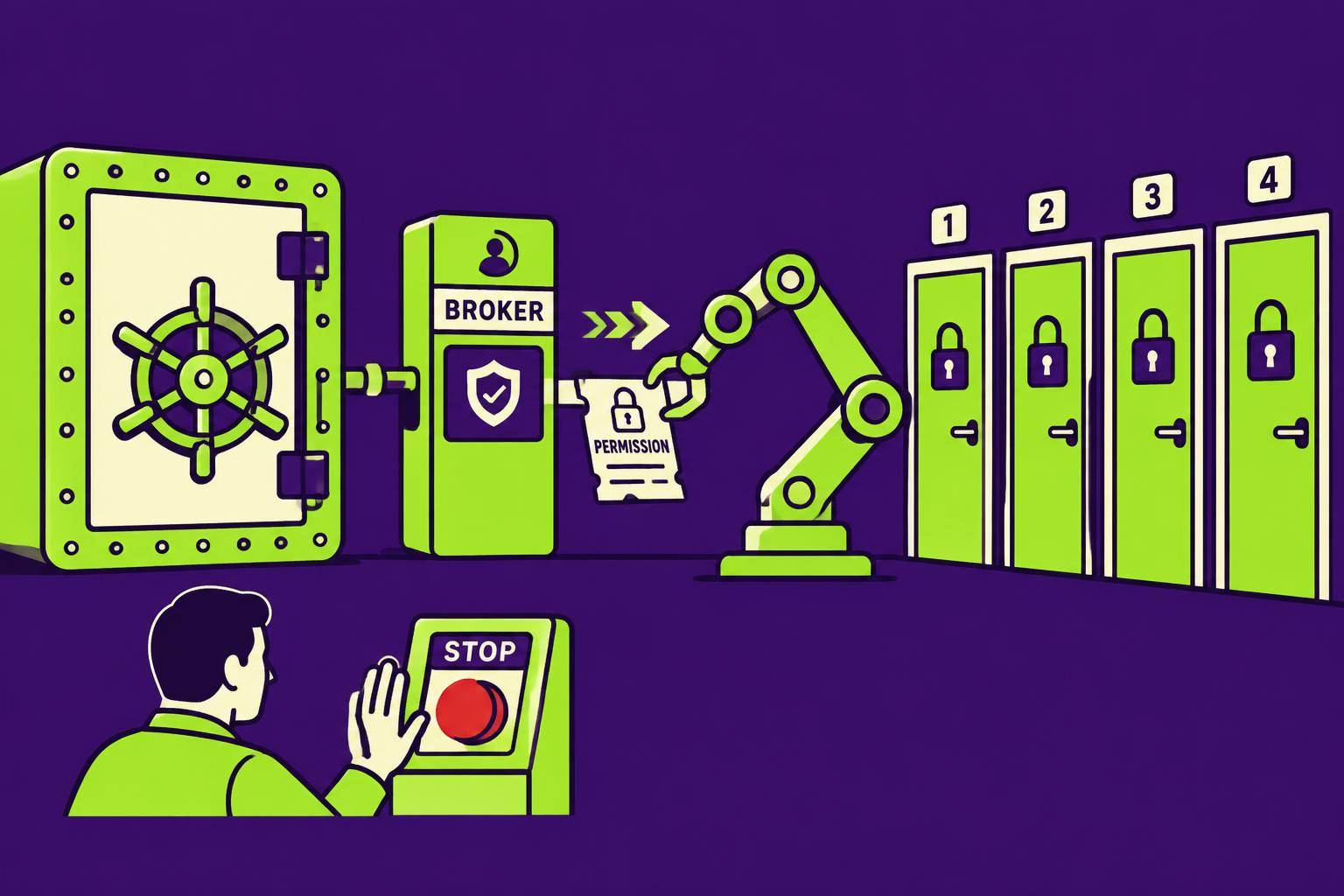
Table of Contents
An agent needs to work in the CMS, but nobody wants to put a password into its prompt. That is a sensible starting point, not the complete security question. Authentication asks how the agent gets in; authorisation asks what it may do once inside. Protecting a password does not prevent an incorrect publication.
What 1Password actually announced
On 22 October 2026 1Password described integrations in which a supported agent requests use of a login. After user approval, credentials are filled directly on the target website; according to the vendor, the agent does not receive the password or one-time code. The 2 November recap separates available integrations from those coming soon. The offering is described for Individual and Family accounts on 1Password.com, not as a generally available enterprise IAM solution.
This illustrates functionally mediated access, explained here as Credential Brokering. It does not establish separate controls for every CMS or advertising action. The requirements below are our integration perspective.
A fictional workflow with a clear boundary
A marketing agent reads existing product pages and prepares revised drafts. The product owner checks claims; an editor publishes. The agent does not need an unrestricted administrator account. If the platform cannot separate drafting from publishing, the integration must enforce that boundary another way or avoid write access.
The permissions matrix
| System | Read | Draft | Edit existing material | Publish / move money |
|---|---|---|---|---|
| CMS | Approved content | Separate draft area | Defined fields after review | Human approval |
| Ad account | Named reports | Suggestions outside the live account | Specific approved changes | Owner decides budgets and launch |
| Customer portal | Task-relevant records | Internal reply template | Task-specific changes only | No blanket approval |
| Asset archive | Approved assets | Variants in a separate folder | Do not overwrite originals | Rights review before distribution |
This matrix is not an out-of-the-box product feature. Check it against actual account permissions and interfaces. A prompt saying “do not publish” is not a technical prohibition.
Five questions before the first login
Identity: Which agent or service acts? Shared credentials make attribution and revocation harder.
Scope: Which resource and action does approval cover? Permission to log in must not silently become consent to execute an entire campaign.
Lifetime: How long does access remain valid? An abandoned task should not leave permanent permission behind.
Evidence: What was requested, approved and executed? Logs should make results traceable without storing passwords or unnecessary personal data.
Revocation: Can the team stop access promptly and inspect consequences? Disconnecting an integration is only useful when already-running work is also considered.
Browser access needs special attention
After login a browser interface may expose many functions the agent does not need. A small click can cause a live change. This differs from a narrowly scoped tool with one defined operation. Test the real signed-in state, including errors and confirmation dialogs.
External pages and documents are untrusted content. Instructions embedded there cannot create new authority. Verify approval for sensitive actions outside that content.
Check whether the boundary holds
Test revoked rights, a wrong target object and a prohibited publication request. Inspect the actual end state. An agent claiming to have stopped may already have made a partial change. Abort handling must identify completed actions.
An incident plan identifies owners, revocation and restoration steps. It does not promise universal undo: some messages or publications cannot be fully recalled.
Creative Engineering needs bounded tools
Human approvals protect creative decisions; controlled integrations protect the production chain. Good integration grants the actions needed for one bounded step, not the largest convenient permission set. Password protection is one component of the operating model, not the whole model.
Sources and context
As of 4 November 2026. Product claims describe vendor statements, not independent evidence of outcomes. The working templates and recommendations are our editorial contribution.
Further reading and next step
Want to review a bounded workflow with us? Describe your project in the Agenten-Pilot. Scope, timing and pricing are agreed after the initial conversation.
Frequently Asked Questions
What is "Agent Access Without Sharing Passwords" about?
Protected login is not controlled action. A permissions matrix for reading, drafting, editing and publishing in marketing systems.
What 1Password actually announced: what matters?
On 22 October 2026 1Password described integrations in which a supported agent requests use of a login. After user approval, credentials are filled directly on the target website; according to the vendor, the agent does not receive the password or one-time code.
A fictional workflow with a clear boundary: what matters?
A marketing agent reads existing product pages and prepares revised drafts. The product owner checks claims; an editor publishes. The agent does not need an unrestricted administrator account.
The permissions matrix: what matters?
This matrix is not an out-of-the-box product feature. Check it against actual account permissions and interfaces. A prompt saying “do not publish” is not a technical prohibition.
Related Articles
You might also be interested in these posts
 Strategy
AI Cybersecurity: Operating Safer Marketing Systems
The PHP incident shows why AI alone cannot protect a business. How marketing and IT can control agent permissions, updates and approvals together.
 Strategy
Sovereign AI Automation: n8n, Make and the EU AI Act
Self-host or EU data centre? Licensing, data location and the new AI Act deadlines after the Digital Omnibus, put into context.
 Strategy
Labelling AI Content: What the EU AI Act Requires — and What It Does Not
Chatbot, avatar, photorealistic image: a clear line on Article 50 transparency duties, plus content credentials and the process behind them.