AI Cybersecurity: Operating Safer Marketing Systems
In short
The PHP incident shows why AI alone cannot protect a business. How marketing and IT can control agent permissions, updates and approvals together.
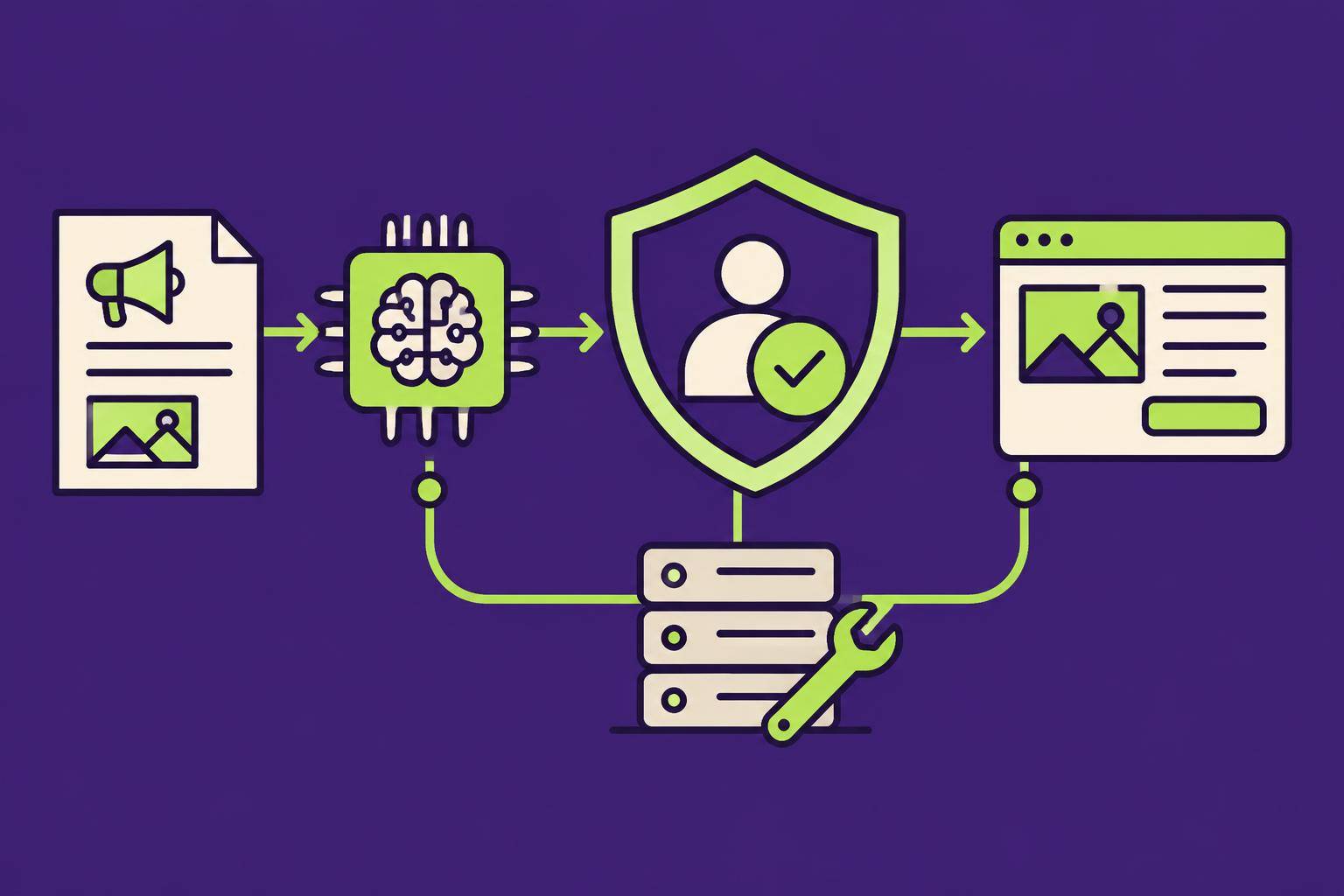
Table of Contents
AI finding a security flaw is not the same as a business becoming secure. The October PHP security releases expose the distance between discovering a vulnerability and actually repairing the systems that depend on it. For AI-powered marketing, that distance is a design and operations problem—not just an IT topic.
The critical moment is between discovery and repair
Finding a vulnerability is a success. Publishing a fix is another. Protection for a particular business begins only when affected systems have been identified, updated and checked.
As AI helps both vulnerability research and potential attackers, the decisive question is not simply who has the strongest model. It is who can turn a warning into a verified repair in time. The October 2026 PHP incident illustrates why marketing leaders should understand the production chain behind their websites, content and agents.
What actually happened with PHP
On 21 October, PHP released security updates for CVE-2026-109618 and CVE-2026-109619. Both can enable unauthenticated remote code execution. The flaws affect PHP's core, beneath the website or application running on it. PHP identifies Apache with mod_php as the highest-risk configuration and describes a demonstrated exploit that acts before application code runs. 1
Fixes for these two vulnerabilities were released in PHP 8.5.12, 8.4.27, 8.3.36 and 8.2.35. Organisations using distribution or long-term-support packages should check their vendor's advisories: backported fixes cannot reliably be judged from an upstream version number alone. PHP says updating is the only complete solution for these two issues; temporary measures mitigate only some attack paths. 1
Important at this article's research date: On 23 October, PHP warned about a further attack path affecting unusual configurations, identified as CVE-2026-115560. On 26 October, Windows packages were rebuilt to address a separate Brotli vulnerability. The 21 October version list is therefore not a blanket statement that every PHP security issue has been resolved. Current PHP and vendor advisories remain authoritative. 1
OpenAI describes coordinated work by researchers, maintainers and security providers under “Patch the Planet”. Wiz also reports AI-assisted discovery. PHP maintainers developed and published the repairs. AI was a tool within coordinated security work, not a replacement for it. 23
The PHP Foundation adds a revealing history: early signs of the out-of-memory problem behind CVE-2026-109618 had been identified in 2024, initially without a concrete exploitation path. Proposed fixes raised compatibility, availability and extension issues, while resources and decision-making mechanisms were insufficient. The Foundation explicitly calls the delay a “structural failure”. That account concerns this particular problem, not the history of both vulnerabilities. 14
Better detection does not automatically resolve difficult maintenance decisions. Effective security also needs people, time and a process capable of implementing repairs despite trade-offs.
A disclosed vulnerability is not proof that every affected system has been breached. An attack attempt is not proof of successful access. Those distinctions matter even when a headline is dramatic.
A defender's advantage is not a guarantee
ARK Invest offers an optimistic interpretation: verified defenders could gain an asymmetric advantage through access to particularly capable AI tools. Initiatives such as OpenAI's Daybreak and Anthropic's expanded Cyber Verification Program aim to make advanced capabilities available for defensive work. Anthropic integrated Project Glasswing into the expanded programme. These are access initiatives, not independent proof that defenders will always win. 425
Amazon Threat Intelligence observed a PHP2Shell exploitation attempt in MadPot telemetry on 17 October—four days before public disclosure. AWS explicitly says it is unclear how the actor obtained advance information or whether the attempts would have succeeded against real systems. This is neither evidence of a widespread breach nor proof that AI generated the attack. It does show why disclosure day should not automatically be treated as the beginning of possible exposure. 6
On 26 October, CISA added both PHP vulnerabilities to its Known Exploited Vulnerabilities catalogue. The risk is therefore not merely theoretical. The listing does not establish a particular theft of data at a named organisation. 13
Our conclusion: an early warning creates a window that an organisation must use. A business can lose that advantage if nobody owns the affected system or its repair.
More disclosed flaws do not automatically mean more successful attacks
Epoch AI examines publicly disclosed high- and critical-severity vulnerabilities from a selection of 21 organisations. Its updated dataset counts approximately 1,550 in June 2026 and 2,500 in July. Ratings and datasets can be revised, changing historical values. Earlier figures should therefore be compared with attention to their data vintage. 7
This is not a census of all vendors or all attacks. More disclosures can reflect better search tools, increased attention, more research or different reporting practices. Timing alone does not establish that new AI models caused the increase; Epoch explicitly discusses these limitations. 7
For a business, the practical question is which of its components is affected, whether it is reachable, what it is authorised to do and whether there is evidence of exploitation—not just how many alerts exist.
Why marketing and IT need to address this together
Modern marketing production connects briefs, models, templates, storage, content-management systems, translation services, analytics tools and publishing channels. Agents add systems that can call tools and trigger actions. Their permissions matter as much as the quality of their answers.
Hypothetical example—not a Davies Meyer client case: An agent reads an external brief, drafts posts and can publish them directly. A document contains hidden instructions that attempt to redirect its actions. That is not a PHP vulnerability. It crosses a trust boundary: a document may supply working material, but it does not acquire authority to approve actions.
OWASP describes such indirect prompt injections. Retrieval from internal knowledge stores and additional model training do not fully eliminate the risk. Defences must go beyond telling a model to ignore manipulative text. 8
OWASP also identifies “Excessive Agency”: too many tools, overly broad permissions or too much autonomy. One especially relevant example is social media: an AI system publishing posts should have an approval process. Permissions must be enforced by connected systems, not merely evaluated by the model. 9
Creative Engineering also means designing authority
Our approach to Creative Engineering is to build the production chain behind creative work as a system. Creative judgement stays with people; variants, formats, languages and distribution become controlled processes.
Security belongs in that same construction. Brand checks assess whether an output fits the brand. Technical authorisation decides whether an action is permitted at all. Human approval assesses a particular publication. These checks do different jobs and cannot substitute for each other.
1. Separate drafting from publishing
An agent that drafts copy does not automatically need publishing rights. Where both capabilities are necessary, separate the steps and explicitly define their permissions. Passing a brand check does not authorise publication. 9
2. Grant access by task
A research tool needs different rights from a publishing system. Credentials do not belong in briefs, model instructions or unprotected logs. OWASP recommends central management, limited access, logging and a managed lifecycle for secrets. Access must be attributable and revocable in an emergency. 10
3. Treat updates as operations
NIST defines patch management as identifying, prioritising, acquiring, installing and verifying updates. An update is not finished until its effective deployment has been checked. Old campaign sites, small automations and rarely used integrations also need a maintenance owner. 11
4. Design approvals around consequences
Not every low-risk intermediate step needs a person. Public publication, a substantial data export or a budget change has different consequences from an internal draft.
Our recommendation is proportionate approval, not the greatest possible number of confirmations: automate bounded, reversible work; review consequential actions. The approver needs to see what will happen, where, and which data or content is affected. “Do you trust this agent?” is not a sufficient decision.
Seven questions for the next CMO–CTO meeting
- Inventory: Which websites, agents, models, integrations and software components belong to the production chain—including older campaigns?
- Ownership: Who monitors advisories, installs updates and verifies their effect? What does a provider cover and what remains our responsibility?
- Access: Which data can each agent read, modify, export or publish? Which rights are actually required?
- Trust boundaries: Can external documents, websites or assets trigger actions they should not authorise?
- Approval: Which actions need a verifiable human decision, and what information does the approver see?
- Prioritisation: Alongside severity, do we consider reachability, business impact and evidence of active exploitation? CISA stresses known exploitation when prioritising repairs. Absence from KEV is not proof of safety. 12
- Recovery: Can we stop a workflow, revoke access, investigate affected systems and roll back supported changes?
The answers do not require a new AI buzzword. They require a shared understanding of actual operations.
A better AI model alone does not make a safer system
The PHP incident shows that AI can support difficult security work. It also shows how little discovery alone tells us about the protection of an individual business.
For marketing organisations, the task is not attaching as many security features as possible to a model. It is understanding and operating the production chain: maintained components, limited rights, verifiable actions and clear ownership.
The advantage does not emerge at the alarm. It emerges at the verified repair.
When planning a marketing agent, describe its boundaries as carefully as its capabilities: data sources, permitted tools, approvals and operations. That is a useful starting point for a bounded agent pilot—not a promise of security.
Sources and editorial context
Starting point: The supplied ARK Invest contribution, “The PHP (Hypertext Preprocessor) Security Scare Highlights AI’s Role On Both Sides Of Cybersecurity”, Newsletter #531, 26 October 2026. This is an independent analysis with a different structure, additional sources and a marketing-production perspective, not a translation of ARK's article. We do not adopt its investment thesis. The supplied text was read; newsletter and title were confirmed through search retrieval. Direct retrieval was restricted.
- PHP project: News Archive 2026. Primary source for the 21, 23 and 26 October advisories, fixes, additional warnings and vendor backports.
- OpenAI, 21 October 2026: Patch the Planet. Provider account of research and coordination, not an independent measurement of defender advantage. Checked through search retrieval; direct access was restricted.
- Wiz, 21 October 2026: PHP2Shell. Participating provider's research report. Its “70% of the Internet” headline is deliberately not used as a risk statistic here.
- ARK Invest, 26 October 2026: Newsletter #531. Starting point and attributed investor perspective.
- Anthropic, 6 October 2026: Expanding the Cyber Verification Program. Access-program announcement, not general proof of security.
- AWS, published 21 October, updated 22 October 2026: PHP2Shell exploitation attempts before disclosure in MadPot. Primary telemetry report; success and the origin of advance information remain uncertain.
- Epoch AI, 2026; data table updated 3 August 2026: Serious cyber vulnerability disclosures kept climbing in July. Selected organisations, public disclosures and revisable ratings—not successful attacks.
- OWASP, 2025 edition: LLM01: Prompt Injection. Risk description and limits of common mitigations.
- OWASP, 2025 edition: LLM06: Excessive Agency. Limits on tools, permissions and autonomy, including social-media publication approvals.
- OWASP, maintained guidance: Secrets Management Cheat Sheet. Credential-management principles; no publication date claimed here.
- NIST, April 2022: SP 800-40 Rev. 4. Patch management as verified preventive maintenance.
- CISA, 3 November 2021: Reducing the Significant Risk of Known Exploited Vulnerabilities. Prioritisation guidance, not a source for current catalogue entries or mandatory obligations on German businesses.
- CISA, updated 26 October 2026: Critical Vulnerabilities in PHP Require Immediate Patching. Confirms both KEV additions; not a victim-specific incident report.
- PHP Foundation, 21 October 2026: Today's PHP security release and how we're strengthening PHP security. Maintainer perspective on history, repair trade-offs, resources and organisational changes.
Frequently Asked Questions
What is "AI Cybersecurity: Operating Safer Marketing Systems" about?
The PHP incident shows why AI alone cannot protect a business. How marketing and IT can control agent permissions, updates and approvals together.
The critical moment is between discovery and repair: what matters?
Finding a vulnerability is a success. Publishing a fix is another. Protection for a particular business begins only when affected systems have been identified, updated and checked.
What actually happened with PHP: what matters?
On 21 October, PHP released security updates for CVE-2026-109618 and CVE-2026-109619. Both can enable unauthenticated remote code execution. The flaws affect PHP's core, beneath the website or application running on it.
A defender's advantage is not a guarantee: what matters?
ARK Invest offers an optimistic interpretation: verified defenders could gain an asymmetric advantage through access to particularly capable AI tools. Initiatives such as OpenAI's Daybreak and Anthropic's expanded Cyber Verification Program aim to make advanced capabilities available for defensive work.
Related Articles
You might also be interested in these posts
 Strategy
Shadow AI & Tool Sprawl: How Marketing Teams Regain Control of AI Chaos
Unapproved AI tools, private accounts, duplicate licenses: how marketing teams detect shadow AI, build a tool inventory, and create governance with fast-lane approvals that don't slow innovation.
 Strategy
AI Liability 2026: Who Pays When the AI Assistant Gives Bad Advice?
Target and Walmart shift liability for AI shopping agents to customers. What this means for companies using AI assistants – including checklist and governance framework.
 Strategy
AI Governance for Marketing Teams: Guidelines, Risks, and Best Practices 2026
How to use AI responsibly in marketing: From EU AI Act compliance to data protection and brand safety guidelines – the complete governance guide for 2026.
AI solutions by Davies Meyer
From an application to the right delivery
Good AI applications need brand knowledge, a clear idea and the right execution. Davies Meyer brings strategy, creativity, content production and technology together. Creative Engineering is our method for making that collaboration repeatable.
We take responsibility for the concept and quality.