SaaS-Pocalypse: What the $300 Billion Shock Reveals About AI Agents
In short
Why AI agents are attacking the SaaS growth model, what the $300 billion sell-off means, and how marketing teams can future-proof their MarTech stack now.
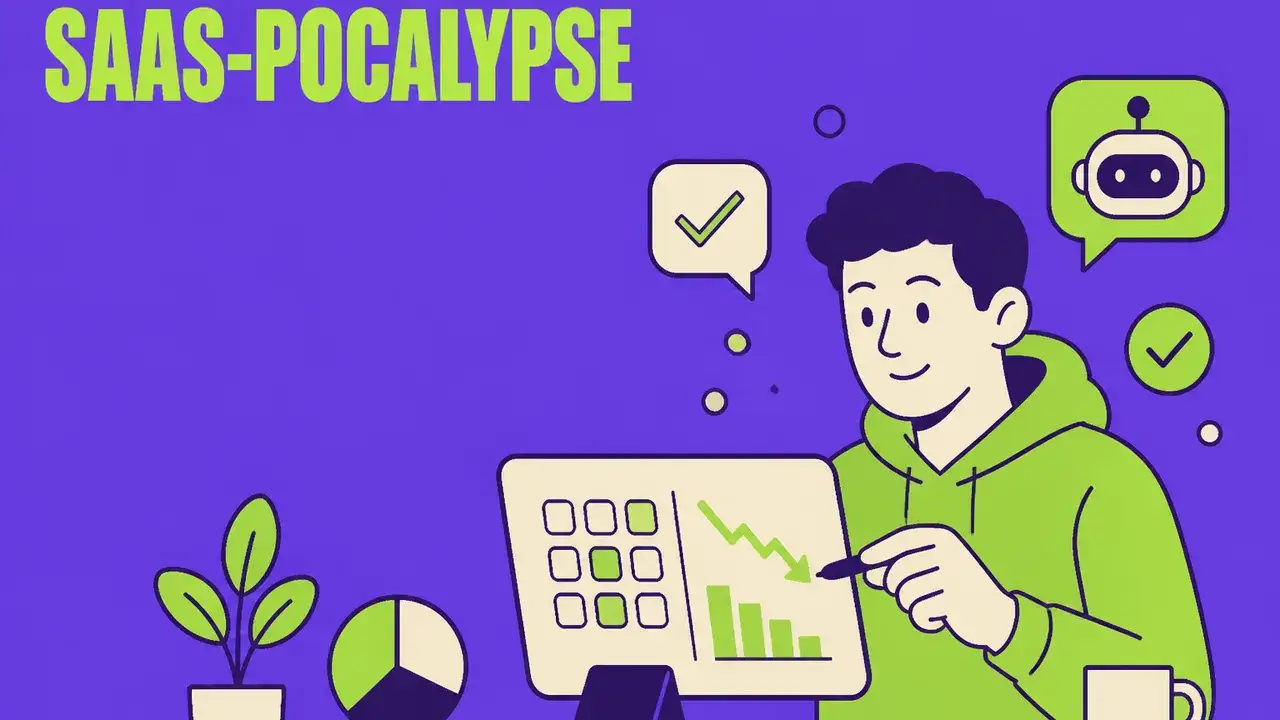
Table of Contents
SaaS-Pocalypse: What the $300 Billion Shock Reveals About AI Agents – and What Companies Should Do Now
On February 3, 2026, a term swept through trading desks and Slack channels: "SaaSpocalypse." Within days, hundreds of billions in market cap were wiped from software and SaaS stocks – not because of a single earnings miss, but because the market suddenly took a new narrative seriously: AI Agents are changing how work gets done – and with it, how software gets paid for.
1) What Just Happened?
Reuters describes the sell-off as an AI-driven revaluation: investors fear that rapidly advancing AI tools could displace entire categories of workflows – with visible price reactions among major software and data providers.
Bloomberg frames the movement as "SaaSpocalypse": a mix of disappointing outlooks, rapidly improving models, and new "agent" capabilities flushed disruption anxiety into the market.
Meanwhile, public data shows how much pressure the sector came under: the iShares Expanded Tech-Software Sector ETF (IGV) traded well below previous highs during this phase (and remains volatile today).
Then came the provocative Forbes frame from Don Muir: "AI didn't kill software. It broke the SaaS growth story." (In essence: it's not that "software is dying," but rather that the previous growth and monetization model is being shaken.)
2) Why Is SaaS Hit So Hard?
Because a large part of SaaS still relies on a simple equation:
More employees at the customer = more seats = more ARR
AI Agents flip this logic:
- When agents take over work, the number of "human seats" using software drops.
- When agents operate software, the UI becomes less important – APIs, data access, and orchestration become more important.
- When output matters more than operation, pricing gets renegotiated: from "per user" to "per outcome / usage / risk / value contribution."
Forrester puts it bluntly: SaaS as we know it is under pressure because the market is betting on a massive shift in how work will be done (and thus what software value remains).
3) What Does This Mean for CMOs, MarTech Leads, and Digital Decision Makers?
In short: Your stack won't get smaller, but different. And tool procurement becomes less "feature comparison," more value contribution per workflow.
Three consequences we're seeing across many teams right now:
A) "Tool Sprawl" Suddenly Gets Expensive
When AI can compress a workflow into an agent loop, individual specialty tools start looking redundant faster. This doesn't mean they're "bad" – but they need to re-prove their place.
B) Differentiation Shifts from "UI" to "System Capability"
Future winners will deliver:
- robust data models,
- clean interfaces,
- governance (permissions, audit, security),
- and an experience that makes both agents and humans productive.
C) Marketing Becomes More of an Operating Unit
When AI accelerates processes, marketing gets measured faster – and pushed harder toward incrementality, efficiency, and output. (Many discussions that used to be "performance vs. brand" are now "automation vs. differentiation.")
4) The 4 Moves That Matter Now (for Vendors and Buyers)
1) From Seat-Pricing to Value-Pricing (Without BS)
The market punishes "seats" because seats depend on humans. Value models can mean:
- usage-based (API calls, tasks),
- outcome-based (e.g., "qualified leads processed"),
- risk-based (e.g., fraud prevention, compliance).
Important: Value must be measurable – otherwise it just looks like a price increase with a different label.
2) Agent-Readiness Becomes a Product Feature
"We also have AI" isn't enough. What matters is:
- What tasks can an agent reliably take over?
- What data can it access?
- What gets logged?
- Where does the human stay in the loop?
3) Consolidation with a Plan: "Systems of Record" Stay – Everything Else Needs to Justify Itself
Many companies won't replace 40 tools in 2026/27. But they'll prioritize harder:
- What's a core system (CRM, ERP, DAM, data layer)?
- What's a replaceable layer?
- Where does an agent across multiple systems make sense?
4) Creative Becomes "the New Targeting" Again
When AI democratizes automation, creativity (idea + story + format logic) becomes an even stronger real advantage. Not in the sense of "beautiful," but as a growth lever that brings performance and brand together.
5) A Pragmatic 30-Day Plan for Marketing Teams
If you're looking at your stack right now wondering "what stays?", do this:
- List your top 10 workflows (lead gen, content ops, reporting, CRM nurture, paid social production, etc.).
- Mark per workflow: Input → Decision → Output. Where is time being wasted today?
- Identify 1 agent pilot that delivers just one clear output (e.g., "briefing → 10 variants → learning loop").
- Build measurement first: Define incrementality/attribution cleanly before you automate.
- Set a governance guardrail: Data access, approvals, logging, brand safety.
The goal isn't "AI everywhere," but AI where it increases throughput and quality simultaneously.
6) Our Take as Creative Engineers
We don't believe in a software ending. We believe in a software redistribution:
- less "interface as product,"
- more "system, orchestration, data intelligence,"
- and more pressure on everyone who has monetized value through seats.
This is exactly where our two core principles come in:
Creative Engineering: Connecting creativity + technology so output scales – without diluting brand voice.
Digital Farming: Data as soil, technology as tools, content as harvest – iterative, measurable, sustainable.
Conclusion
The SaaS-Pocalypse isn't an ending – it's a reset. Those who position their stack today with a focus on agent-readiness, value-pricing, and creative differentiation will have the advantage tomorrow. The question isn't whether things will change – but whether you'll actively shape that change.
Your next step: Do a stack audit with us – workflow map → agent pilot → measurement setup. And yes: with a setup that doesn't make your brand voice "AI-generic." Why lower costs mean more software, not less, is explained in our article on the Jevons Paradox of the AI Era. And how Agentic AI enables autonomous marketing workflows is shown in our hands-on guide.
Frequently Asked Questions
What is "SaaS-Pocalypse: What the $300 Billion Shock Reveals About AI Agents" about?
Why AI agents are attacking the SaaS growth model, what the $300 billion sell-off means, and how marketing teams can future-proof their MarTech stack now.
What Just Happened?
Reuters describes the sell-off as an AI-driven revaluation: investors fear that rapidly advancing AI tools could displace entire categories of workflows – with visible price reactions among major software and data providers.
Why Is SaaS Hit So Hard?
Because a large part of SaaS still relies on a simple equation: More employees at the customer = more seats = more ARR AI Agents flip this logic: When agents take over work, the number of "human seats" using software drops.
What Does This Mean for CMOs, MarTech Leads, and Digital Decision Makers?
In short: Your stack won't get smaller, but different. And tool procurement becomes less "feature comparison," more value contribution per workflow.
Related Articles
You might also be interested in these posts
 Trends & Insights
Creator Commerce Goes Agentic: Product Feeds for the AI Discovery Layer
LTK, TikTok Shop and agentic campaign management: why attribute coverage now beats aesthetics — and how to make invisible losses visible.
 Trends & Insights
SynthID Text: How Invisible Watermarks in AI Text Work
Anthropic brings SynthID watermarking to Claude. What it means for content teams, detectors and compliance.
 Trends & Insights
Abundance Economy: Why AI-Driven Abundance Is Breaking Your Marketing Model — And How to Profit
Energy –99%, diamonds –95%, content production near zero: Peter Diamandis' Abundance thesis meets the Jevons Paradox and structural deflation. Five strategies for marketing teams.