Multimodal AI in Content Marketing: Text, Image, Video, Audio in One Workflow
In short
GPT-5, Gemini 3 and Sora v2 unify text, image, video and audio. How marketing teams build multimodal workflows and revolutionize content production.
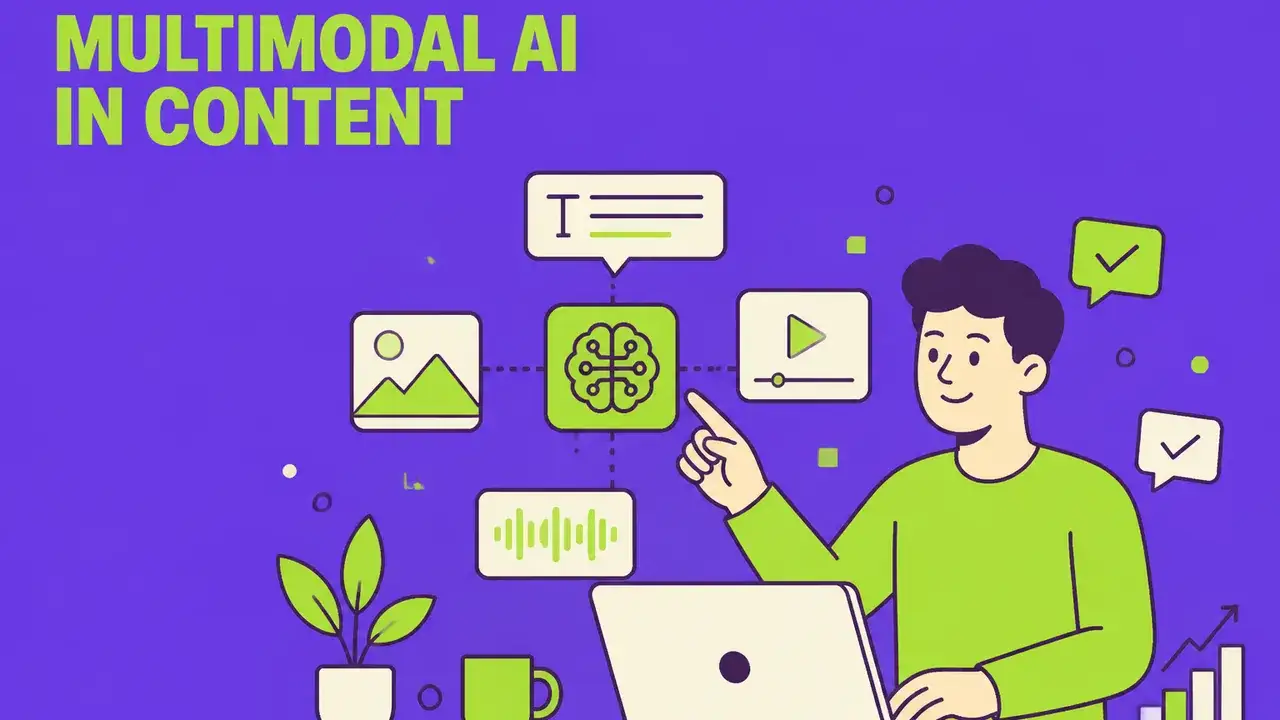
Multimodal AI in Content Marketing: Text, Image, Video, Audio in One Workflow
By July 2026, the content marketing landscape has been fundamentally transformed by the rapid development of multimodal AI models. What once operated as separate disciplines – text creation, image editing, video production, and audio engineering – each with its own tools and specialists, is now increasingly merging into integrated workflows. The current generation of AI models such as GPT-5.6, Google Gemini 3.6 Flash, Veo 3.1, Kling 3.0, and specialized audio tools enables more connected creation and optimization of content across media formats. This development not only boosts efficiency but also unlocks entirely new creative possibilities and strategic approaches for content marketers.
The Evolution of Multimodal AI Models
The first generations of AI in content marketing primarily focused on text generation. Tools like GPT-3 or GPT-4 revolutionized text creation and the automation of SEO-relevant content. However, the true breakthrough came with the ability of models to not only process and generate text but also to understand and interpret images, videos, audio, and code. This is known as multimodality – the integration of various data streams and sensory perceptions, comparable to human cognition.
GPT-5.6: OpenAI's GPT-5.6 family offers a context window of 1.05 million tokens and supports outputs of up to 128,000 tokens. GPT-5.6 Sol is the flagship tier, while Terra balances performance and cost and Luna is designed for lower-cost, faster workloads. For content marketing, these models can, for instance, analyze large volumes of campaign material, website content, briefs, and structured data to suggest optimizations, generate detailed descriptions, or help create code-based content experiences. New reasoning modes such as max and ultra enable deeper deliberation, although their cost and latency characteristics are not documented.
Google Gemini 3.6 Flash: Google's Gemini 3.6 Flash combines a 1 million token context window with Flash-class latency and strong search-grounding capabilities. It is designed for efficient work across complex information sources and is particularly useful where marketing teams need to analyze large collections of text, visual material, transcripts, and campaign data. For content marketers, Gemini can support campaign planning, SEO analysis, text creation, research-grounded content development, and the summarization of long video sequences or transcripts.
Veo 3.1 and Kling 3.0: Video generation has increasingly democratized video production. Veo 3.1 supports native dialogue audio and 4K output, while Kling 3.0 provides longer clips, native 4K motion, and low-cost video generation. What once required expensive equipment, professional teams, and weeks of production time can now be prototyped much faster with AI-supported workflows. For marketing teams, this means they can quickly test various video approaches, create personalized video ads, or develop explanatory animation concepts without always requiring a conventional production setup.
Audio Production Tools: In the realm of audio content, AI-assisted audio tools increasingly support the creation of voiceovers, podcasts, audio ads, and localized content. Synthetic voices can help teams create scalable spoken content and adapt material for different markets. However, quality assurance, consent, brand safety, and rights management remain essential when using voice generation or voice-cloning capabilities.
Integrated Workflows in Content Marketing
The true power of these multimodal AI models unfolds when they work together in integrated workflows. We are no longer talking about isolated solutions, but about seamlessly linked steps that cover an entire content production chain. The concept of Agentic AI, where autonomous agents take on specific tasks and communicate with each other, plays a crucial role here. Equally important is the Model-Context-Protocol (MCP), which ensures that the various AI models maintain a consistent context and a deep understanding of brand identity and communication goals.
An exemplary integrated workflow could look like this:
- Market Analysis and Strategy Formulation (GPT-5.6/Gemini 3.6 Flash): Starting with a comprehensive analysis of market trends, competitive activities, and target audience needs, utilizing GPT-5.6 for large-scale content analysis and Gemini 3.6 Flash for efficient, search-grounded research. The AI identifies content gaps, top-performing formats, and drafts initial content strategy proposals.
- Content Conception and Outline (Gemini 3.6 Flash/GPT-5.6): Based on the strategy, Gemini 3.6 Flash generates detailed content outlines for blog articles, video scripts, social media posts, and podcast episodes. GPT-5.6 can support visual concepts for graphics or video mood boards.
- Text Generation (GPT-5.6/Gemini 3.6 Flash): The core content, be it an extensive blog post, website text, or a script, is created by GPT-5.6 or Gemini 3.6 Flash. SEO optimizations, semantic structure, and brand-specific requirements can be integrated into the workflow.
- Visual Asset Creation (Gemini 3.1 Flash Image/Veo 3.1/Kling 3.0):
- Images: For blog posts or social media, Gemini 3.1 Flash Image, also known as Nano Banana 2, can generate fitting images, infographics, or illustrations based on text and brand guidelines. Nano Banana 2 Lite and Nano Banana Pro are also available for image-generation workflows.
- Videos: For social media or the website, short videos or explainer videos can be generated by Veo 3.1 or Kling 3.0. Text scripts can be transformed into videos with desired scenes, characters, dialogue, and camera movements. Existing material can also be incorporated into AI-assisted editing workflows.
- Audio Production:
- Voiceover: Generated video scripts or blog texts can be converted into high-quality voiceovers using suitable AI audio tools. Teams can use different speaker voices or develop a consistent brand voice where rights and consent are clearly managed.
- Podcasts: Audio snippets can be assembled into podcast episodes, including jingles and suitable background music, supported by AI-assisted production tools.
- Localization and Personalization (GPT-5.6/Gemini 3.6 Flash): The entire content stack – text, image, video, and audio – can be translated and localized for different markets. GPT-5.6 and Gemini 3.6 Flash can adapt content to specific target audience segments or user profiles to achieve greater relevance, while human review ensures cultural and brand accuracy.
- Performance Analysis and Optimization (Gemini 3.6 Flash): After publication, Gemini 3.6 Flash can support the monitoring of content performance across channels. It analyzes interaction rates, conversions, and user feedback, and proposes data-driven optimizations that are then fed back into the multimodal workflow to iteratively improve content.
Challenges and Solutions
While the advantages are obvious, multimodality also presents challenges:
- Quality Assurance and Consistency: The sheer volume of generated content requires robust quality control mechanisms. The MCP is crucial here to ensure brand guidelines and tone are maintained across all media. Human oversight remains essential.
- Interoperability of Models: Seamless communication between different AI models requires standardized interfaces and protocols. This calls for frameworks and platforms that enable such integration.
- Ethics and Copyright: Questions of authorship, misuse, deepfakes, data provenance, and consent remain central points of discussion. Companies must develop clear guidelines for the ethical use of AI.
- Complexity in Implementation: Building such integrated workflows requires specialized knowledge and the ability to manage complex AI systems. Not every company possesses these internal capabilities.
The Role of the Content Marketer in the Era of Multimodal AI
The role of the content marketer is shifting from a pure creator to a strategist, operator, and curator. Instead of producing individual content pieces, the marketer focuses on:
- Prompt Engineering and AI Control: The ability to formulate precise and effective prompts to optimally guide the AI and achieve desired results becomes a core competency.
- Strategic Alignment: Defining goals, target audiences, and brand messages that the AI then implements in various formats.
- Quality Control and Ethics: Reviewing AI-generated content for accuracy, tone, brand compliance, rights, consent, and ethical standards.
- Creative Vision: AI is a tool. Human creativity and the ability to think of new approaches and develop disruptive ideas remain irreplaceable.
- Integration and Workflow Management: Understanding the technical possibilities and managing integrated AI workflows.
Conclusion
Multimodal AI models such as GPT-5.6, Gemini 3.6 Flash, Gemini 3.1 Flash Image, Veo 3.1, and Kling 3.0 have ushered content production into a new era. The integration of text, image, video, and audio into a single, coherent workflow enables unprecedented efficiency, scalability, and creativity. Companies that strategically deploy these technologies can significantly transform their content marketing efforts and gain a crucial competitive advantage. The key is not just to understand the individual models but to skillfully integrate them into a connected system, maintaining human expertise as the strategic and creative guiding institution.
So unterstützt Davies Meyer: As an experienced AI marketing agency, we assist you with strategy development, implementation, and optimization of multimodal AI workflows to transform your content production and achieve sustainable success. Contact us to learn more about our tailored solutions.
Frequently Asked Questions
What is "Multimodal AI in Content Marketing: Text, Image, Video, Audio in One Workflow" about?
GPT-5, Gemini 3 and Sora v2 unify text, image, video and audio. How marketing teams build multimodal workflows and revolutionize content production.
Multimodal AI in Content Marketing: Text, Image, Video, Audio in One Workflow: what matters?
By July 2026, the content marketing landscape has been fundamentally transformed by the rapid development of multimodal AI models. What once operated as separate disciplines – text creation, image editing, video production, and audio engineering – each with its own tools and specialists, is now increasingly merging into integrated workflows.
The Evolution of Multimodal AI Models: what matters?
The first generations of AI in content marketing primarily focused on text generation. Tools like GPT-3 or GPT-4 revolutionized text creation and the automation of SEO-relevant content.
Integrated Workflows in Content Marketing: what matters?
The true power of these multimodal AI models unfolds when they work together in integrated workflows. We are no longer talking about isolated solutions, but about seamlessly linked steps that cover an entire content production chain.
Related Articles
You might also be interested in these posts
 Tools & Technology
Grok Bot: xAI's AI Teammates With Their Own Computer
In beta since 11 August 2026: bots with their own cloud computer sign in to your tools and finish tasks. What that means for marketing, permissions and Grokipedia.
 Tools & Technology
Agentic Ad Buying via MCP: Governance Before Speed
X's advertiser MCP and Agentforce let agents buy media directly. Budget caps, approval thresholds, prompt-injection defence and incrementality — the practical frame.
 Tools & Technology
ChatGPT Ads 2026: Custom Audiences, Formats and What Actually Works
New markets, a 25,000-user minimum for custom audiences, sponsored suggestions: how to plan advertising inside the chat interface.