AI Influencers vs. Creators 2026: Pricing, Duties, Practice
In short
Virtual personas push fees down, new laws force disclosure. How brands should plan their creator mix.
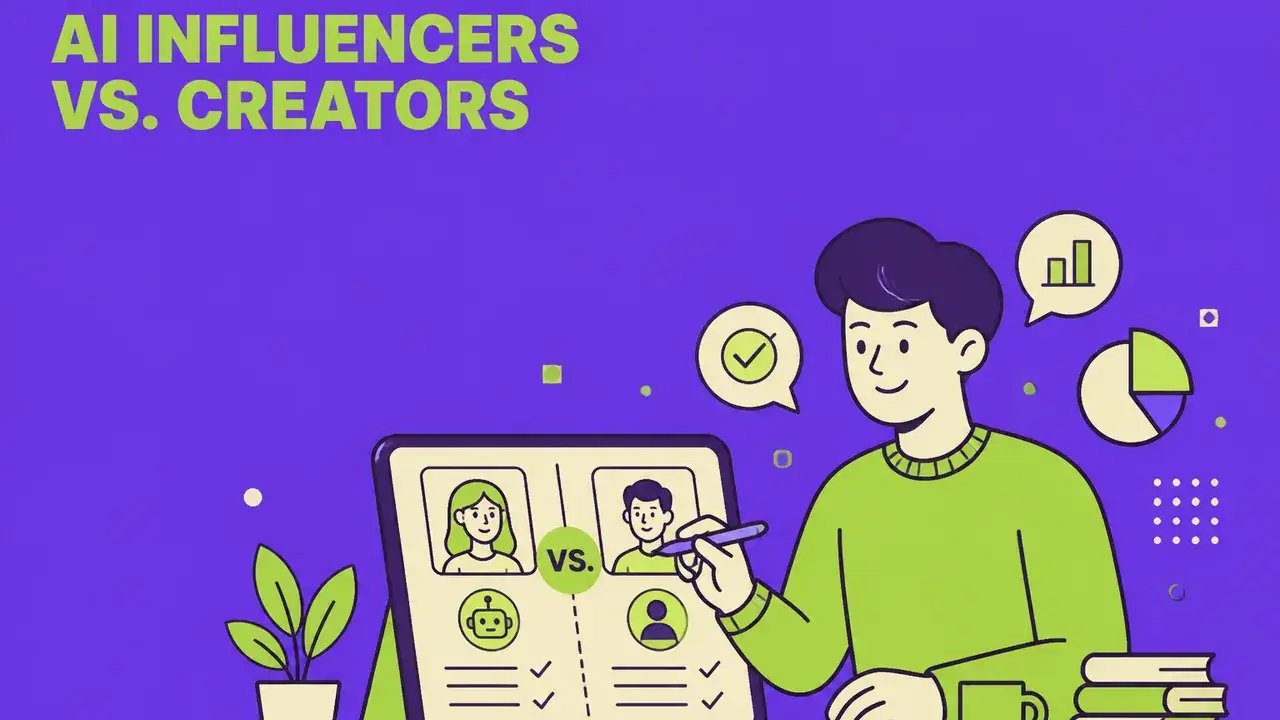
AI Influencers vs. Creators 2026: Pricing, Duties, Practice
The landscape of influencer marketing is undergoing a significant transformation, driven by the rapid evolution of artificial intelligence. As of August 2026, brands face a complex decision-making process when allocating budgets between human creators and their synthetic counterparts. The emergence of AI-generated personas offers new avenues for scalability and cost efficiency, yet it simultaneously introduces novel legal and ethical considerations, alongside quantifiable differences in audience engagement and trust. Marketing leaders must navigate these shifting dynamics to optimize their creator mix and maintain authentic brand connections.
This article provides a detailed analysis of the current state of AI influencers versus human creators, focusing on pricing mechanisms, evolving legal obligations, and practical implications for brand strategy. We will delve into how recent legislative changes, particularly in New York and the EU, are reshaping disclosure requirements and operational paradigms. Understanding these nuances is crucial for CMOs and marketing leads looking to formulate resilient and compliant creator strategies that leverage AI's potential without compromising brand integrity or consumer trust.
The New Legal Framework: Mandatory Disclosure and Transparency
The regulatory environment for AI-generated content has matured significantly by mid-2026, impacting how brands can deploy virtual personas. These regulations are designed to ensure transparency and combat potential deception, particularly regarding the authenticity of digital content and its human or AI origin.
Firstly, a new law effective June 2026 in New York mandates explicit disclosure for all fully AI-generated creator content. This legislation requires clear labeling, ensuring that consumers are aware when they are interacting with an artificial entity or content not produced by a human. Non-compliance carries significant penalties, including fines and reputational damage, making strict adherence critical for brands operating in or targeting this market.
Secondly, the European Union's regulatory framework, particularly Article 50 of the EU AI Act, further solidifies these requirements. Effective August 2, 2026, Article 50 necessitates that providers of AI systems generating synthetic audio, image, video, or text content explicitly disclose that the content has been artificially generated or manipulated. This applies broadly across member states and impacts any brand engaging with AI influencers within the EU. The German legal term for this obligation is "Kennzeichnungspflicht" (labeling obligation), which signifies the legal duty to identify AI-generated content. Marketers must integrate these disclosures prominently and unambiguously, for instance, through clear textual overlays, watermarks, or dedicated disclaimers within posts and bios. Failure to comply with these provisions can lead to significant regulatory fines, potentially up to €30 million or 6% of global annual turnover, whichever is higher, as stipulated by the EU AI Act for certain non-compliance categories. For a deeper dive into the practical implications of these regulations, refer to our analysis on the EU AI Act in Praxis for Marketing 2026.
These regulations collectively establish a new baseline for transparency. Brands must now implement robust internal processes to identify and label AI-generated content effectively, ensuring that their creative teams and external agencies are fully aware of and compliant with these legal obligations. This extends beyond simple disclosure to encompass the technical infrastructure that supports content provenance, such as C2PA content credentials, which are gaining traction as a standard for digital media authentication.
The AI Persona Pricing Floor: Cost Dynamics and Market Impact
The introduction of AI influencers has undeniably altered the economic dynamics of the creator economy. Unlike human creators, virtual personas do not demand a living wage, travel stipends, or personal amenities, fundamentally shifting the cost structure. This has led to what we term the "AI Persona Pricing Floor."
This floor represents a new baseline for content creation costs, as AI-generated personas can be commissioned at significantly lower rates compared to their human counterparts, especially for tasks involving standardized content generation, repetitive posting schedules, or localized adaptations across multiple markets. For instance, a basic campaign involving static images and templated text posts from an AI influencer might cost 30-50% less than a comparable human creator campaign, depending on the complexity of the AI persona's development and maintenance. The ability to rapidly scale content production without the human logistical overhead is a key driver here.
However, it is crucial to recognize that this pricing floor does not universally depress human creator rates. Instead, it segments the market. Human creators who offer unique skills – genuine authenticity, nuanced emotional expression, real-world experiences, and established, deeply engaged communities – can continue to command premium rates. The AI Persona Pricing Floor primarily affects the lower and mid-tiers of the creator market, where content generation is often more commoditized and less reliant on genuine human connection.
Comparative Cost Factors: AI vs. Human Creators
| Factor | AI Influencer (GPT-5.6 Sol, Claude Opus 5, etc.) | Human Creator (Micro to Macro) |
|---|---|---|
| Development/Setup | High initial investment (3D modeling, voice synthesis, AI engine integration, brand identity design) | Minimal (personal branding, social media presence) |
| Per-Campaign Fees | Lower than human; often project-based or subscription (e.g., $500-$5,000 per standardized campaign) | Variable (e.g., Micro: $200-$2,000; Macro: $5,000-$50,000+ per campaign) |
| Content Production | Scalable, fast, consistent. Generative AI models like Veo 3.1 or Kling 3.0 enable rapid video output. | Limited by human capacity, time, and resources. Variable quality. |
| Logistics/Overhead | Near zero (no travel, wardrobe, personal management) | Significant (travel, accommodation, styling, agent fees) |
| Revision Cycles | Automated, rapid iteration based on prompt adjustments | Human-dependent, slower, potential for misinterpretation |
| Audience Engagement | Weaker community signals, lower trust values. Engagement often driven by novelty. | Stronger, authentic community signals, higher trust. Engagement based on genuine connection. |
| Legal Compliance | Focus on AI disclosure (New York law, Art. 50 EU AI Act), IP for persona/training data. | Focus on advertising disclosure, brand guidelines. |
| Long-Term ROI | Cost-effective for volume, controlled messaging. Lower conversion rates on high-trust items. | Higher conversion potential for high-trust products, authentic advocacy. |
Brands must meticulously evaluate their objectives. If the goal is high-volume, consistent, and controlled messaging, AI personas offer significant cost efficiencies. For campaigns requiring deep emotional resonance, genuine endorsements, or direct audience interaction that builds long-term trust, human creators remain indispensable despite higher costs.
Community Signals and Trust Values: The AI Deficit
One of the most critical distinctions between AI influencers and human creators lies in their ability to generate strong community signals and cultivate trust. While AI personas like those generated via advanced models such as GPT-5.6 Terra or Claude Opus 5 can produce highly realistic and engaging content, they inherently deliver "weaker community signals and trust values."
This deficit stems from several fundamental characteristics:
- Lack of Genuine Experience: AI personas cannot genuinely experience a product, embody a lifestyle, or relate personal anecdotes in the same way a human can. Their "experiences" are synthetic, derived from vast datasets, but lack the subjective, lived reality that resonates deeply with audiences.
- Perceived Authenticity: Despite sophisticated rendering (e.g., using Veo 3.1 for video or Kling 3.0 for realistic imagery), consumers often perceive AI content, once disclosed, as less authentic. The mandatory disclosure laws reinforce this perception, making it clear that the interaction is with a machine, not a person with agency and feelings.
- Community Building: Human creators build communities through direct interaction, shared vulnerabilities, and the development of parasocial relationships. AI influencers, while capable of automated responses (e.g., using fine-tuned Gemini 3.6 Flash for comment replies), cannot replicate the nuanced, empathetic, and spontaneous human connection that fosters true loyalty and advocacy. Their engagement often remains transactional or novelty-driven.
- Trust as Currency: Trust is the most valuable currency in influencer marketing. Consumers trust human recommendations because they believe the creator genuinely uses and believes in the product. This trust translates directly into higher conversion rates and brand loyalty. AI personas, by their very nature, cannot "trust" a product, nor can they inspire the same level of implicit trust in their audience.
For brands, this means carefully segmenting campaign objectives. For product launches requiring broad awareness, consistent messaging, or reaching niche demographics efficiently with controlled content, AI influencers can be highly effective. For campaigns requiring deep engagement, authentic reviews, advocacy for sensitive products, or building long-term brand affinity through genuine connection, human creators are unequivocally superior. This split indicates that AI influencers are better suited for "lower-funnel" activities focused on awareness and standardized information dissemination, while human creators excel in "mid-to-upper-funnel" activities focused on consideration, preference, and advocacy.
Crafting a Hybrid Creator Mix: The Strategic Imperative
Given the distinct advantages and disadvantages of both AI influencers and human creators, the optimal strategy for most brands in 2026 involves a hybrid creator mix. This approach leverages the strengths of each, mitigating weaknesses and maximizing overall campaign effectiveness and ROI.
Steps to Develop an Effective Hybrid Creator Mix:
-
Define Clear Campaign Objectives:
- Awareness & Reach: For broad, rapid dissemination of information or product launches, AI influencers (due to scalability and cost-efficiency) can be primary.
- Trust & Conversion: For nuanced storytelling, product demonstrations requiring genuine testimonials, or fostering deep brand loyalty, human creators are essential.
- Niche Targeting: AI personas can be rapidly generated and customized for hyper-specific demographics or interests where human creators might be scarce or prohibitively expensive.
-
Segment Audience and Content Needs:
- Identify which segments of your target audience respond best to authentic human interaction versus novelty or factual information from a virtual entity.
- Determine content types: AI is strong for standardized visuals, short video loops, and text-heavy posts. Humans excel at long-form narratives, emotional content, and live interactions.
-
Allocate Budget Strategically:
- Leverage the "AI Persona Pricing Floor" for high-volume, low-cost content. This frees up budget for more impactful, higher-cost human creator collaborations.
- Consider the total cost of ownership: AI development and maintenance vs. human creator fees and management. For more on ROI tracking, explore our services in Data & Analytics.
-
Implement Robust Disclosure Protocols:
- Integrate mandatory disclosure for all AI-generated content across all platforms. This means clear labels like "AI-Generated Content" or "[AI]" in captions, bios, and visual overlays.
- Educate internal teams and external partners on legal requirements (New York law, EU AI Act Art. 50). This should be a non-negotiable part of every AI influencer campaign brief.
-
Establish Clear Contractual Agreements:
- For AI personas, contracts must explicitly address ownership of the persona, usage rights, modification rights, and the handling of the training data. This prevents future disputes over IP or brand association.
- For human creators, standard contracts apply, but with added clauses for content authentication (e.g., C2PA compliance where applicable).
-
Monitor Performance Differentially:
- Track key performance indicators (KPIs) separately for AI and human creator campaigns. AI campaigns might excel in reach and impressions per dollar, while human campaigns might lead in engagement rate, sentiment, and conversion rate.
- Analyze qualitative data: Community sentiment towards AI influencers vs. human creators. Are discussions around AI personas positive or are they dominated by skepticism?
By meticulously planning and executing a hybrid strategy, brands can achieve both efficiency and authenticity, adapting to the dynamic creator landscape of 2026. For assistance in developing comprehensive campaign strategies, our Campaigns & Media services offer tailored solutions.
Legal and Contractual Safeguards: Protecting Brand and Persona
The rapid integration of AI influencers introduces complex legal challenges that demand proactive contractual and operational safeguards. Beyond basic disclosure, brands must meticulously address intellectual property, data rights, and potential liabilities.
Key Contractual Considerations for AI Influencer Engagements:
-
Persona Ownership and Licensing:
- Clearly define who owns the AI persona: Is it the brand, the AI development agency, or a third-party platform? In most cases, brands should aim for full ownership or an exclusive, perpetual, and transferable license.
- Specify usage rights: Where can the persona appear? For what duration? Can the brand modify the persona's appearance or "personality"? This includes rights to use the persona across different platforms and for various campaign types.
-
Training Data Rights and Provenance:
- The creation of AI personas often involves training on vast datasets. Brands must ensure that the underlying training data used to create their AI persona was legally sourced and that no intellectual property infringements or privacy violations occurred.
- Demand assurances and indemnification clauses from AI development partners regarding the legality and ethical sourcing of training data. Understand the risks associated with potential biases or undesirable characteristics embedded within the training data that could manifest in the persona's behavior or content.
-
Content Ownership and Usage:
- Who owns the content generated by the AI persona? Typically, the brand should retain full ownership and perpetual usage rights for all content produced under its direction.
- Address the "chain of title" for AI-generated content. With models like GPT-5.6 Sol or Claude Opus 5 synthesizing content, ensuring clear ownership from the prompt to the final output is crucial for future commercial exploitation.
-
Liability and Brand Reputation:
- Include indemnification clauses that protect the brand from liabilities arising from the AI persona's actions or generated content (e.g., misinformation, offensive output, accidental IP infringement).
- Establish clear protocols for content moderation and rapid response in case an AI persona generates problematic content. While AI models are advanced, they are not infallible.
-
Compliance with Disclosure Laws:
- Mandate contractual clauses requiring the AI development partner or platform to assist the brand in complying with all relevant disclosure laws (e.g., New York's law, Art. 50 EU AI Act). This includes technical implementation of labels or metadata. For more on the role of technical content credentials, see our article on C2PA Content Credentials and AI Labeling.
By addressing these intricate legal and contractual elements proactively, brands can safeguard their investments, mitigate risks, and maintain control over their AI-driven marketing assets. Ignoring these aspects can lead to costly legal disputes and significant damage to brand reputation.
Performance Tracking and Optimization: Beyond Vanity Metrics
Effective utilization of both AI influencers and human creators requires a nuanced approach to performance tracking and optimization, moving beyond traditional vanity metrics. The distinct characteristics of each creator type necessitate tailored evaluation frameworks.
Key Metrics and Methodologies:
-
AI Influencers: Efficiency and Controlled Messaging:
- Reach & Impressions (Cost-Optimized): Focus on cost per thousand impressions (CPM) and total reach, as AI personas excel at distributing standardized messages widely and affordably.
- Content Consistency & Brand Alignment: Evaluate adherence to brand guidelines, tone of voice, and messaging accuracy across multiple outputs. AI's strength is its ability to maintain perfect consistency.
- Click-Through Rate (CTR) for Specific Actions: Track CTR on links embedded in AI-generated content, especially for direct response campaigns where novelty might drive initial clicks.
- Sentiment Analysis (for basic recognition): While AI lacks emotional depth, advanced NLP models (e.g., based on Claude Sonnet 5 or Fable 5) can gauge whether the content is perceived positively or negatively, helping to refine prompts.
- A/B Testing Scalability: Leverage AI to rapidly generate multiple content variations for A/B testing, optimizing for headlines, visuals, and calls to action at scale.
-
Human Creators: Trust, Engagement, and Conversion:
- Engagement Rate (Authenticity-Driven): Go beyond likes; measure comments, shares, saves, and the quality of discussion. Authentic engagement is a key indicator of trust and community health.
- Sentiment & Brand Association (Qualitative Depth): Conduct qualitative analysis of comments and mentions. Are followers discussing the product genuinely? Is the creator's personality enhancing brand perception?
- Conversion Rate (Direct Impact): Track conversions directly attributable to human creator content, as their recommendations often carry more weight. This includes sales, sign-ups, or app downloads.
- Audience Demographics & Psychographics: Ensure the creator's audience aligns authentically with the brand's target, leading to more qualified leads and conversions.
- Long-Term Brand Loyalty & Advocacy: Monitor repeat purchases, brand mentions, and user-generated content inspired by human creators. This signifies enduring impact beyond a single campaign.
-
Hybrid Mix Optimization:
- Attribution Modeling: Employ sophisticated attribution models to understand the synergistic effects of combining AI and human creator efforts. Does AI-driven awareness amplify the conversion power of human creators, or vice-versa?
- Feedback Loops: Use insights from human creator interactions (e.g., common questions, pain points) to refine AI persona content, making it more relevant and responsive. Conversely, use AI-generated trend analysis to inform human creator briefs.
- Scenario Planning: Model different budget allocations between AI and human creators to predict outcomes and optimize ROI. This requires robust analytics capabilities, for which our Data & Analytics services can provide support.
The ultimate goal is to understand not just what each creator type delivers, but how they contribute to overall marketing objectives, leveraging their distinct strengths for a more comprehensive and resilient marketing strategy.
Fazit
The year 2026 marks a pivotal moment in the evolution of influencer marketing, where AI-generated personas have moved from experimental concepts to viable, albeit distinct, components of a comprehensive creator strategy. The regulatory landscape, specifically the New York disclosure law and Article 50 of the EU AI Act, mandates an unprecedented level of transparency regarding AI-generated content. This legal framework, coupled with the inherent differences in cost structure, community engagement, and trust signals, necessitates a sophisticated approach from brands. The "AI Persona Pricing Floor" offers undeniable cost efficiencies and scalability for certain campaign objectives, particularly those focused on broad reach and consistent messaging. However, it cannot replicate the authentic connection, emotional resonance, and deep trust that human creators foster within their communities, which remain paramount for driving genuine advocacy and high-value conversions.
For CMOs and marketing leads, the strategic imperative is clear: develop a thoughtful, hybrid creator mix. This involves meticulously defining campaign objectives, segmenting audiences, and allocating resources to leverage the complementary strengths of both AI and human creators. Crucially, brands must embed robust legal and contractual safeguards from the outset, addressing persona ownership, data rights, and clear disclosure protocols to protect against reputational and regulatory risks. By embracing a data-driven approach to performance tracking and continuously optimizing the interplay between AI and human talent, brands can navigate this complex environment, achieving both efficiency and authenticity in their marketing efforts.
Frequently Asked Questions
How do AI influencers change fee structures?
They set a pricing floor: for purely product-centric, repeatable formats market rates drop, because a persona can produce around the clock and in multiple languages. Premium pricing survives where reach is tied to genuine community bonds, credibility, and live interaction.
Do AI influencers have to be disclosed?
Yes. In the EU, AI Act transparency duties for synthetic content and AI interaction apply on top of standard advertising disclosure; in the US, FTC rules tighten disclosure further. Practically: label in the creative, in the profile, and in the campaign description.
Where do human creators still outperform?
On trust signals: comment quality, referrals, community response rate, and conversion in considered-purchase categories. AI personas often deliver solid reach and CPMs but weaker trust and retention metrics in the lower funnel.
What does a sensible hybrid creator mix look like?
A workable split has AI personas cover scalable awareness, product, and localisation formats while human creators handle testimonials, experience reports, and community formats. Contracts should explicitly govern rights to the persona, voice, and reuse.
Related Articles
You might also be interested in these posts
 Strategy
Labelling AI Content: What the EU AI Act Requires — and What It Does Not
Chatbot, avatar, photorealistic image: a clear line on Article 50 transparency duties, plus content credentials and the process behind them.
 Strategy
EU AI Act Article 50: What Marketing Must Label Since 2 August 2026
Chatbots, synthetic media, deepfakes: transparency duties in practice – with a decision tree and ready-to-use wording.
 Strategy
Shadow AI & Tool Sprawl: How Marketing Teams Regain Control of AI Chaos
Unapproved AI tools, private accounts, duplicate licenses: how marketing teams detect shadow AI, build a tool inventory, and create governance with fast-lane approvals that don't slow innovation.