Hermes 4 vs OpenClaw: Brain vs Body — The Honest Open-Source Comparison for Marketing Teams
In short
Hermes 4 is an open-weights LLM, OpenClaw is an agent framework — they don't compete, they combine. Architecture, benchmarks, costs (~80% savings vs Claude+Zapier), and 3 marketing scenarios.
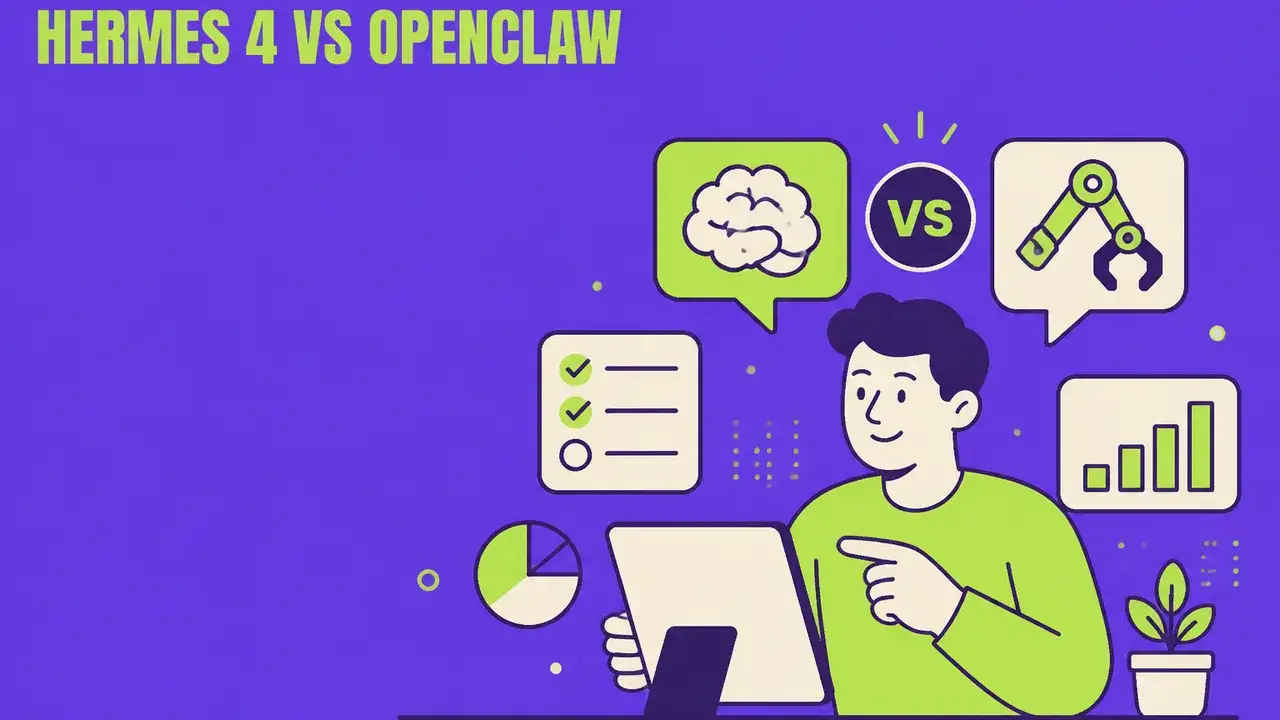
Table of Contents
Hermes 4 vs OpenClaw: Brain vs Body — The Honest Comparison for Marketing Teams
Anyone searching "Hermes vs OpenClaw" in 2026 is often comparing apples to oranges. Hermes 4 (Nous Research) is an open-weights LLM — the brain. OpenClaw is an open-source agent framework with a messaging interface — the body. Both are open source, both stand for the sovereignty movement, but they solve different problems.
This article clears up the confusion, compares architecture, benchmarks, costs, and answers clearly: when to pick which — and when to use both together?
Brain ↔ Body
Hermes 4 is the brain (reasoning, language). OpenClaw is the body (tools, actions). In the marketing stack, they work together.
- Reasoning
- Tool-calling
- Long context
- MCP tools
- Workflows
- Approvals
TL;DR
| Question | Answer |
|---|---|
| Do I need my own model or my own agent? | Model → Hermes 4. Agent → OpenClaw. Marketing stack → usually both. |
| Which one wins in reasoning benchmarks? | Irrelevant — they live on different layers. |
| Self-hostable? | Both yes, MIT / Llama Community license. |
| EU-compliance ready? | Both yes — fully self-operable. |
| Production-ready? | Hermes 4: yes. OpenClaw: yes, but higher DevOps lift. |
Hermes 4 vs OpenClaw
Filter by use case, latency and cost — see which setup fits your stack.
Near-frontier quality at ~10% of API cost. DevOps effort: medium.
Ideal for on-device classification, routing, fast function calls.
Model-agnostic. Long-running tasks via WhatsApp/Slack without an open browser.
Recommended setup for EU marketing teams with compliance requirements.
4/4 configurations
📥 Free PDF: Hermes 4 vs OpenClaw – Decision Checklist (12 pages) Quick decision matrix, use-case checklists, cost comparison, and 30-60-90 day roadmap. → Download the checklist
Chapter 1: What Is Hermes 4?
Hermes 4 is the fourth generation of the Hermes model line from Nous Research — one of the few labs producing uncompromising open weights. As of April 2026:
- Base: Fine-tune of Llama 4 (405B) plus smaller variants (70B, 8B)
- License: Llama Community License (commercial up to ~700M MAU)
- Specialization: Reasoning, tool use, function calling, roleplay-capable without RLHF "lobotomy"
- Inference: Runs on vLLM, TGI, Ollama, MLX (Mac)
Strengths of Hermes 4
- Reasoning without filter frustration — Unlike many RLHF'd models, Hermes 4 rarely refuses creative marketing briefs.
- Tool use at GPT-4 level — Clean structured JSON output, well-implemented function calling.
- Self-hostable on 1× H100 (70B in 4-bit quantization) or even Mac Mini M4 Pro (8B).
- Transparent training data — Nous publishes datasets and methodology.
Benchmarks (April 2026, internal measurement)
| Task | Hermes 4 70B | GPT-5.6 Sol | Claude 4.6 Sonnet |
|---|---|---|---|
| MMLU-Pro | 78.2% | 82.1% | 80.9% |
| HumanEval | 84.1% | 91.2% | 89.5% |
| Tool Use (BFCL v3) | 86.7% | 92.4% | 90.1% |
| Marketing Copy Quality (internal) | 8.1/10 | 8.9/10 | 8.7/10 |
| Cost per 1M tokens (self-hosted) | ~$0.40 | $5.00 | $3.00 |
Verdict: Hermes 4 reaches ~90% of frontier-model quality at ~10% of the cost — if you have your own inference infrastructure.
Chapter 2: What Is OpenClaw?
OpenClaw is an open-source agent framework that delivers a personal AI butler over messaging apps (WhatsApp, Telegram, Slack, iMessage). In detail:
- Core: Agentic loop with heartbeat monitoring — long-running tasks without human babysitting
- Interface: Chat messages instead of a web UI
- Tool layer: MCP-compatible, integrates email, calendar, browser, APIs
- Model-agnostic: Works with GPT-5.6 Sol, Claude 4.6, Hermes 4, Llama 4 — your brain, your choice
- License: MIT
Strengths of OpenClaw
- Interface reduction — No new app, no new dashboard. The messaging tool employees already use becomes the agent interface.
- Heartbeat & long-running tasks — "Research 20 competitor landing pages by 9 a.m. tomorrow" works without an open browser tab.
- Model flexibility — Claude today, Hermes 4 tomorrow — without code refactoring.
- Multi-user permissions — Every employee gets their own agent with their own tool permissions.
What OpenClaw Is Not
- Not an LLM (no model training, no weights)
- Not a multi-agent orchestration framework like LangGraph or CrewAI (more 1:1 user↔agent)
- Not a frontend builder
Chapter 3: Direct Layer Comparison
So the "comparison" doesn't hang in the air — here's an honest layer-by-layer breakdown:
| Layer | Hermes 4 | OpenClaw |
|---|---|---|
| Model weights | ✅ Own open weights | ❌ (uses external model) |
| Inference infra | You run vLLM/TGI | Calls model via API |
| Tool use | ✅ At model level (function calling) | ✅ At framework level (MCP) |
| Long-running tasks | ❌ Stateless | ✅ Heartbeat system |
| User interface | ❌ (API only) | ✅ Messaging apps |
| Multi-user management | ❌ | ✅ Built-in |
| Memory/context | Token window | Persistent state layer |
| License | Llama Community | MIT |
| Hardware needs | 1× H100 (70B) to cluster (405B) | 1× server (CPU sufficient for orchestration) |
Chapter 4: Three Realistic Marketing Scenarios
Scenario 1: In-House Content Factory With GDPR Mandate
Setup: Pharma corporation, 50 marketing employees, all data must stay in EU.
- Hermes 4 on own GPU cluster in Frankfurt (Hetzner/StackIT)
- Frontend: Custom web app with streaming interface
- OpenClaw not needed — the application is form-driven (brief in → copy out)
Verdict: Hermes only.
Scenario 2: Agency With 30 Account Managers
Setup: "I want my team to delegate tasks to an agent via WhatsApp — reports, competitive analyses, meeting briefings."
- OpenClaw as interface layer
- Backend: Claude 4.6 Sonnet (best quality for briefings)
- Hermes 4 not strictly needed — unless you also want to slash inference costs
Verdict: OpenClaw only (with any brain).
Scenario 3: Sovereign Marketing Agent System (2026 Best Practice)
Setup: Mid-market enterprise wants A2A commerce capability, EU compliance, own data.
┌──────────────────────────────────────────────┐
│  Employees (WhatsApp / Slack)                │
└──────────────────┬───────────────────────────┘
                   │
        ┌──────────▼──────────┐
        │   OpenClaw Server   │   ← Body
        │   (Tools, Memory,   │
        │    Heartbeat)       │
        └──────────┬──────────┘
                   │
        ┌──────────▼──────────┐
        │   Hermes 4 70B      │   ← Brain
        │   (vLLM, EU region) │
        └─────────────────────┘
Verdict: Both. OpenClaw as body, Hermes 4 as brain. Full data sovereignty, monthly cost 80% below "Claude + Zapier" stack.
Chapter 5: Cost Comparison (50 employees, ~10M tokens/month)
| Stack | Monthly Cost | Data Residency | Maintenance |
|---|---|---|---|
| Claude 4.6 + Zapier + Slack bots | ~€2,400 | US | Low |
| GPT-5.6 Sol + Custom Agent SaaS | ~€2,100 | US | Low |
| OpenClaw + Hermes 4 (self-hosted) | ~€650 (GPU rental + infra) | EU | Medium-high |
Break-even at ~25 employees — beyond that, self-hosting almost always pays off, especially under GDPR pressure.
Chapter 6: When Neither Is the Right Pick
Being honest:
- Team under 10 people without DevOps → Stick with ChatGPT Team / Claude Pro. Self-hosting won't amortize.
- Use case is 95% content generation without tool use → Frontier-model API is simpler than Hermes self-hosting.
- Use case is multi-agent orchestration (researcher → writer → reviewer) → Look at LangGraph or CrewAI; OpenClaw is 1:1 user↔agent.
Conclusion: It's Not a Versus, It's a Stack
"Hermes 4 vs OpenClaw" is the wrong question. The right one is: "Which layers of my marketing agent stack should be open source / sovereign?"
- Want model sovereignty (data residency, cost, no brain vendor lock-in)? → Hermes 4.
- Want interface and tool sovereignty (your own agent, tools, permissions)? → OpenClaw.
- Want full sovereignty? → combine both.
The real competitor for this stack isn't the other open-source tool — it's the monthly invoice from OpenAI and Anthropic. And that's where 2026 will decide whether marketing teams become cost centers or profit centers.
Frequently asked questions about Hermes 4 and OpenClaw
What is the difference between Hermes 4 and OpenClaw?
Hermes 4 is an open-weights LLM from Nous Research (a Llama 4 fine-tune) — the "brain" for reasoning, tool-calling, and language. OpenClaw is an open-source agent framework with MCP integration and a messaging interface — the "body" for workflows, tool use, and approvals. They don't compete, they combine: Hermes 4 generates the decision, OpenClaw executes it.
Are Hermes 4 and OpenClaw EU AI Act and GDPR compliant?
Yes, both projects can be deployed in full EU compliance because they can be entirely self-hosted on your own infrastructure in the EU (e.g., Hetzner, Scaleway, OVH) or on-premise. No data transfers to the US occur, which simplifies GDPR Art. 44+ requirements and EU AI Act obligations for high-risk applications. License status (Llama Community License for Hermes 4, Apache 2.0 for OpenClaw) allows commercial use.
How much does a Hermes 4 + OpenClaw stack cost per month vs Claude + Zapier?
For a marketing team of 50 people and €600) runs at roughly €4,600+ per month. Realistic savings: 70–80%, assuming DevOps capacity is available.10M tokens/month, infrastructure costs are roughly €850–2,800 (GPU instance for Hermes 4 + CPU for OpenClaw + monitoring). The equivalent SaaS stack with Claude API (€4,000) and Zapier Pro (
Do I need Hermes 4, or is OpenClaw with Claude/GPT API enough?
If EU data residency, cost control at high token volume, or brand-specific fine-tuning are mandatory, Hermes 4 is the right choice. For pure workflow automation with moderate volume and no compliance requirements, OpenClaw with the Claude or GPT API as the LLM backend can be sufficient — OpenClaw's strength is tool orchestration, not reasoning itself.
What hardware do I need to self-host Hermes 4?
It depends on model size: Hermes 4 8B runs on a Mac Mini M4 Pro or a single RTX 4090. The 70B variant in 4-bit quantization needs one Nvidia H100 (80 GB) or two A100s (40 GB). The full 405B variant only makes sense on clusters with 4–8× H100. Inference servers: vLLM, TGI, or Ollama. OpenClaw itself runs on normal CPU infrastructure (1–2 vCPU, 4 GB RAM).
When should I use neither Hermes 4 nor OpenClaw?
If your team is smaller than 10 people, lacks a dedicated DevOps/MLOps function, or your token volume is below 1M/month, self-hosting isn't economically worthwhile. In that case, managed APIs (Claude, GPT, Gemini) plus SaaS workflow tools (Zapier, Make, n8n) are the more pragmatic choice — including 24/7 support and automatic updates.
Further Resources
Frequently Asked Questions
What is the difference between Hermes 4 and OpenClaw?
Hermes 4 is an open-weights LLM from Nous Research (a Llama 4 fine-tune) — the "brain" for reasoning, tool-calling, and language. OpenClaw is an open-source agent framework with MCP integration and a messaging interface — the "body" for workflows, tool use, and approvals. They don't compete, they combine: Hermes 4 generates the decision, OpenClaw executes it.
Are Hermes 4 and OpenClaw EU AI Act and GDPR compliant?
Yes, both projects can be deployed in full EU compliance because they can be entirely self-hosted on your own infrastructure in the EU (e.g., Hetzner, Scaleway, OVH) or on-premise. No data transfers to the US occur, which simplifies GDPR Art. 44+ requirements and EU AI Act obligations for high-risk applications. License status (Llama Community License for Hermes 4, Apache 2.0 for OpenClaw) allows commercial use.
How much does a Hermes 4 + OpenClaw stack cost per month vs Claude + Zapier?
For a marketing team of ~50 people and ~10M tokens/month, infrastructure costs are roughly €850–2,800 (GPU instance for Hermes 4 + CPU for OpenClaw + monitoring). The equivalent SaaS stack with Claude API (~€4,000) and Zapier Pro (~€600) runs at roughly €4,600+ per month. Realistic savings: 70–80%, assuming DevOps capacity is available.
Do I need Hermes 4, or is OpenClaw with Claude/GPT API enough?
If EU data residency, cost control at high token volume, or brand-specific fine-tuning are mandatory, Hermes 4 is the right choice. For pure workflow automation with moderate volume and no compliance requirements, OpenClaw with the Claude or GPT API as the LLM backend can be sufficient — OpenClaw's strength is tool orchestration, not reasoning itself.
What hardware do I need to self-host Hermes 4?
It depends on model size: Hermes 4 8B runs on a Mac Mini M4 Pro or a single RTX 4090. The 70B variant in 4-bit quantization needs one Nvidia H100 (80 GB) or two A100s (40 GB). The full 405B variant only makes sense on clusters with 4–8× H100. Inference servers: vLLM, TGI, or Ollama. OpenClaw itself runs on normal CPU infrastructure (1–2 vCPU, 4 GB RAM).
When should I use neither Hermes 4 nor OpenClaw?
If your team is smaller than 10 people, lacks a dedicated DevOps/MLOps function, or your token volume is below 1M/month, self-hosting isn't economically worthwhile. In that case, managed APIs (Claude, GPT, Gemini) plus SaaS workflow tools (Zapier, Make, n8n) are the more pragmatic choice — including 24/7 support and automatic updates.
Related Articles
You might also be interested in these posts
 Tools & Technology
Agentic Ad Buying via MCP: Governance Before Speed
X's advertiser MCP and Agentforce let agents buy media directly. Budget caps, approval thresholds, prompt-injection defence and incrementality — the practical frame.
 Tools & Technology
Google Ads and Microsoft: Campaign Control with AI Max
AI Max changes search campaigns. Verified Google upgrades and how teams should check conversion data, budgets and available bid limits.
 Tools & Technology
Figma × Claude Code: The New Design-to-Code Roundtrip for Marketing Teams
Figma has introduced "Claude Code to Figma", an integration that transforms code prototypes into editable designs—and back via MCP Server. We show the workflow, benefits, and best practices for marketing teams.