Creative Engineering: From Idea to Production System
In short
Why marketing AI projects fail between concept and delivery – and how Creative Engineering closes that gap.
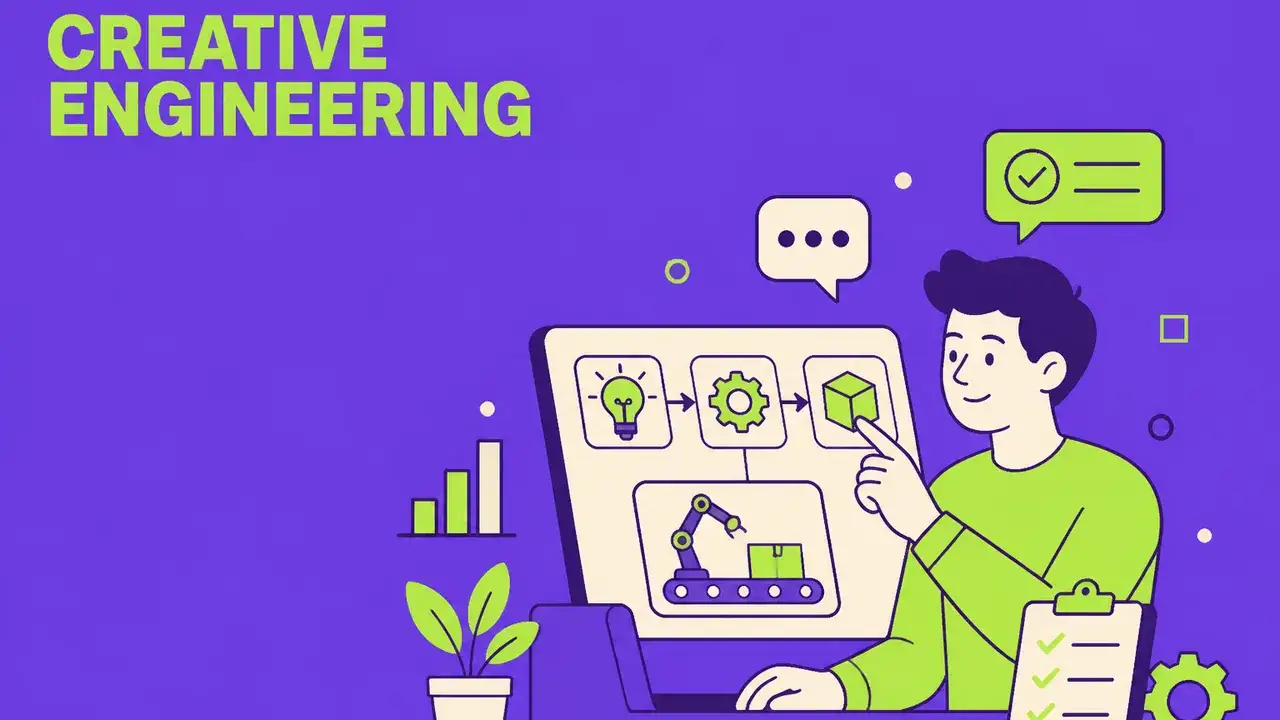
Table of Contents
Creative Engineering: Turning Creative Ideas into Production Systems
Most AI projects in marketing don't fail because of the idea or the model. They fail on the stretch in between: between the approved concept and the 400 assets that need to come out of it across six languages, three formats and two channels – repeatably, on brand, and verifiable.
That is exactly where Creative Engineering operates. It is our working model: creative work isn't replaced, it is moved into a production architecture that holds up.
Short definition: Creative Engineering combines creative conception with systems thinking from software engineering – versioned artefacts, machine-checkable rules, reproducible pipelines. More in the Creative Engineering glossary entry.
Why "more tools" doesn't solve it
A typical state in marketing organisations in 2026: an image model, a video tool, a writing assistant, a translation service, plus a few automations. Each tool works on its own. The output is still unreliable.
The reasons repeat:
| Symptom | Actual cause |
|---|---|
| Results vary between runs | Prompts, references and model versions aren't versioned |
| Brand violations only surface in review | Brand rules exist as a PDF, not as a check |
| Scaling still eats time despite AI | Every step is triggered manually instead of chained |
| Nobody knows what works | Measurement happens at campaign level, not at creative-attribute level |
None of these is a model problem. They are system problems – and system problems are solved with engineering method, not with the next tool subscription.
The four building blocks
1. The concept stays with people
The creative idea, the tone, the stance of a brand: that still comes from the team, not the model. What gets automated is execution – variants, formats, languages, adaptations. This split isn't nostalgia, it's economics: an interchangeable concept only scales interchangeable output.
2. Brand rules become machine-checkable
A brand book only humans can read blocks every automation. We translate rules into checkable form: allowed colour spaces, logo clear space, claim variants, tonality boundaries, prohibited statements. Every generated asset runs against those checks before a human ever sees it.
The effect isn't "less control", it's relocated control: people decide on edge cases instead of obvious errors.
3. Production is a chain, not a tool
Brief → concept variant → generation → brand check → localisation → format derivation → approval → distribution. Every step has defined inputs and outputs, every run is reproducible, every error maps to a step.
That turns "we used AI" into a process that can be audited, handed over and evolved – including by people who didn't build it.
4. Impact is measured at attribute level
Not "campaign A beats campaign B", but: which motif attribute, which hook length, which tonality carries the result? When creative attributes travel as metadata, creative work becomes analysable – and the next round doesn't start from zero.
What this means for different roles
Creative Engineering answers different questions for CMOs and CTOs, which is why we describe both perspectives separately:
- CMO view: scale approved creative across formats, languages and audiences without losing brand governance. Details on the Solutions for CMOs page.
- CTO view: versioned artefacts, reproducible runs, clean interfaces and an operating model that can be handed over. Details on the Solutions for CTOs page.
In practice both roles sit in the same project. The most common conflict: marketing wants speed, IT wants traceability. Creative Engineering doesn't resolve that with compromise but with sequence – checkable rules and the pipeline first, speed after.
How to tell whether a setup really is Creative Engineering
Five questions that create clarity fast:
- Can an asset from the last campaign be reproduced identically today?
- Are brand rules stored as an automatic check or only as a document?
- How many manual steps sit between approval and distribution?
- Are creative attributes stored as metadata?
- Could another team take over the pipeline without asking questions?
If you have to pass on two or more, you have AI tools in use – but not yet a production system.
The typical entry point
We rarely start with the most complete pipeline, but with one format used often enough to justify the effort:
- One channel, one format – e.g. social assets for one product line
- Formalise rules – the ten brand rules that come up most often in review
- Build the chain – generation, check, localisation, derivation
- Set measurement points – record creative attributes
- Hand over – documentation, access, operational ownership
Breadth comes after: more formats, more languages, more channels.
Conclusion
Creative Engineering isn't a new tool category or a rebrand of automation. It is the decision to treat creative production like a system: clear artefacts, checkable rules, measurable attributes – so the creative idea stays the part that actually makes a difference.
Next step: the creative engineering service page explains how we build the chain, how you measure it and how to request a chain assessment through the form there. Alongside it: the glossary definition and the CMO and CTO perspective.
Frequently Asked Questions
What is Creative Engineering?
Creative Engineering combines creative conception with software engineering methods: versioned artefacts, machine-checkable brand rules and reproducible production chains. The concept stays with people, execution becomes systematic.
How is Creative Engineering different from marketing automation?
Marketing automation controls campaign logic and delivery. Creative Engineering concerns how assets are created: generation, brand checks, localisation and format derivation as a traceable, repeatable chain.
Do you need a developer team for it?
Building the pipeline and the check rules requires technical skill. Day-to-day operation usually sits with the marketing team, since rules, templates and approvals are maintained there.
Where should a Creative Engineering project start?
With one channel and one format used often enough to justify effort: formalise rules, build the chain, set measurement points for creative attributes, hand over with documentation. More formats and languages follow later.
Related Articles
You might also be interested in these posts
 Strategy
Search Console Generative AI Reports: How to Read AI Impressions Correctly
Rolled out worldwide since August 2026: what Google Search Console's new AI reports show, what they hide, and how to measure GEO properly anyway.
 Strategy
Agentic Marketing Blueprint: The Four Layers of Working Agent Teams
Knowledge, tools, agents, control: the reference architecture marketing organisations converge on in 2026 — including sequence, roles and metrics.
 Strategy
Cutting LLM Inference Cost: The Math Behind Tokens, Latency and Budget
Caching, model routing, context discipline: the full calculation marketing teams use to cut inference cost by 40 to 70 percent without losing quality.