57% Disappear: Why Your Guides Drop Out of AI Search
In short
An analysis of 2.4M citations shows: comparison pages survive, complete guides die after a month.
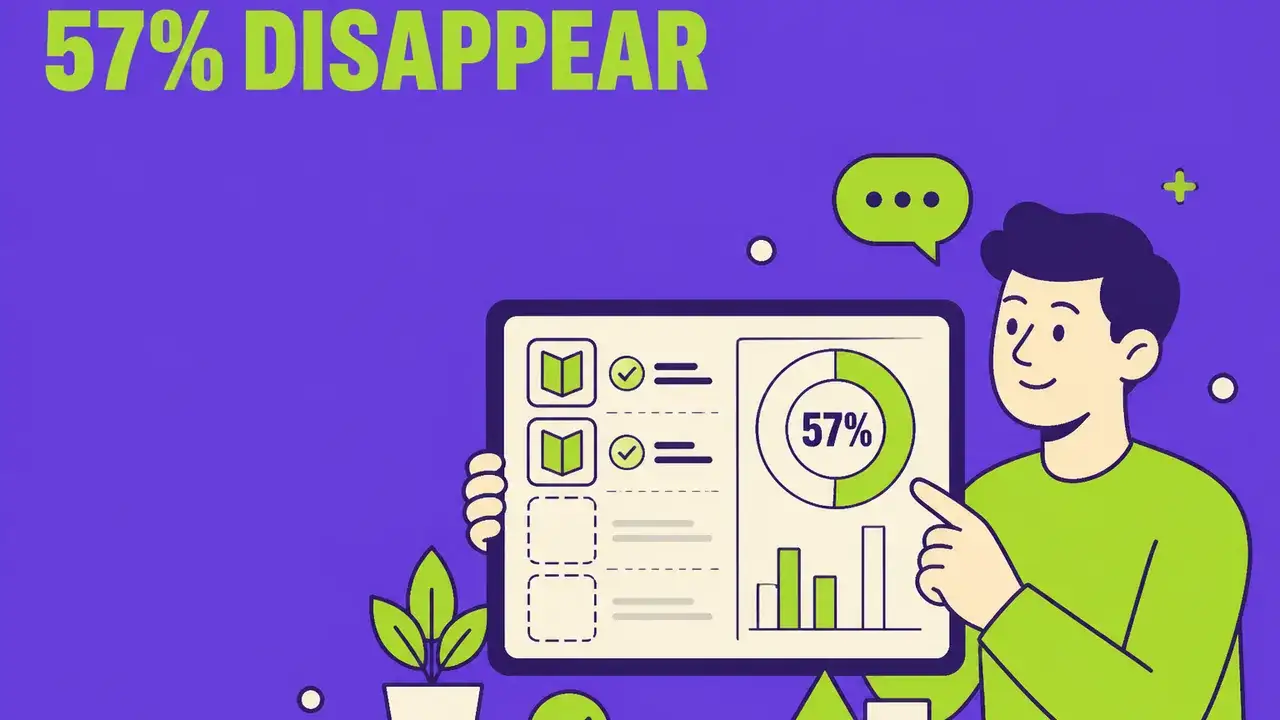
57% Disappear: Why Your Guides Drop Out of AI Search
In the rapidly evolving landscape of Artificial Intelligence, visibility is paramount. For content creators and marketing departments, the aspiration to be cited by leading AI models – such as GPT-5.6 (Sol/Terra/Luna), Claude Opus 5, Gemini 3.6 Flash, or even specialized models like Veo 3.1 for video content or Kling 3.0 for generative visuals – represents a new frontier in organic reach. Our content's ability to be not just discovered, but actively referenced and presented by these AI systems, has become a critical performance indicator for many B2B and high-value B2C verticals.
However, a recent comprehensive study from August 17, 2026, based on an analysis of 2.4 million citation datasets, reveals a sobering truth: the longevity of AI citations is precariously short for a significant portion of content. This analysis, conducted by independent researchers, indicates that a staggering 57.2% of pages initially cited in AI responses are never referenced again after their initial citation. This rapid disappearance challenges fundamental assumptions about content strategy in the AI era and necessitates a re-evaluation of how we produce and maintain digital assets.
The Ephemeral Nature of AI Citations: A Data-Driven Insight
The study’s central finding – that 57.2% of cited pages vanish from AI responses after a single mention – underscores a critical churn rate in the AI content ecosystem. This phenomenon disproportionately affects certain content types while others exhibit remarkable resilience. Generic long-form guides, often crafted as comprehensive evergreen resources, are among the most vulnerable. They frequently experience an initial surge in citations, only to be supplanted within weeks or even days.
In stark contrast, comparison pages, pricing overviews, and data-rich resources featuring clear update timestamps demonstrate significantly prolonged citation lifespans. This distinction suggests that AI models, in their quest to provide users with the most accurate, current, and actionable information, prioritize content formats that inherently signal reliability and recency. The "long-tail" content strategy, once a cornerstone of SEO, appears to be undergoing a fundamental reinterpretation when filtered through the lens of AI model ingestion and response generation.
The implication for marketing leads is clear: content produced without specific considerations for AI's operational logic risks becoming digital ephemera. It's not enough to simply rank; the imperative now is to rank and persist within the AI knowledge graph. This requires a shift from viewing AI as merely another search engine to understanding it as a sophisticated, constantly updating knowledge curator with its own distinct preferences and validation mechanisms.
What AI Models Prioritize: Beyond Keyword Density
Understanding why certain content types endure while others fade is crucial. AI models, particularly advanced ones like GPT-5.6 Terra and Claude Opus 5, are optimized for relevance, authority, and currency. They are designed to minimize the propagation of outdated or unverified information.
- Verifiability and Specificity: Content that presents distinct data points, unambiguous figures, and clearly attributed sources naturally aligns with an AI's need for verifiable information. A statement like "Market growth was 15.3% in Q2 2026, according to the Davies Meyer Industry Report," is inherently more valuable to an AI than a general assertion that "the market is growing rapidly."
- Recency Signals: The presence of explicit update timestamps (
<time datetime="YYYY-MM-DD">) is a powerful signal. While search engines have long used these, AI models appear to weigh them even more heavily, especially for topics where information rapidly depreciates. - Structured Data and Comparison Formats: AI models excel at extracting and synthesizing information from structured data. Comparison tables, bulleted lists for pros and cons, and pricing grids offer a machine-readable format that simplifies information extraction and reduces the computational overhead of interpretation. This explains why comparison pages are cited more frequently and for longer durations.
- C2PA and Content Credentials: The increasing adoption of C2PA (Coalition for Content Provenance and Authenticity) standards further reinforces this. As discussed in our previous article on /en/blog/c2pa-content-credentials-ki-kennzeichnung, content with verifiable credentials indicating origin and modification history is inherently more trustworthy to AI systems, directly impacting its likelihood of citation persistence.
Strategic Content Transformation: From Guides to Granular Data
The study's findings necessitate a re-evaluation of long-form content strategies. Instead of abandoning comprehensive guides, the focus must shift towards transforming them into AI-digestible, persistently citable assets.
1. Content Refresh Cadence: A Non-Negotiable Imperative
For content intended to be cited by AI, the traditional "set it and forget it" approach is obsolete. A rigorous content refresh schedule is now fundamental.
- Dynamic Updates: Implement a system for regular, documented updates. Every update, even minor ones, should visibly alter the content's
last modifieddate, both in the HTML and potentially within the content itself. - "Last Updated" Stamps: Ensure prominent, machine-readable "Last Updated" or "As of" timestamps are present on all critical pages. This is not merely a user experience enhancement but a direct signal to AI crawlers and indexing agents.
- Automated Monitoring: Leverage internal tools or third-party services to monitor AI citation patterns for your key content. This allows for proactive refreshing of content showing signs of declining citation frequency.
2. Embrace Data-Centric Formatting
Transforming generic prose into structured, data-rich formats significantly enhances AI parsability and citation longevity.
-
Leverage Markdown Tables: Present comparative data, specifications, and feature sets in clear Markdown tables. This is a universally understood format for AI models.
| Feature | Traditional Guide | Data-Centric Page | AI Citation Longevity | | :-------------- | :---------------- | :---------------- | :-------------------- | | Update Frequency| Low / Ad-hoc | High / Scheduled | Short | | Data Structure | Free-form prose | Tables, Lists | Long | | Source Clarity | General | Specific, Linked | Long | | Timestamping | Absent | Prominent | Long | | AI Preference | Low | High | Persistent | -
Bulleted and Numbered Lists: Break down complex information into digestible lists. Each item should ideally be atomic – a single, verifiable fact or point.
-
Semantic HTML5: Utilize
<dl>,<figure>,<table>, and other semantic HTML5 elements to provide structural clues to AI models about the nature of your content.
3. Prioritize Unique Data and Benchmarks
Content that provides unique, clearly sourced data, benchmarks, or proprietary insights holds immense value for AI. This positions your organization as a primary source, a critical factor for persistent citation.
- Proprietary Research: Invest in original research and publish its findings. Datasets, statistics, and industry trend analyses from your own studies are gold.
- Interactive Data Visualizations: While AI might not "see" a chart, the underlying data used to generate it can be embedded or linked, allowing the AI to access the raw information.
- Clear Source Attribution: For every data point, ensure the source is explicitly mentioned and, if possible, linked. This strengthens the content's authority and verifiability. This aligns with the principles of E-E-A-T (Experience, Expertise, Authoritativeness, Trustworthiness) that remain crucial for AI-driven information retrieval.
Implementing a Future-Proof Content Strategy: Step-by-Step
To adapt to this new reality, marketing organizations need a systematic approach to content creation and maintenance. This is not about sacrificing creativity or brand voice, but about intelligently structuring and signaling content value to AI systems.
Here's a step-by-step guide for CMOs and marketing leads:
-
Audit Existing Content for AI Readiness:
- Identify your top-performing long-form guides.
- Analyze their current AI citation frequency and persistence using available analytics tools or by manually querying major AI models with relevant prompts.
- Categorize content by AI citation performance (high persistence, moderate, disappearing).
- For disappearing content, identify the primary reasons (lack of timestamps, generic prose, outdated data).
-
Redesign Key Content Pages:
- Focus on Data Extraction: For pages identified as vulnerable, prioritize transforming content into formats easily parsable by AI. This means converting paragraphs into bullet points, comparison tables, or structured FAQs.
- Implement Clear Timestamps: Ensure all relevant pages feature prominent, machine-readable "Last Updated" dates. Consider adding "Verified On" dates for critical data points.
- Embed Structured Data (Schema.org): While often associated with search engines, rich snippets and structured data (e.g.,
Article,FAQPage,Productschemas) provide invaluable context to AI models. This enhances their ability to understand and cite specific content elements.
-
Establish a Robust Content Refresh Protocol:
- Define refresh cycles for different content categories (e.g., weekly for market data, monthly for product comparisons, quarterly for in-depth analysis).
- Assign clear ownership for content updates.
- Integrate content refresh tasks into your editorial calendar and project management workflows.
- Consider automated tools for identifying outdated information or flagging content for review based on external data feeds.
-
Prioritize Original, Verifiable Data:
- Invest in primary research that produces unique data points.
- Collaborate with data analysts (see our insights on /en/services/data-analytics) to extract and present key findings effectively.
- Develop a standard operating procedure for citing all data sources accurately and clearly, both internally and externally. This also aligns with principles for preventing hallucinations in AI models.
-
Educate Content Teams:
- Provide training on AI citation best practices, including structured writing, timestamping, and source attribution.
- Emphasize the difference between content for human consumption and content optimized for AI ingestion.
- Foster a culture of data-driven content creation, where the persistence of AI citations is a recognized KPI.
-
Monitor and Iterate:
- Continuously track your content's AI citation performance.
- A/B test different content formats and refresh frequencies.
- Stay informed about updates to AI model capabilities and preferences. The AI landscape is dynamic; what works today might need adjustment tomorrow, as highlighted in discussions around /en/blog/ai-brand-visibility-aeo-2026.
Fazit
The era of AI-driven information retrieval demands a profound shift in content strategy. The study's finding that 57.2% of cited pages disappear after their initial mention is not merely a statistic; it is a clear signal that the content practices optimized for traditional search engines are no longer sufficient. CMOs and marketing leads must recognize that content longevity in the AI ecosystem hinges on an entirely new set of principles: verifiability, recency, structured data, and clear attribution.
By embracing a strategy focused on rigorous content refreshing, data-centric formatting, and the consistent provision of unique, verifiable information, organizations can move beyond the ephemeral nature of initial AI citations. This proactive adaptation will ensure that valuable content not only reaches its audience through AI but also maintains its authoritative presence, establishing a durable competitive advantage in the intelligent search landscape of August 2026 and beyond.
Frequently Asked Questions
Why do long-form guides lose AI citations so quickly?
Because AI engines reward freshness, specificity, and clearly extractable statements. A 'complete guide' is broad but rarely the most precise answer to a narrow question. As soon as fresher, tighter sources appear, the model swaps the citation — often within weeks.
Which content types stay cited longest?
Comparison pages, pricing and benchmark overviews, well-structured definitions, and original data with a described methodology. The common factor: unambiguous, verifiable statements with numbers, tables, and dates that a model can quote without interpreting.
How often should existing articles be refreshed?
A quarterly cadence for top pages and a semi-annual one for the rest works well, plus event-driven updates when models, pricing, or regulation change. Show a visible update date and change actual substance — a date swap alone achieves nothing.
How do you measure content decay in AI search?
Through citation monitoring: run defined prompt sets per topic cluster across several engines, log citations and competitor mentions, and track the trend per URL. If a URL declines at two consecutive measurement points, it goes on the refresh list.
Related Articles
You might also be interested in these posts
 Strategy
GEO-SFE: 17% More AI Citations Through Structure, Not Keywords
Structural feature engineering shows which page components AI engines actually cite – checklist included.
 Strategy
GEO: Generative Engine Optimization – The End of SEO As We Know It
How to optimize your content for ChatGPT, Perplexity and Google AI Overviews. The ultimate guide to GEO and AEO for marketing professionals in 2025.
 Strategy
Visibility in AI Search and Agentic Commerce: What Counts in 2026 Instead of Rankings
Citation share instead of click-through rate, product attributes instead of images: the complete guide to visibility in AI answers and with shopping agents.