Autonomous Cybersecurity: AI-Assisted Auditing in Daily Practice
In short
Agents review code continuously instead of by sampling: what pattern findings, dependency analysis and fix proposals deliver, where the limits are and which permissions and filters defensive use requires.
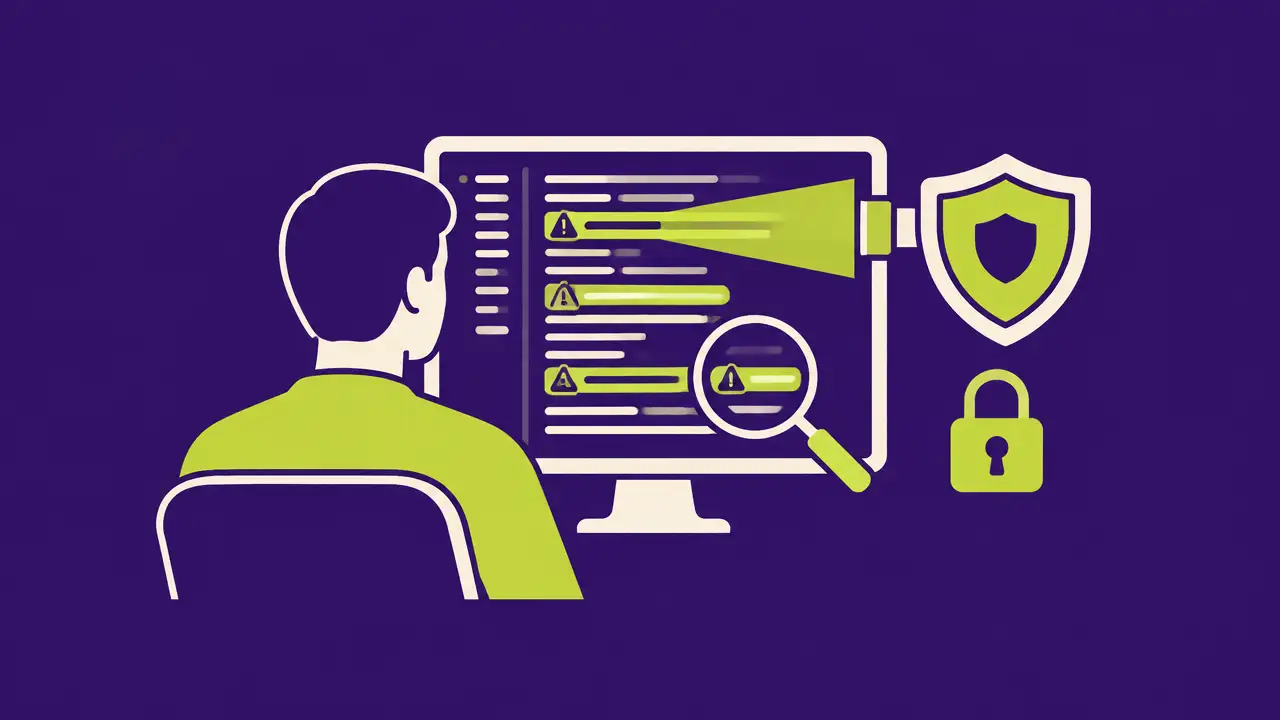
Table of Contents
Security review of code was always a question of coverage: an audit looks at a slice, at a point in time, with limited hours. Between two audits hundreds of changes appear that nobody examines at the same depth.
Agents move exactly that boundary. They can read code continuously, follow dependencies, describe attack paths and formulate fixes. That does not automatically make security work better — but it makes continuity possible where sampling used to be the norm.
1) What Agentic Auditing Can Do
Realistic and common today:
- Pattern findings in source code. Unsafe input handling, missing authorisation checks, sloppy error handling — recognised in the context of the surrounding code, not just as text patterns.
- Dependency analysis. Known vulnerabilities in packages including the question of whether the affected path is actually reachable in your code. That classification is exactly what classic scanners lacked.
- Configuration review. Access rules, open ports, overly broad permissions, missing encryption at rest.
- Fix proposals with tests. Not just "there is a problem here" but a change plus a test case demonstrating the gap.
- Runtime errors as signal. Crash and error patterns often point to exploitable states. The glossary describes the combination of log and code analysis as Autonomous Crash Watching & Debugging.
2) What It Does Not Do
Three limits matter, because ignoring them gets expensive:
- No substitute for threat modelling. Whether a feature should exist at all, who may see which data and which misuse harms the business — those are decisions, not code findings.
- No completeness guarantee. A clean run does not prove the absence of vulnerabilities. It proves that certain patterns were not found.
- No substitute for penetration testing and certification. External review with its own methodology stays necessary, especially where evidence is required.
There is also a practical problem: false positives. An agent reporting fifty items weekly of which five matter produces fatigue — and then the five get missed too. Prioritisation by reachability and impact is therefore not a nicety but a precondition.
3) Defensive Use Requires Its Own Rules
An agent with read access to the entire codebase is itself a target and a data-processing activity. Minimum requirements:
- Broad read, narrow write. Changes strictly as proposals, approval through review and tests. Direct intervention in production stays excluded.
- Filter logs. Error logs often contain personal data. Masking belongs before analysis, not after.
- Separate credentials. Distinct, time-limited credentials per task. No shared admin rights.
- Document processing. Purpose, legal basis, processing agreement, retention — the same duties as with any other provider.
- Log findings. Finding, assessment, decision, remediation. That trail is the real value in audits and in an incident.
4) Why Speed Cuts Both Ways Here
The same capabilities are available to attackers. The time between disclosure of a vulnerability and its exploitation shrinks when analysis and exploit development are partly automated.
The sober conclusion is not alarm but a shift in priority: responsiveness beats perfection. Concretely, know and shorten three durations — until a vulnerability is detected, until a fix exists, until it is deployed. A team shipping in hours rather than weeks is better protected than one with the more thorough annual audit.
5) Getting Started in Four Steps
- Establish inventory. Which applications, which data categories, which credentials? Without inventory every prioritisation is guesswork.
- Limit agentic auditing to one area. One service, read access, findings as tickets with an assessment.
- Prioritise by reachability. Work only on findings whose path is reachable in your code — and document that rule.
- Measure time to ship. From finding to fix in production. That number is the best single indicator of your security posture.
Conclusion
AI-assisted auditing turns security review from an appointment into a continuous state. The gain lies in continuity and shorter response times, not in completeness. What stays decisive is that findings are prioritised, permissions bounded and decisions documented — otherwise you get lots of activity and little protection.
Further reading: how agents detect failures in operation is covered in Full Autonomy Instead of Autocomplete.
Frequently Asked Questions
What is "Autonomous Cybersecurity: AI-Assisted Auditing in Daily Practice" about?
Agents review code continuously instead of by sampling: what pattern findings, dependency analysis and fix proposals deliver, where the limits are and which permissions and filters defensive use requires.
What Agentic Auditing Can Do: what matters?
Realistic and common today: Pattern findings in source code. Unsafe input handling, missing authorisation checks, sloppy error handling — recognised in the context of the surrounding code, not just as text patterns.
What It Does Not Do: what matters?
Three limits matter, because ignoring them gets expensive: No substitute for threat modelling. Whether a feature should exist at all, who may see which data and which misuse harms the business — those are decisions, not code findings.
Defensive Use Requires Its Own Rules: what matters?
An agent with read access to the entire codebase is itself a target and a data-processing activity. Minimum requirements: Broad read, narrow write. Changes strictly as proposals, approval through review and tests.
Related Articles
You might also be interested in these posts
 Strategy
Full Autonomy Instead of Autocomplete: The Shift to Agentic Engineering
From code suggestions to parallel sub-agents: what changed technically, why "more agents" solves nothing and how teams rebuild workflows for delegation — including permissions, acceptance and cost caps.
 Strategy
Vibe Coding vs. Software Architecture: Why Governance and Taste Matter More
Unreviewed vibe coding damages mature systems: duplicated logic, broken layers, tests without evidentiary value. Which guardrails actually hold in AI-assisted development — and where the style fits.
 Strategy
The New Bottleneck in IT Organisations: From Implementation to Vision
When implementation takes days instead of months, unclear product vision, slow approvals and missing judgement surface. How teams tier approvals by risk and measure the real bottleneck.