Server-Side Tracking & Conversion APIs 2026: The Complete Implementation Guide
In short
sGTM, Meta CAPI, TikTok Events API, Reddit CAPI: architectures, identity stitching, and compliance for a resilient tracking infrastructure.
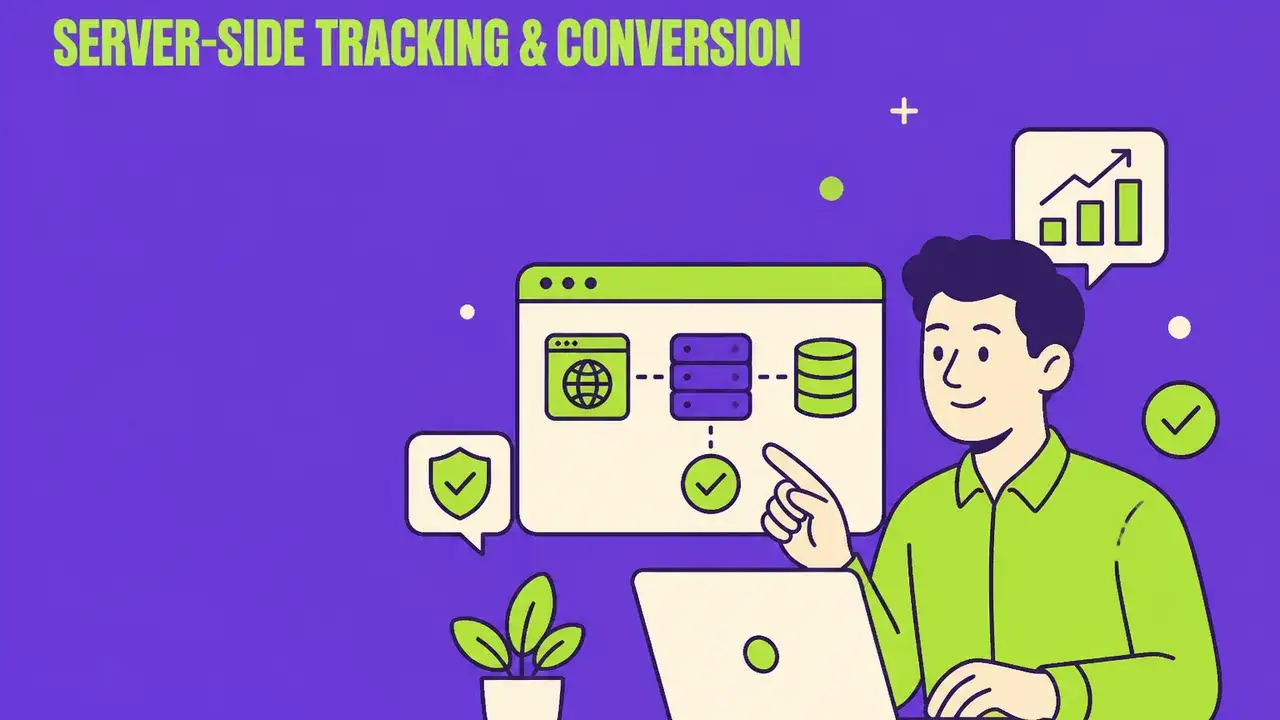
Table of Contents
Server-Side Tracking & Conversion APIs 2026: The Practical Setup Guide
Server-side tracking is no longer a "nice to have" architecture in 2026. With cookie decay, consent gaps, and increasingly aggressive ad blockers, classic pixels lose between 25 and 50% of conversions. Server-side tracking + platform-native Conversion APIs (Meta CAPI, Google Enhanced Conversions, TikTok Events API) are the pragmatic way to close that gap — clean, GDPR-compliant, and audit-proof.
This article is part of the Measurement & Attribution Hub series and serves as the practical setup guide for DACH teams.
TL;DR
- Server-side tracking is mandatory infrastructure in 2026, not an experiment
- Classic pixels lose 25–50% of conversions — server-side closes the gap
- Stack: Server-Side GTM + platform Conversion APIs + clean identity layer
- Server-side tracking is NOT a consent bypass — consent remains mandatory
- Setup effort: 4–8 weeks for mid-market, €80–150k investment
Why classic pixels no longer suffice in 2026
The data losses are documented:
- Browser restrictions: Safari ITP, Firefox ETP, Chrome 3rd-party cookie death cost 15–30% of sessions.
- Ad blockers: 25–35% of desktop users in DACH.
- Consent losses: 40–60% of users decline marketing cookies.
- iOS restrictions: Mail Privacy Protection and Hide-My-Email mask users.
Combined, classic pixel setups in DACH realistically lose 30–50% of conversions. That's exactly the gap that has performance teams no longer trusting their own platform reports.
What server-side tracking concretely does
Instead of firing the tracking pixel in the user's browser, tracking runs on a server you control (typically a Google Tag Manager Server-Side container on your own subdomain). Advantages:
- Data leaves the server in controlled, filtered form
- Server calls aren't affected by browser/ad-blocker restrictions
- First-party cookies can be set with longer lifetimes
- Data enrichment (hashing, customer-ID enrichment) happens server-side
- Platform Conversion APIs are addressed directly server-to-server
The 2026 standard stack
| Layer | Component | Function |
|---|---|---|
| Client tag | GTM Web container | Sends events to server container |
| Server container | GTM Server (Cloud Run / App Engine) | Processes, anonymizes, forwards |
| Conversion APIs | Meta CAPI, Google Enhanced Conversions, TikTok Events API | Receive server-to-server events |
| Identity layer | Hashed email, first-party cookie, customer ID | Connects sessions deterministically |
| Consent layer | TCF v2.2 / Google Consent Mode v2 | Controls what is transmitted |
More on the identity layer in First-Party Data as an AI Competitive Advantage.
Step-by-step setup (mid-market)
- Set up a subdomain (e.g. metrics.example.com) for the server container
- Deploy GTM Server container on Google Cloud Run (€200–600/month depending on volume)
- Configure platform tags: Meta CAPI, Google Ads Enhanced Conversions, LinkedIn Insight, TikTok
- Wire Consent Mode v2 correctly — mandatory for EEA since March 2024
- Hashing pipeline for PII (email, phone) inside the server container
- Deduplication logic between client and server events
- Testing phase: side-by-side comparison client vs. server for 4 weeks
- Rollout & monitoring with anomaly alerts
The most important Conversion APIs in 2026
| Platform | API | Key notes |
|---|---|---|
| Meta | CAPI (Conversions API) | Aim for Event Match Quality > 7, dedupe with pixel |
| Google Ads | Enhanced Conversions for Web/Leads | Hashed email/phone required, dedupe with gtag |
| Conversions API | Significantly better match since 2024, mandatory for B2B | |
| TikTok | Events API | Separate web events and offline events |
| Reddit, Pinterest, Microsoft | Native APIs | Worth it from €50k/month spend |
The most common mistakes
- Treating server-side as a consent bypass: unlawful and an immediate stop in any DPO audit. Consent stays mandatory.
- Double tracking without deduplication: leads to inflated conversions and wrong optimization signals.
- Poor Event Match Quality: without clean PII hashing, events get dropped at Meta/Google.
- No identity layer: without hashed email or customer ID, server-side delivers no advantage over client tracking.
- Server container without monitoring: a 5xx error in the container costs hours of conversions before anyone notices.
The GDPR reality
Server-side tracking is not a trick to bypass consent. What changes:
- Data leaves the user's browser in controlled form
- Hashing and aggregation happen before data goes to third parties
- Cookie setting remains in the user's browser and therefore requires consent
- Personal data may only be passed on with consent / legitimate interest
For the compliance architecture we recommend our AI Governance consulting or the Compliant AI Hubs service.
What server-side tracking concretely delivers
Empirics from DACH projects in the last 12 months:
- Meta CAPI: 15–35% more tracked conversions, 8–18% ROAS improvement
- Google Enhanced Conversions: 8–20% more conversions in Search Ads
- LinkedIn CAPI: up to 40% more tracked lead conversions in B2B
- Overall: 20–40% more accurate picture of actual performance
These numbers are the basis for MMM and MTA being able to work cleanly at all.
Cost
Realistic investment for mid-market:
- Setup (4–8 weeks): €80–150k
- Server container hosting: €200–600/month
- Platform API integrations: 1 week per platform
- Ongoing optimization: €2–4k/month
ROI break-even usually after 3–6 months, when the recovered conversions translate into better algorithmic signals on Meta/Google.
Bottom line
Server-side tracking is the mandatory infrastructure of any serious 2026 marketing stack. Without a clean server-side setup, MMM, MTA, and agentic analytics are built on sand. With server-side setup, teams recover 20–40% more accurate performance data — and with it, the foundation for audit-proof budget decisions. We build the stack pragmatically and compliance-clean — get in touch.
Frequently Asked Questions
What is server-side tracking?
Server-side tracking moves tracking logic from the user's browser to a server you control (typically a GTM Server-Side container). Events are processed, hashed server-side, and sent server-to-server to ad platforms via platform Conversion APIs (Meta CAPI, Google Enhanced Conversions).
Is server-side tracking a consent bypass?
No. Server-side tracking is not a trick to bypass consent. Cookie setting in the user browser remains consent-bound; personal data may only be passed to third parties with consent or legitimate interest. Server-side only changes the transmission path, not the legal basis.
How many more conversions does server-side tracking deliver?
Empirics from DACH projects: Meta CAPI yields 15–35% more tracked conversions and 8–18% ROAS improvement, Google Enhanced Conversions 8–20% more search conversions, LinkedIn CAPI up to 40% more lead conversions in B2B. Overall, a clean server-side setup delivers a 20–40% more accurate performance picture.
What does a server-side tracking setup cost?
Realistic mid-market: €80–150k setup (4–8 weeks implementation), €200–600/month hosting for the GTM Server container, 1 week per platform API integration, €2–4k/month ongoing optimization. ROI break-even usually after 3–6 months from recovered conversions and better algorithmic signals.
Which Conversion APIs matter most in 2026?
Meta CAPI (mandatory for anyone with Meta spend), Google Enhanced Conversions for Web/Leads (mandatory in Google Ads), LinkedIn Conversions API (much better match since 2024, mandatory for B2B), TikTok Events API (mandatory at significant TikTok spend). Reddit, Pinterest, and Microsoft Advertising are worth it from ~€50k/month spend.
What are the most common mistakes with server-side tracking?
Five typical mistakes: 1) misunderstanding server-side as a consent bypass (unlawful), 2) double tracking without deduplication (inflated conversions), 3) poor Event Match Quality from faulty PII hashing, 4) missing identity layer (no advantage over client tracking), 5) server container without monitoring (silent conversion outages).
Related Articles
You might also be interested in these posts
 Tools & Technology
Marketing Mix Modeling 2026: A Practical Guide to Modern MMM Stacks
Bayesian MMM, open-source stacks (Robyn, LightweightMMM, Meridian) and vendor reality: how to build a robust marketing mix model in 2026.
 Tools & Technology
Incrementality Testing 2026: Geo-Holdouts, Conversion Lift, and AI-Driven Designs
Geo experiments, conversion lift studies, and synthetic controls: how AI makes incrementality tests faster, cheaper, and more valid.
 Strategy
The 2026 CMO Measurement Stack: A Blueprint for the First 12 Months
90/180/365-day roadmap for CMOs: a layered measurement stack with MMM, incrementality, attribution, and agentic analytics — including vendor selection.