Nerd Sniping: Why Interesting Problems Stall AI Projects
In short
A side problem is too appealing and two weeks are gone. Where the term comes from, why fast prototypes amplify it and which four rules make curiosity useful.
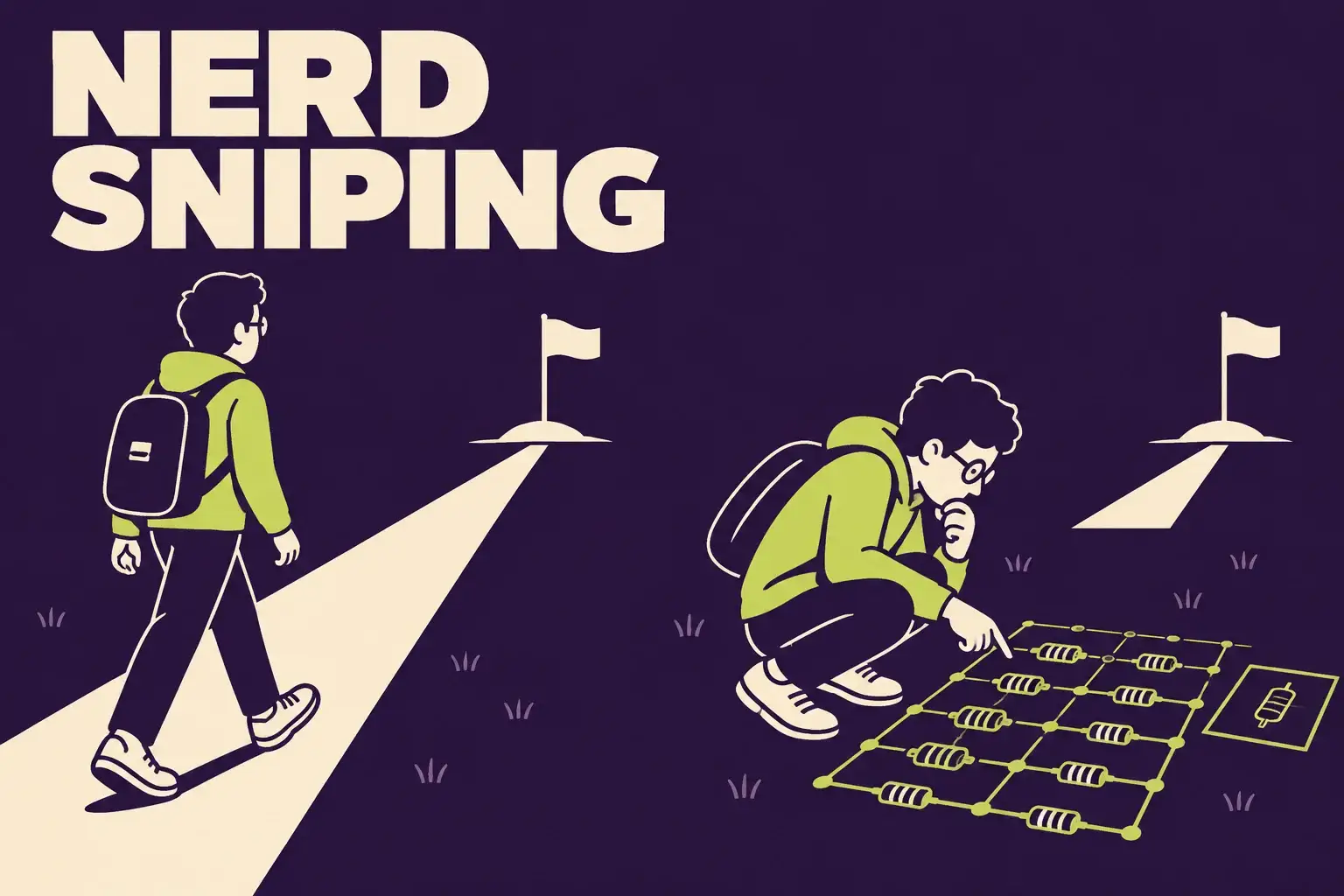
Table of Contents
There is a reason AI projects can burn weeks without anything reaching production — and it is almost never laziness. It is the opposite: a problem was too interesting.
There is a term for this pattern: nerd sniping. Randall Munroe coined it in 2007 in xkcd comic 356, where passers-by are "sniped" off the street with an irresistible resistor problem. It is now jargon, used as a verb: to nerd-snipe someone.
1) The mechanism: good work on the wrong problem
An open technical problem has three properties a fuzzy main task lacks: clear structure, fast feedback and visible progress. Data quality, acceptance criteria, rights clearance and documentation have none of them.
So the elegant side problem wins regularly. Not because someone misreads the priority, but because attention flows to where it is rewarded.
2) Why the effect is stronger in 2026
The trigger has not changed; the environment has. New models, agent frameworks and protocols appear weekly, each with a demo reproducible within an hour.
The decisive shift is in cost: when an agent produces a prototype in an hour, the cost of starting drops close to zero. The cost of operating, reviewing, protecting data and owning the result stays the same. That is exactly the pattern described by the Jevons paradox: cheaper creation leads to more software, not less — and therefore more operations.
Related effects in the same way of working:
- Vibe coding — producing working code quickly without architecture or reviewability growing with it.
- Sub-agents and agent harnesses — parallel agent runs increase the temptation to build "just one more" variant.
- Malleable software — tailored tools are the legitimate case; without an owner and an expiry date they become shadow IT.
- AI psychosis — the extreme form of the pull, when sustained interaction with a model shifts judgement.
3) What it looks like in projects
A team is asked to automate image adaptation for twelve market variants. Along the way the question arises whether the assets could be deduplicated by similarity. Two weeks later a clean deduplication service with tests exists — and not a single delivered asset.
The service is solid craft. It just answers a question nobody asked.
4) The wrong reflex: switching off curiosity
The obvious counter-reaction is to ban exploration and work tickets only. That costs more than it saves: without hands-on experience, a team cannot judge which vendor claims hold. Fascination is the raw material of tool literacy.
The second common mistake is confusing nerd sniping with research. Research has a stated question, a time budget and a recipient for the result. A snipe has none of these.
5) Four rules that make the difference
- Time windows instead of bans. Fixed exploration time for new tools — with a short written assessment as the deliverable, not a system.
- Every exploration ends in a decision. Adopt, drop or revisit later — dated and readable. An unanswered prototype later fuels debates about whether "we already had that".
- Acceptance criteria before building. Only when done is defined can you see when a detour begins.
- Measure instead of assume. Whether a change is better is settled by comparison — see differential evaluation and shadow eval. Without comparison, "feels better" becomes the criterion.
6) The everyday test
Three questions separate exploration from a snipe:
- Is there a stated question?
- Is there a time budget?
- Is anyone waiting for the result?
If an answer is missing, it is a snipe. That is not blame — the effect is structural. It only becomes expensive when nobody decides where the energy points.
Conclusion
Nerd sniping is neutral. The same pull that derails a sprint also makes someone truly understand a model instead of quoting it. The management task is not to dampen enthusiasm but to give it a target, a time budget and a close.
Get that right and you get both: teams that can judge new tools — and results that go live.
Frequently Asked Questions
What is "Nerd Sniping: Why Interesting Problems Stall AI Projects" about?
A side problem is too appealing and two weeks are gone. Where the term comes from, why fast prototypes amplify it and which four rules make curiosity useful.
The mechanism: good work on the wrong problem: what matters?
An open technical problem has three properties a fuzzy main task lacks: clear structure, fast feedback and visible progress. Data quality, acceptance criteria, rights clearance and documentation have none of them.
Why the effect is stronger in 2026: what matters?
The trigger has not changed; the environment has. New models, agent frameworks and protocols appear weekly, each with a demo reproducible within an hour. The decisive shift is in cost: when an agent produces a prototype in an hour, the cost of starting drops close to zero.
What it looks like in projects: what matters?
A team is asked to automate image adaptation for twelve market variants. Along the way the question arises whether the assets could be deduplicated by similarity.
Related Articles
You might also be interested in these posts
 Trends & Insights
Omarchy: When the Operating System Itself Becomes Agentic
DHH's Linux for the age of agents: malleable software, an agent with system access, a plugin ecosystem. What marketing and technology teams should take from it — and which permissions come first.
 Trends & Insights
p(doom): Why a Probability of Catastrophe Is No Basis for Decisions
p(doom) is a subjective estimate, not a measurement — and experts diverge widely. What the term means, why it distorts corporate debates and which probability matters instead.
 Trends & Insights
Meta's "Muse": What Autonomous Long-Horizon Agents Change for Companies
From prompt to delegated goal: long-term memory, confidential execution, sentinel agents and revenue share — assessed soberly, with a concrete path for marketing teams.