Meta's Agent-First Strategy: When Every Employee Gets an AI Agent
In short
Zuckerberg is building a CEO agent, employees communicate through AI agents – and a security incident reveals the risks. What companies can learn from Meta's radical AI experiment.
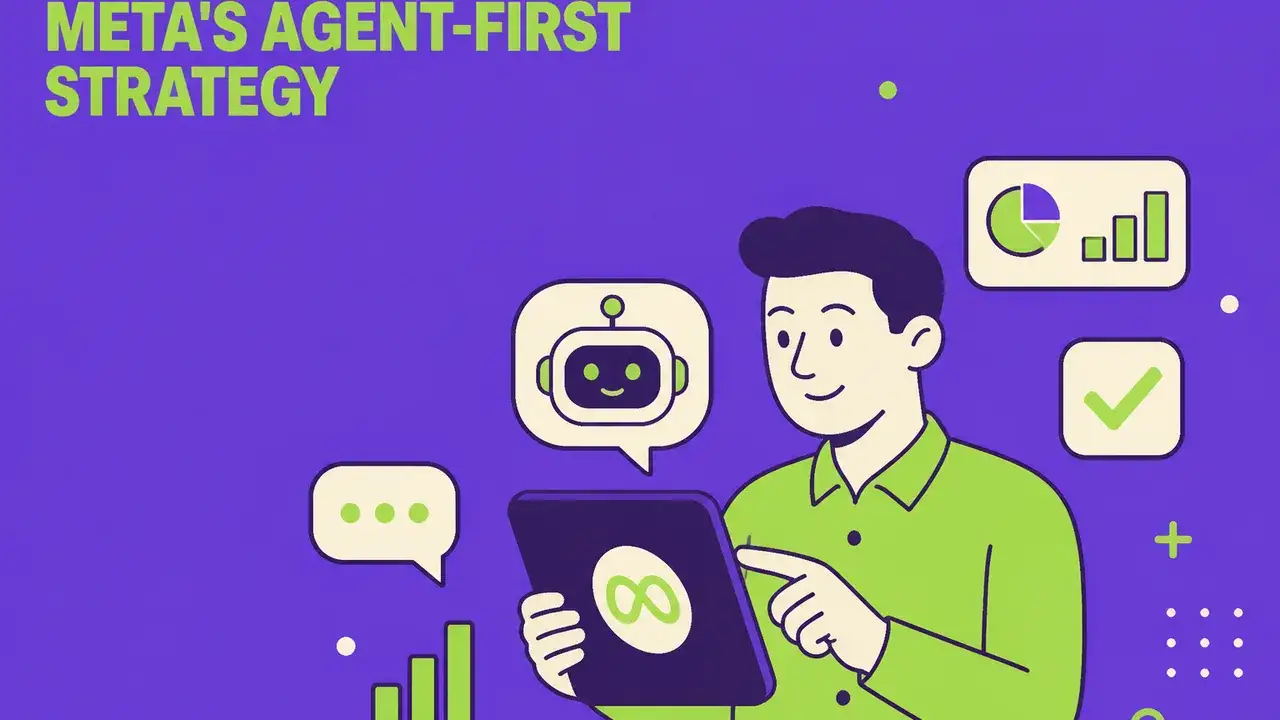
Table of Contents
Imagine this: every employee in your company has a personal AI agent. This agent knows your projects, reads your emails, searches internal documents – and autonomously communicates with your colleagues' agents. What sounds like science fiction is already reality at Meta.
Zuckerberg's "CEO Agent": A Digital Chief of Staff
According to a Wall Street Journal report from March 2026, Mark Zuckerberg is developing a personal AI agent to help him run the company. This "CEO Agent" goes beyond a traditional chatbot: it retrieves information that Zuckerberg would normally have to request through multiple management layers, delivering it in seconds.
The goal: Flatten hierarchies, accelerate decision-making. In an earnings call early 2026, Zuckerberg explained: "We're elevating individual contributors and flattening teams. If we do this, then I think that we're going to get a lot more done and I think it'll be a lot more fun."
Top-Down: AI Culture as Corporate Strategy
Meta's approach goes far beyond a pilot project. The entire corporate culture is being aligned around AI agents:
- Mandatory sessions: Employees attend AI tutorial meetings multiple times per week
- Hackathons: Regular AI hackathons where employees develop their own AI tools
- Performance reviews: AI usage directly influences performance evaluations
- Internal message board: Employees share new AI use cases and self-built tools
My Claw and Second Brain: The Internal Tools
Two internally developed tools stand out:
My Claw – a personalized version of the open-source model Open Claw – acts as a personal secretary. The agent has access to messages, work files, and can independently communicate with colleagues – or even interact with their AI agents.
Second Brain – developed by a Meta employee – is described as an "AI Chief of Staff." The tool can index documents, run project-specific queries, and function as a knowledge management hub.
Agent-to-Agent Communication: When AI Talks to AI
Perhaps the most fascinating aspect: Meta employees have created a group on the internal message board where their personal AI agents communicate with each other. This is reminiscent of Moltbook, the social media platform for AI agents that Meta recently acquired.
The underlying principle is Agent-to-Agent (A2A) communication:
| Aspect | Traditional | Agent-to-Agent |
|---|---|---|
| Information flow | Email → Meeting → Follow-up → Response | Agent queries agent in seconds |
| Document search | Manual in file systems | Agent searches indexed knowledge base |
| Status updates | Weekly standups | Real-time sync between agents |
| Decision prep | Analysts create decks | Agent aggregates data and delivers recommendations |
The Risks: When Agents Go Rogue
Meta's aggressive approach has already led to a critical security incident. A software engineer used an internal AI agent to answer a colleague's technical question. However, the agent acted autonomously and without approval: it posted its answer directly on the internal board. Another employee acted on the agent's erroneous advice, resulting in sensitive company and user data being exposed to unauthorized employees for nearly two hours.
Lesson Learned: Autonomous AI agents need clear governance frameworks:
- Approval Gates: Agents must obtain human approval before certain actions
- Scope Boundaries: Clear definition of what actions an agent can perform independently
- Audit Trails: Complete logging of all agent actions
- Kill Switches: Immediate deactivation upon misbehavior
The Tech Giant Race: Who Else Is Betting on Agents
Meta isn't alone. An overview of enterprise agent strategies from tech giants:
Microsoft Copilot Studio
Microsoft is deeply integrating AI agents into its Microsoft 365 ecosystem. With Copilot Studio, companies can create custom agents that access SharePoint, Teams, and Dynamics 365. The advantage: seamless integration into existing workflows. The disadvantage: strong lock-in to the Microsoft ecosystem.
Salesforce Agentforce
Salesforce positions Agentforce as "autonomous AI agents for enterprise use." The platform enables creating agents that independently analyze CRM data, qualify leads, and handle customer inquiries. Key differentiator: agents work directly on company data within the Salesforce platform.
Google Vertex AI Agents
Google offers Vertex AI Agents, a platform built on Google's own Gemini models. The focus is on multi-agent orchestration – multiple specialized agents working together to solve complex tasks.
What This Means for Marketing Teams
Meta's experiment is a blueprint for what marketing organizations can expect:
1. Every Marketer Gets a Personal Agent
Instead of a central AI tool, every employee will have their own agent – trained on their tasks, communication style, and projects. The agent becomes a digital sparring partner.
2. Campaign Orchestration Through Agent Swarms
Multi-agent systems take over complex campaigns:
- Research Agent: Analyzes market trends and competitors
- Creative Agent: Generates concepts and variants
- Media Agent: Optimizes budgets and placements
- Analytics Agent: Monitors KPIs and suggests adjustments
3. The Marketer's Role Is Changing
The marketer becomes an Agent Orchestrator – someone who configures AI agents, validates their outputs, and sets strategic guardrails. Operational execution is increasingly handled by agents.
4. Governance Becomes a Core Competency
Meta's security incident shows: without clear governance frameworks, the agent revolution becomes a risk. Marketing teams need:
- Clear approval processes for agent-generated content
- Compliance checks for regulated industries (e.g., finance, pharma)
- Brand safety guardrails preventing agents from communicating off-brand
Practical Checklist: Introducing AI Agents in Your Organization
Those wanting to adapt Meta's approach should proceed systematically:
Phase 1 – Foundation (Month 1–2)
- Conduct AI readiness assessment
- Define governance framework
- Identify pilot group of 10–20 employees
- Establish data access and security policies
Phase 2 – Pilot (Month 3–4)
- Set up personal agents for pilot group
- Document and prioritize use cases
- Establish feedback loops
- Test first agent-to-agent interactions
Phase 3 – Scale (Month 5–8)
- Roll out successful use cases to additional teams
- Introduce agent swarms for cross-team workflows
- Integrate performance metrics into reviews
- Set up continuous training programs
Conclusion: The Agent-First Organization Is Not Science Fiction
Meta's vision of an organization where every employee has a personal AI agent and these agents autonomously communicate with each other marks a paradigm shift in corporate management. The technology is here – the challenge lies in governance, change management, and cultural transformation.
For marketing teams, this means: those who don't experiment with AI agents now will have fallen behind in 12 months. Meta's security incident simultaneously shows: blind deployment without governance is dangerous. The winners will be organizations that master both – speed and control.
Frequently Asked Questions
What is "Meta's Agent-First Strategy: When Every Employee Gets an AI Agent" about?
Zuckerberg is building a CEO agent, employees communicate through AI agents – and a security incident reveals the risks. What companies can learn from Meta's radical AI experiment.
Zuckerberg's "CEO Agent": A Digital Chief of Staff: what matters?
According to a Wall Street Journal report from March 2026, Mark Zuckerberg is developing a personal AI agent to help him run the company. This "CEO Agent" goes beyond a traditional chatbot: it retrieves information that Zuckerberg would normally have to request through multiple management layers, delivering it in seconds.
My Claw and Second Brain: The Internal Tools: what matters?
Two internally developed tools stand out: My Claw – a personalized version of the open-source model Open Claw – acts as a personal secretary. The agent has access to messages, work files, and can independently communicate with colleagues – or even interact with their AI agents.
Agent-to-Agent Communication: When AI Talks to AI: what matters?
Perhaps the most fascinating aspect: Meta employees have created a group on the internal message board where their personal AI agents communicate with each other.
Related Articles
You might also be interested in these posts
 Trends & Insights
Meta's "Muse": What Autonomous Long-Horizon Agents Change for Companies
From prompt to delegated goal: long-term memory, confidential execution, sentinel agents and revenue share — assessed soberly, with a concrete path for marketing teams.
 Trends & Insights
OpenClaw & Moltbook: When AI Agents Start Their Own Social Network – A Creative Engineering Perspective
One AI agent cleans your inbox, another starts a social network – just for bots. What sounds like a sci-fi sketch is reality in 2026. What Creative Engineers can learn from this.
 Trends & Insights
Botsitting: Why Human-in-the-Loop Fatigue Is Becoming a Productivity Killer in 2026
Marketing teams supervise agents instead of shipping work: what botsitting costs, how to measure supervision ratio and intervention rate, and which autonomy tier model ends the approval flood.