AI Models 2026 Benchmark Comparison: GPT-5.6 Terra, Claude Opus 5, Gemini 3 & Llama 4
In short
The most comprehensive benchmark comparison of current AI flagships: GPT-5.6 Terra, Claude Opus 5, Gemini 3.1 Pro and Llama 4 Scout – with concrete numbers, costs and marketing practice tests.
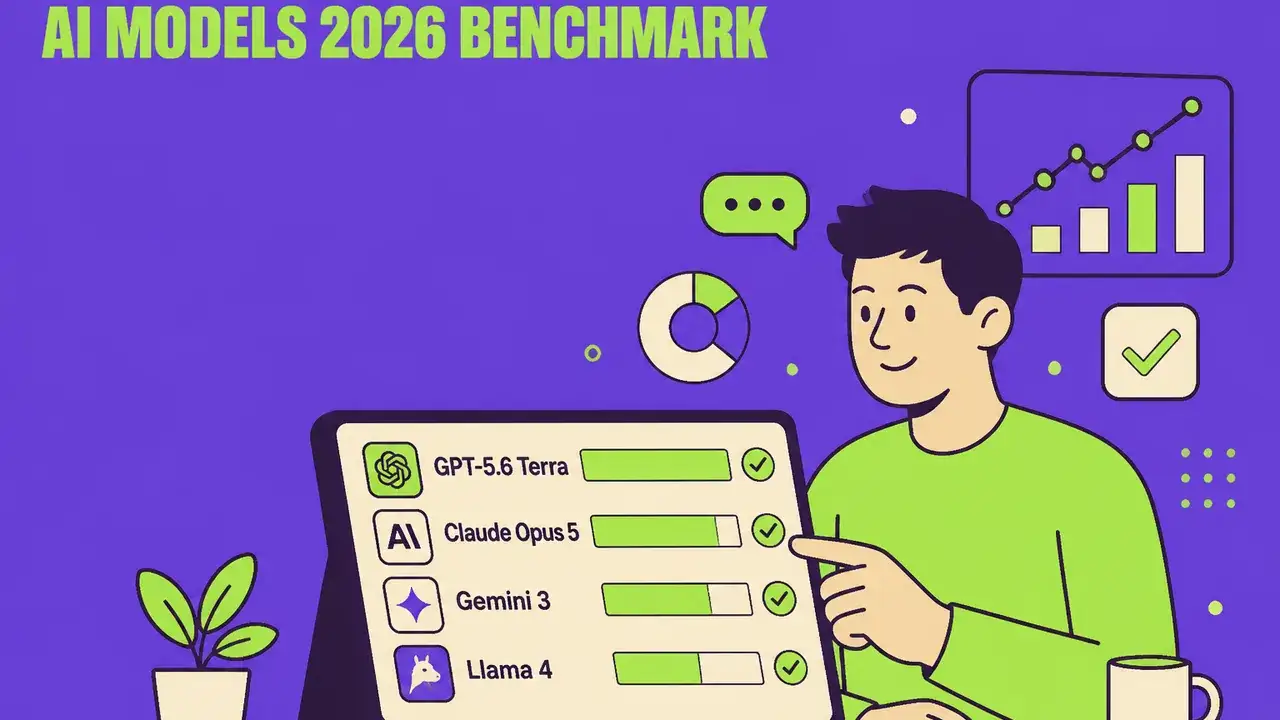
Table of Contents
The AI Landscape 2026: A New Chapter
At the start of 2026, we face perhaps the most exciting generation of AI models since the original GPT-4 moment in late 2023. With GPT-5.6 Terra, Claude Opus 5, Gemini 3.1 Pro, and emerging alternatives such as DeepSeek V4-Pro, the playing field has fundamentally changed.
This article provides the most comprehensive benchmark comparison of current flagship models – with concrete numbers where verified, marketing-relevant tests, and clear recommendations for which model is ideal for which use case.
The Flagship Models at a Glance
GPT-5.6 Terra (OpenAI)
OpenAI's balanced GPT-5.6 model combines strong reasoning performance with a lower price point than the flagship Sol:
- Context Window: 1.05M tokens
- Maximum Output: 128K tokens
- Reasoning: New max and ultra reasoning modes are available; their additional cost and latency are not documented
- Benchmark: 84.3% on Terminal-Bench 2.1
- Price Tier: $2.50 / $15.00 per 1M input/output tokens, with cached input at $0.25
Claude Opus 5 (Anthropic)
Anthropic's everyday flagship combines broad capability with a price point close to Fable 5 at half the cost:
- Context Window: 1M tokens
- Maximum Output: 128K tokens
- Adaptive Thinking: Thinking is enabled by default rather than using a classic Extended Thinking flag
- Frontier Performance: State of the art on Frontier-Bench and GDPval-AA
- Price Tier: $5.00 / $25.00 per 1M input/output tokens
Gemini 3.1 Pro (Google)
Google's preview model combines a large context window with multimodal capabilities and Search grounding:
- Context Window: 1M tokens
- Google Ecosystem: Strong Search-grounding capabilities
- Benchmark: 77.1% on ARC-AGI-2 and 70.7% on Terminal-Bench 2.1
- Price Tier: $2.00 / $12.00 per 1M input/output tokens for prompts up to 200K tokens; $4.00 / $18.00 above that threshold
DeepSeek V4-Pro
DeepSeek V4-Pro is a highly cost-efficient alternative and an important price anchor in the current market:
- Price Tier: $0.435 / $0.87 per 1M input/output tokens
- Positioning: Cost-focused option for high-volume workloads
- Benchmark Performance: Performance details should be assessed according to the specific use case
- Context Window: Available specifications should be checked in the respective deployment environment
- Costs: One of the lowest documented price points among current frontier-oriented models
The Grand Benchmark Comparison
Reasoning & Logic
| Benchmark | GPT-5.6 Terra | Opus 5 | Gemini 3.1 Pro | DeepSeek V4-Pro |
|---|---|---|---|---|
| Terminal-Bench 2.1 | 84.3% | Qualitatively strong | 70.7% | Not specified |
| ARC-AGI-2 | Not specified | Not specified | 77.1% | Not specified |
| Frontier-Bench | Not specified | SOTA | Not specified | Not specified |
| GDPval-AA | Not specified | SOTA | Not specified | Not specified |
| Cybersecurity | Not specified | Behind Mythos 5 | Not specified | Not specified |
Result: Claude Opus 5 leads on Frontier-Bench and GDPval-AA, while GPT-5.6 Terra delivers strong Terminal-Bench performance at a balanced price point. Gemini 3.1 Pro remains a capable option for long-context and grounded workflows.
Content Quality & Creativity
| Criterion | GPT-5.6 Terra | Opus 5 | Gemini 3.1 Pro | DeepSeek V4-Pro |
|---|---|---|---|---|
| Text Coherence | Strong | Strong | Strong | Use-case dependent |
| Creative Diversity | Strong | Strong | Strong | Use-case dependent |
| Brand Tonality | Strong | Strong | Strong | Use-case dependent |
| Factual Accuracy | Strong | Strong | Search-grounded workflows | Use-case dependent |
| Multilingual | Strong | Strong | Strong | Use-case dependent |
Result: Opus 5 is positioned as Anthropic's everyday flagship for broad high-quality work. Gemini 3.1 Pro is particularly relevant when Google Search grounding and long-context workflows matter.
Marketing Practice Test
We tested all models with identical marketing tasks:
| Task | GPT-5.6 Terra | Opus 5 | Gemini 3.1 Pro | DeepSeek V4-Pro |
|---|---|---|---|---|
| Blog Article (2,000 words) | Strong | Strong | Strong | Use-case dependent |
| Social Media (10 posts) | Strong | Strong | Strong | Cost-efficient option |
| Email Campaign (5 variants) | Strong | Strong | Strong | Cost-efficient option |
| Data Analysis (Dashboard) | Strong | Strong | Strong | Use-case dependent |
| SEO Strategy (Keyword Plan) | Strong | Strong | Search-grounded workflows | Use-case dependent |
| Competitive Analysis | Strong | Strong | Strong | Use-case dependent |
Result: No single model dominates all categories. The right choice depends on the primary use case, required context length, workflow integration, latency requirements, and budget.
Speed & Latency
| Metric | GPT-5.6 Terra | Opus 5 | Gemini 3.1 Pro | DeepSeek V4-Pro |
|---|---|---|---|---|
| Time-to-First-Token | Not specified | Not specified | Not specified | Not specified |
| Tokens/Second | Not specified | Not specified | Not specified | Not specified |
| Long-Response Latency | Not specified | Not specified | Not specified | Not specified |
Result: Verified cross-model latency figures are not available. Gemini 3.6 Flash is positioned for frontier-near intelligence at Flash latency and offers higher token efficiency than Gemini 3.5 Flash.
Cost Comparison
Prices per 1 Million Tokens (as of July 2026)
| Model | Input | Output | Cached Input |
|---|---|---|---|
| GPT-5.6 Sol | $5.00 | $30.00 | $0.50 |
| GPT-5.6 Terra | $2.50 | $15.00 | $0.25 |
| GPT-5.6 Luna | $1.00 | $6.00 | $0.10 |
| Claude Fable 5 | $10.00 | $50.00 | Not specified |
| Claude Opus 5 | $5.00 | $25.00 | Not specified |
| Claude Sonnet 5 | $3.00 | $15.00 | Not specified |
| Gemini 3.1 Pro | $2.00 | $12.00 | Not specified |
| Gemini 3.6 Flash | $1.50 | $7.50 | Not specified |
| DeepSeek V4-Pro | $0.435 | $0.87 | Not specified |
Claude Sonnet 5 is available at an introductory price of $2.00 / $10.00 per 1M input/output tokens until 31 August 2026. Gemini 3.1 Pro costs $4.00 / $18.00 for prompts exceeding 200K tokens.
Price-Performance Winner: DeepSeek V4-Pro is the documented price anchor for high-volume workloads. GPT-5.6 Luna and Gemini 3.6 Flash are strong options when cost efficiency and speed are key priorities.
Strengths and Weaknesses in Detail
GPT-5.6 Terra: The All-Rounder
Strengths:
- Strong Terminal-Bench 2.1 result of 84.3%
- 1.05M-token context window
- 128K maximum output
- Balanced price point within the GPT-5.6 family
Weaknesses:
- Not the highest-performing GPT-5.6 tier on Terminal-Bench 2.1
- Additional cost and latency for max and ultra reasoning modes are not documented
- Sol may be more appropriate for the most demanding agentic workflows
Claude Opus 5: The Analyst
Strengths:
- State-of-the-art performance on Frontier-Bench and GDPval-AA
- 1M-token context window
- 128K maximum output
- Thinking enabled by default
- Near Fable 5 performance at half the price
Weaknesses:
- Behind Claude Mythos 5 in cybersecurity
- Not Anthropic's dedicated long-horizon agent model
- No classic Extended Thinking flag
Gemini 3.1 Pro: The Data Expert
Strengths:
- 1M-token context window
- 77.1% on ARC-AGI-2
- Strong Google Search-grounding capabilities
- Competitive pricing for prompts up to 200K tokens
Weaknesses:
- Still in preview
- 70.7% on Terminal-Bench 2.1 trails GPT-5.6 Terra
- Higher pricing applies above 200K input tokens
DeepSeek V4-Pro: The Disruptor
Strengths:
- Extremely low documented token pricing
- Strong choice for cost-sensitive, high-volume workloads
- Important market price anchor
Weaknesses:
- Verified benchmark figures are not specified here
- Context window specifications are not specified here
- Model selection should be validated against concrete quality and integration requirements
Which Model for Which Marketing Use Case?
Content Creation at Scale
Recommendation: GPT-5.6 Luna, Gemini 3.6 Flash, or DeepSeek V4-Pro
For volume content like product descriptions, social media posts, or newsletter variants, cost-efficient models offer the best price-performance ratio. DeepSeek V4-Pro is especially relevant when token cost is the decisive factor.
Strategic Analysis & Reporting
Recommendation: Claude Opus 5
When it comes to in-depth market analysis, competitive comparisons, or strategic recommendations, Opus 5 is a strong choice due to its state-of-the-art results on Frontier-Bench and GDPval-AA.
Performance Marketing & Data Analysis
Recommendation: Gemini 3.1 Pro
Google Search grounding makes Gemini a relevant partner for research-intensive campaign optimization, SEO analysis, and data-driven marketing workflows.
Brand Content & Thought Leadership
Recommendation: Claude Opus 5 or GPT-5.6 Terra
For premium content that needs to closely match brand voice, Opus 5 and GPT-5.6 Terra offer strong capabilities. The final choice should depend on workflow design, context requirements, and budget.
Multi-Agent Workflows
Recommendation: Model Mix (Orchestration)
The best strategy is an intelligent mix: affordable models for routing and preprocessing, premium models for final quality assurance. Our GPT Orchestration Engine makes exactly that possible.
The Trend: Model Orchestration Instead of Single-Model Strategy
The most important takeaway from our benchmarks: No single model is superior in all categories. The future lies in intelligent orchestration of multiple models.
The Orchestration Principle
- Classification: A fast, affordable model such as Gemini 3.6 Flash analyzes the incoming request
- Routing: Based on complexity and requirements, the optimal model is selected
- Processing: The chosen flagship model processes the task
- Quality Assurance: A second model reviews the result
Result: Cost savings and quality gains depend on workflow design, model selection, and evaluation criteria.
Outlook: What Comes Next?
Q2-Q3 2026: The Current Wave
- GPT-5.6 Family: GPT-5.6 Sol, Terra, and Luna reached general availability on 9 July 2026
- Claude Opus 5: Anthropic released its everyday flagship on 24 July 2026
- Gemini 3.6 Flash: Google released its latest Flash model on 21 July 2026
- Video Generation: Veo 3.1 and Kling 3.0 are the dominant video-model options in 2026
The Convergence of Capabilities
Interestingly, the quality differences between top models are shrinking. Competition is increasingly shifting to:
- Speed and latency
- Price-performance ratio
- Ecosystem and integration
- Industry use-case specialization
Conclusion: The Right Strategy for 2026
The AI model landscape in 2026 offers more choice and higher quality than ever before. But this very diversity makes the strategic decision more complex.
Our Top 3 Recommendations:
-
Invest in model orchestration, not a single model. Combining different models delivers better results at lower costs.
-
Invest in prompt engineering and workflows, not just model upgrades. A well-structured prompt on GPT-5.6 Luna can outperform a poorly formulated prompt on GPT-5.6 Terra.
-
Stay flexible. The model landscape is evolving rapidly. Avoid lock-in effects and invest in modular architectures.
Your next step: Use our AI Model Explorer to compare models interactively, or contact us for individual model strategy consulting. Also read our detailed Opus 5 vs. GPT-5.6 Terra Comparison for a deeper analysis of the two top models.
Frequently Asked Questions
What is "AI Models 2026 Benchmark Comparison: GPT-5.6 Terra, Claude Opus 5, Gemini 3 & Llama 4" about?
The most comprehensive benchmark comparison of current AI flagships: GPT-5.6 Terra, Claude Opus 5, Gemini 3.1 Pro and Llama 4 Scout – with concrete numbers, costs and marketing practice tests.
The AI Landscape 2026: A New Chapter: what matters?
At the start of 2026, we face perhaps the most exciting generation of AI models since the original GPT-4 moment in late 2023. With GPT-5.6 Terra, Claude Opus 5, Gemini 3.
GPT-5.6 Terra (OpenAI): what matters?
OpenAI's balanced GPT-5.6 model combines strong reasoning performance with a lower price point than the flagship Sol: Context Window: 1.05M tokens Maximum Output: 128K tokens Reasoning: New max and ultra reasoning modes are available; their additional cost and latency are not documented Benchmark: 84.
Claude Opus 5 (Anthropic): what matters?
Anthropic's everyday flagship combines broad capability with a price point close to Fable 5 at half the cost: Context Window: 1M tokens Maximum Output: 128K tokens Adaptive Thinking: Thinking is enabled by default rather than using a classic Extended Thinking flag Frontier Performance: State of the art on Frontier-Bench and GDPval-AA
Related Articles
You might also be interested in these posts
 Tools & Technology
The New Model Generation July 2026: GPT-5.6 Sol vs. Claude Fable 5 & Opus 5 vs. Gemini 3.6 Flash
GPT-5.6 Sol, Terra and Luna, Claude Fable 5 and Opus 5, Gemini 3.6 Flash: pricing, context windows, benchmarks and a workable routing strategy for marketing teams – including migration after the Sora shutdown.
 Tools & Technology
Opus 5 vs. GPT-5.6 Terra & Codex 5.3: The Ultimate AI Model Comparison 2026
Claude Opus 5, GPT-5.6 Terra and Codex 5.3 compared head-to-head: quality, cost, coding and marketing practice. Which AI model fits your team?
 Tools & Technology
GPT-5.6 Sol vs. Claude Opus 5 vs. Gemini 3.1 Pro: Benchmarks & Cost (April 2026 Snapshot)
Three flagship models, three philosophies: Benchmarks, costs, context windows, and marketing use cases in direct comparison – with hybrid strategy and decision matrix.