RAG for Marketing: How Retrieval Augmented Generation Revolutionizes Your Content Strategy
In short
RAG eliminates AI hallucinations and generic outputs. Learn how to create brand-specific, fact-based content with Retrieval Augmented Generation.
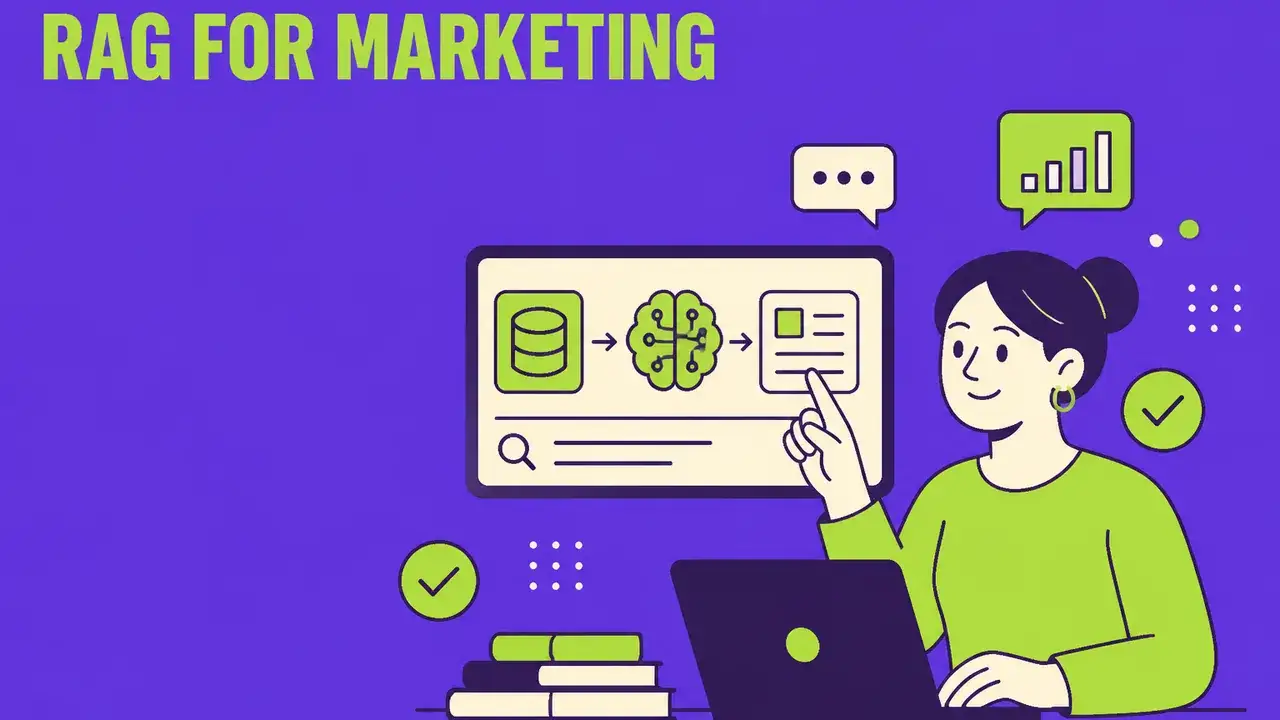
Table of Contents
RAG for Marketing: How Retrieval Augmented Generation Revolutionizes Your Content Strategy
Published February 6, 2026 | 14 min read
The Big Weakness of ChatGPT & Co.
You've probably experienced it yourself: You ask ChatGPT to write a blog article about your product, and you get text that:
- Invents facts about your company
- States wrong prices
- Describes features that don't exist
- Sounds generic and ignores your brand voice
This isn't a bug – it's a fundamental design problem. Large Language Models (LLMs) were trained on general internet data and know nothing about:
- Your current product specifications
- Your brand guidelines and tonality
- Your customer reviews and FAQs
- Your latest campaigns and offers
The solution: RAG – Retrieval Augmented Generation.
What is RAG?
RAG (Retrieval Augmented Generation) is an architecture that connects LLMs with an external knowledge database. Instead of only relying on training knowledge, the model retrieves relevant information from your own data source with every request.
The RAG Workflow in 4 Steps
| Step | What Happens | Example |
|---|---|---|
| 1. Query | User asks a question | "Write an email about our new premium membership" |
| 2. Retrieval | System searches knowledge base | Finds: Pricing document, feature list, previous email templates |
| 3. Augmentation | Relevant documents added to prompt | LLM receives context with real facts |
| 4. Generation | LLM generates based on real data | Email with correct prices and features |
Technical Components of a RAG System
1. Knowledge Base
- Product documentation
- Brand guidelines
- FAQ databases
- CRM data
- Previous campaigns
2. Embedding Model
- Converts text into vectors
- Enables semantic search
- Example: OpenAI text-embedding-3-large
3. Vector Database
- Stores embeddings
- Enables fast similarity search
- Examples: Pinecone, Weaviate, Chroma
4. LLM (Large Language Model)
Why RAG is Becoming Essential for Marketing
1. Elimination of Hallucinations
Without RAG, an LLM invents facts when it doesn't know them. With RAG, it responds based on real documents – or admits when no information is available.
2. Consistent Brand Voice
RAG can use your style guides, tone-of-voice documents, and previous content as context.
3. Content Freshness
LLMs have a knowledge cutoff date. RAG enables access to real-time data.
4. Compliance and Legal Safety
Marketing claims must be factually correct. RAG enables verified product statements and audit trails.
Marketing Use Cases for RAG
Use Case 1: Real-Time Product Descriptions
Problem: E-commerce with 10,000+ products needs unique, SEO-optimized descriptions.
RAG Solution:
- Knowledge base: Product database, supplier specs, customer reviews
- Output: Unique descriptions based on real features
Use Case 2: Personalized Email Campaigns
RAG Solution:
- Knowledge base: CRM data, purchase history, interaction data
- Output: Hyper-personalized emails with real purchase suggestions
Use Case 3: Knowledge-Based Chatbots
RAG Solution:
- Knowledge base: Support tickets, product docs, return policies
- Output: Precise answers to any question
Use Case 4: Localized Content Creation
RAG Solution:
- Knowledge base: Local style guides, market-specific campaigns, regional specifics
- Output: Culturally adapted content
Use Case 5: Competitive Intelligence Content
RAG Solution:
- Knowledge base: Competitor monitoring, own strengths documents, win/loss analyses
- Output: Up-to-date comparison content
Technical Implementation: How to Get Started
Phase 1: Build Knowledge Base (Week 1-2)
- Export product database
- Collect brand guidelines
- Compile FAQ documents
- Split documents into chunks (500-1000 tokens)
Phase 2: Build RAG Pipeline (Week 2-3)
Best Practices:
- Hybrid Search: Combination of keyword + semantic
- Chunk Overlap: 10-20% overlap for context preservation
- Metadata Filtering: Filter by recency, category
Phase 3: Integration and Testing (Week 3-4)
Metrics:
| Metric | Target |
|---|---|
| Response accuracy | >95% |
| Source citation | 100% |
| Average latency | <2s |
| User satisfaction | >4.5/5 |
Common Mistakes and How to Avoid Them
- Chunks Too Large → 500-1000 tokens per chunk
- Outdated Knowledge Base → Automated sync pipelines
- Missing Metadata → Rich metadata when indexing
- Blind Trust in Retrieval → Reranking models, thresholds
- No Source Citations → Citations in output
Tools and Platforms for Marketing RAG
| Tool | Type | Strength | Best For |
|---|---|---|---|
| LangChain | Framework | Flexibility, Open Source | Developer Teams |
| LlamaIndex | Framework | Document-focused | Data Teams |
| Pinecone | Vector Database | Scalability, managed | Enterprise |
| Weaviate | Vector Database | Open Source, Hybrid Search | Startups |
| CustomGPT | No-Code | Simplicity | Marketing Teams |
| Vectara | RAG-as-a-Service | All-in-one | Quick Implementation |
ROI Calculation for Marketing RAG
Annual ROI: ($8,440 × 12 - $26,400) / $26,400 = 284%
The Future: Agentic RAG
In 2026, RAG is evolving into Agentic RAG – systems that don't just retrieve information but actively take action.
Your Action Plan
This Week
- Create inventory: What documents belong in your knowledge base?
- Evaluate tools: Test CustomGPT for quick start
- Prioritize use case: Product descriptions, FAQs, or emails?
This Month
- Start pilot project: One use case with 100 documents
- Define metrics: Accuracy, time savings, user satisfaction
- Train team: RAG basics for marketing
This Quarter
- Go live: Scale first use case
- Iterate: Collect feedback, expand knowledge base
- Document ROI: Business case for additional use cases
RAG is no longer future technology – it's the present of professional AI use in marketing. Those who start today have a structural advantage over competitors still working with hallucinating LLMs.
The first step: Export three documents today (product info, FAQ, style guide) and test a RAG service like CustomGPT. You'll see the difference within an hour. Also discover how Context Engineering embeds RAG as one of five context layers into a holistic AI architecture.
Frequently Asked Questions
What is "RAG for Marketing: How Retrieval Augmented Generation Revolutionizes Your Content Strategy" about?
RAG eliminates AI hallucinations and generic outputs. Learn how to create brand-specific, fact-based content with Retrieval Augmented Generation.
The Big Weakness of ChatGPT & Co.: what matters?
You've probably experienced it yourself: You ask ChatGPT to write a blog article about your product, and you get text that: Invents facts about your company States wrong prices Describes features that don't exist Sounds generic and ignores your brand voice This isn't a bug – it's a fundamental design problem.
What is RAG?
RAG (Retrieval Augmented Generation) is an architecture that connects LLMs with an external knowledge database. Instead of only relying on training knowledge, the model retrieves relevant information from your own data source with every request.
Technical Components of a RAG System: what matters?
1. Knowledge Base Product documentation Brand guidelines FAQ databases CRM data Previous campaigns 2. Embedding Model Converts text into vectors Enables semantic search Example: OpenAI text-embedding-3-large 3.
Related Articles
You might also be interested in these posts
 Strategy
Cutting LLM Inference Cost: The Math Behind Tokens, Latency and Budget
Caching, model routing, context discipline: the full calculation marketing teams use to cut inference cost by 40 to 70 percent without losing quality.
 Strategy
Full Autonomy Instead of Autocomplete: The Shift to Agentic Engineering
From code suggestions to parallel sub-agents: what changed technically, why "more agents" solves nothing and how teams rebuild workflows for delegation — including permissions, acceptance and cost caps.
 Strategy
Vibe Coding vs. Software Architecture: Why Governance and Taste Matter More
Unreviewed vibe coding damages mature systems: duplicated logic, broken layers, tests without evidentiary value. Which guardrails actually hold in AI-assisted development — and where the style fits.